

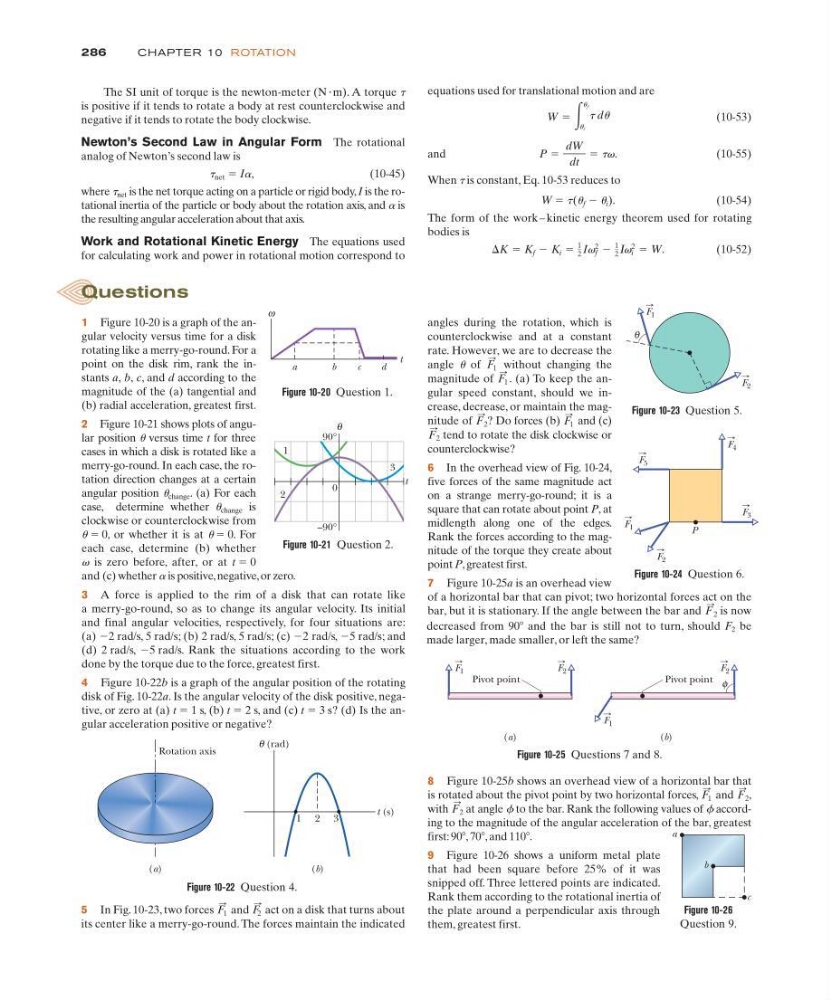
8 Figure 10-25b shows an overhead view of a horizontal bar that
is rotated about the pivot point by two horizontal forces,
and ,
with
at angle f to the bar. Rank the following values of f according to the magnitude of the angular acceleration of the bar, greatest
first: 90Њ, 70Њ, and 110Њ.
9 Figure 10-26 shows a uniform metal plate
that had been square before 25% of it was
snipped off. Three lettered points are indicated.
Rank them according to the rotational inertia of
the plate around a perpendicular axis through
them, greatest first.
F
:
2
F
:
2
F
:
1
286
CHAPTE R 10 ROTATION
angles during the rotation, which is
counterclockwise and at a constant
rate. However, we are to decrease the
angle u of
without changing the
magnitude of . (a) To keep the angular speed constant, should we increase, decrease, or maintain the magnitude of ? Do forces (b)
and (c)
tend to rotate the disk clockwise or
counterclockwise?
6 In the overhead view of Fig. 10-24,
five forces of the same magnitude act
on a strange merry-go-round; it is a
square that can rotate about point P, at
midlength along one of the edges.
Rank the forces according to the magnitude of the torque they create about
point P, greatest first.
7 Figure 10-25a is an overhead view
of a horizontal bar that can pivot; two horizontal forces act on the
bar, but it is stationary. If the angle between the bar and
is now
F
:
2
F
:
2
F
:
1
F
:
2
F
:
1
F
:
1
1 Figure 10-20 is a graph of the angular velocity versus time for a disk
rotating like a merry-go-round. For a
point on the disk rim, rank the instants a, b, c, and d according to the
magnitude of the (a) tangential and
(b) radial acceleration, greatest first.
2 Figure 10-21 shows plots of angular position u versus time t for three
cases in which a disk is rotated like a
merry-go-round. In each case, the rotation direction changes at a certain
angular position u change . (a) For each
case, determine whether u change is
clockwise or counterclockwise from
u ϭ 0, or whether it is at u ϭ 0. For
each case, determine (b) whether
v is zero before, after, or at t ϭ 0
and (c) whether a is positive, negative, or zero.
3 A force is applied to the rim of a disk that can rotate like
a merry-go-round, so as to change its angular velocity. Its initial
and final angular velocities, respectively, for four situations are:
(a) Ϫ2 rad/s, 5 rad/s; (b) 2 rad/s, 5 rad/s; (c) Ϫ2 rad/s, Ϫ5 rad/s; and
(d) 2 rad/s, Ϫ5 rad/s. Rank the situations according to the work
done by the torque due to the force, greatest first.
4 Figure 10-22b is a graph of the angular position of the rotating
disk of Fig. 10-22a. Is the angular velocity of the disk positive, negative, or zero at (a) t ϭ 1 s, (b) t ϭ 2 s, and (c) t ϭ 3 s? (d) Is the angular acceleration positive or negative?
Questions
ω
t
a
b
c
d
Figure 10-20 Question 1.
1
2
3
0
–90°
90°
θ
t
Figure 10-21 Question 2.
Rotation axis
t (s)
(rad)
θ
1 2 3
(a)
(b)
Figure 10-22 Question 4.
F 1
θ
F 2
Figure 10-23 Question 5.
Figure 10-24 Question 6.
F 5
F 4
F 3
F 2
F 1
P
Pivot point
F 1
F 2
Pivot point
(a)
( b)
φ
F 1
F 2
a
b
c
Figure 10-26
Question 9.
Figure 10-25 Questions 7 and 8.
The SI unit of torque is the newton-meter (N иm). A torque t
is positive if it tends to rotate a body at rest counterclockwise and
negative if it tends to rotate the body clockwise.
Newton’s Second Law in Angular Form The rotational
analog of Newton’s second law is
t net ϭ Ia,
( 1 0 - 4 5 )
where t net is the net torque acting on a particle or rigid body, I is the rotational inertia of the particle or body about the rotation axis, and a is
the resulting angular acceleration about that axis.
Work and Rotational Kinetic Energy The equations used
for calculating work and power in rotational motion correspond to
equations used for translational motion and are
(10-53)
and
(10-55)
When t is constant, Eq. 10-53 reduces to
W ϭ t(u f Ϫ u i ).
(10-54)
The form of the work – kinetic energy theorem used for rotating
bodies is
(10-52)
⌬K ϭ K f Ϫ K i ϭ
1
2 Iv f
2 Ϫ
1
2 ⌱v i
2 ϭ W.
P ϭ
dW
dt
ϭ tv.
W ϭ ͵
u f
u i
t du
5 In Fig. 10-23, two forces
and act on a disk that turns about
its center like a merry-go-round. The forces maintain the indicated
F
:
2
F
:
1
decreased from 90Њ and the bar is still not to turn, should F 2 be
made larger, made smaller, or left the same?
is rotated about the pivot point by two horizontal forces,
and ,
with
at angle f to the bar. Rank the following values of f according to the magnitude of the angular acceleration of the bar, greatest
first: 90Њ, 70Њ, and 110Њ.
9 Figure 10-26 shows a uniform metal plate
that had been square before 25% of it was
snipped off. Three lettered points are indicated.
Rank them according to the rotational inertia of
the plate around a perpendicular axis through
them, greatest first.
F
:
2
F
:
2
F
:
1
286
CHAPTE R 10 ROTATION
angles during the rotation, which is
counterclockwise and at a constant
rate. However, we are to decrease the
angle u of
without changing the
magnitude of . (a) To keep the angular speed constant, should we increase, decrease, or maintain the magnitude of ? Do forces (b)
and (c)
tend to rotate the disk clockwise or
counterclockwise?
6 In the overhead view of Fig. 10-24,
five forces of the same magnitude act
on a strange merry-go-round; it is a
square that can rotate about point P, at
midlength along one of the edges.
Rank the forces according to the magnitude of the torque they create about
point P, greatest first.
7 Figure 10-25a is an overhead view
of a horizontal bar that can pivot; two horizontal forces act on the
bar, but it is stationary. If the angle between the bar and
is now
F
:
2
F
:
2
F
:
1
F
:
2
F
:
1
F
:
1
1 Figure 10-20 is a graph of the angular velocity versus time for a disk
rotating like a merry-go-round. For a
point on the disk rim, rank the instants a, b, c, and d according to the
magnitude of the (a) tangential and
(b) radial acceleration, greatest first.
2 Figure 10-21 shows plots of angular position u versus time t for three
cases in which a disk is rotated like a
merry-go-round. In each case, the rotation direction changes at a certain
angular position u change . (a) For each
case, determine whether u change is
clockwise or counterclockwise from
u ϭ 0, or whether it is at u ϭ 0. For
each case, determine (b) whether
v is zero before, after, or at t ϭ 0
and (c) whether a is positive, negative, or zero.
3 A force is applied to the rim of a disk that can rotate like
a merry-go-round, so as to change its angular velocity. Its initial
and final angular velocities, respectively, for four situations are:
(a) Ϫ2 rad/s, 5 rad/s; (b) 2 rad/s, 5 rad/s; (c) Ϫ2 rad/s, Ϫ5 rad/s; and
(d) 2 rad/s, Ϫ5 rad/s. Rank the situations according to the work
done by the torque due to the force, greatest first.
4 Figure 10-22b is a graph of the angular position of the rotating
disk of Fig. 10-22a. Is the angular velocity of the disk positive, negative, or zero at (a) t ϭ 1 s, (b) t ϭ 2 s, and (c) t ϭ 3 s? (d) Is the angular acceleration positive or negative?
Questions
ω
t
a
b
c
d
Figure 10-20 Question 1.
1
2
3
0
–90°
90°
θ
t
Figure 10-21 Question 2.
Rotation axis
t (s)
(rad)
θ
1 2 3
(a)
(b)
Figure 10-22 Question 4.
F 1
θ
F 2
Figure 10-23 Question 5.
Figure 10-24 Question 6.
F 5
F 4
F 3
F 2
F 1
P
Pivot point
F 1
F 2
Pivot point
(a)
( b)
φ
F 1
F 2
a
b
c
Figure 10-26
Question 9.
Figure 10-25 Questions 7 and 8.
The SI unit of torque is the newton-meter (N иm). A torque t
is positive if it tends to rotate a body at rest counterclockwise and
negative if it tends to rotate the body clockwise.
Newton’s Second Law in Angular Form The rotational
analog of Newton’s second law is
t net ϭ Ia,
( 1 0 - 4 5 )
where t net is the net torque acting on a particle or rigid body, I is the rotational inertia of the particle or body about the rotation axis, and a is
the resulting angular acceleration about that axis.
Work and Rotational Kinetic Energy The equations used
for calculating work and power in rotational motion correspond to
equations used for translational motion and are
(10-53)
and
(10-55)
When t is constant, Eq. 10-53 reduces to
W ϭ t(u f Ϫ u i ).
(10-54)
The form of the work – kinetic energy theorem used for rotating
bodies is
(10-52)
⌬K ϭ K f Ϫ K i ϭ
1
2 Iv f
2 Ϫ
1
2 ⌱v i
2 ϭ W.
P ϭ
dW
dt
ϭ tv.
W ϭ ͵
u f
u i
t du
5 In Fig. 10-23, two forces
and act on a disk that turns about
its center like a merry-go-round. The forces maintain the indicated
F
:
2
F
:
1
decreased from 90Њ and the bar is still not to turn, should F 2 be
made larger, made smaller, or left the same?