

245
QU ESTIONS
Questions
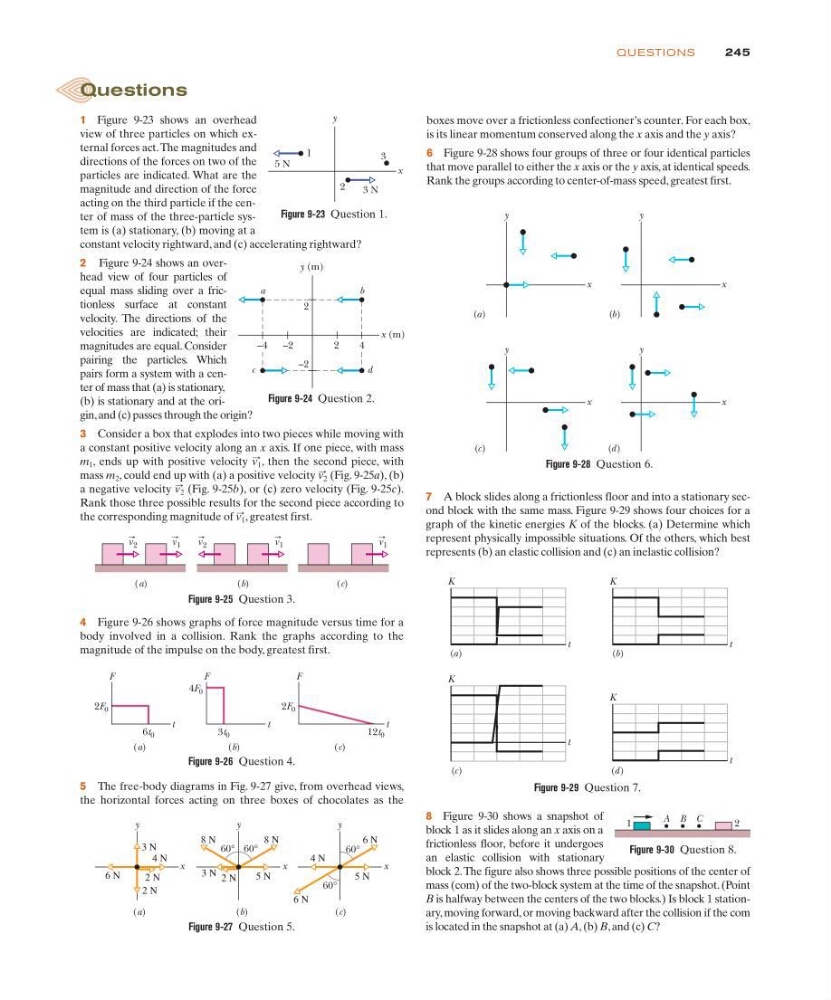
1 Figure 9-23 shows an overhead
view of three particles on which external forces act.The magnitudes and
directions of the forces on two of the
particles are indicated. What are the
magnitude and direction of the force
acting on the third particle if the center of mass of the three-particle system is (a) stationary, (b) moving at a
constant velocity rightward, and (c) accelerating rightward?
2 Figure 9-24 shows an overhead view of four particles of
equal mass sliding over a frictionless surface at constant
velocity. The directions of the
velocities are indicated; their
magnitudes are equal. Consider
pairing the particles. Which
pairs form a system with a center of mass that (a) is stationary,
(b) is stationary and at the origin, and (c) passes through the origin?
3 Consider a box that explodes into two pieces while moving with
a constant positive velocity along an x axis. If one piece, with mass
m 1 , ends up with positive velocity , then the second piece, with
mass m 2 , could end up with (a) a positive velocity (Fig. 9-25a), (b)
a negative velocity (Fig. 9-25b), or (c) zero velocity (Fig. 9-25c).
Rank those three possible results for the second piece according to
the corresponding magnitude of , greatest first.
v 1
:
v 2
:
v 2
:
v 1
:
boxes move over a frictionless confectioner’s counter. For each box,
is its linear momentum conserved along the x axis and the y axis?
6 Figure 9-28 shows four groups of three or four identical particles
that move parallel to either the x axis or the y axis, at identical speeds.
Rank the groups according to center-of-mass speed, greatest first.
y
1
5 N
3 N
2
3
x
Figure 9-23 Question 1.
c
d
a
y (m)
2
–2
2
4
–4
–2
x (m)
b
Figure 9-24 Question 2.
v 2
v 2
v 1
v 1
(b)
(c)
(a)
v 1
Figure 9-25 Question 3.
2F 0
4F 0
6t 0
t
F
F
t
t
F
(a)
(b)
(c)
3t 0
12t 0
2F 0
Figure 9-26 Question 4.
x
x
x
y
y
y
60°
60°
60°
60°
8 Ν
6 Ν
5 Ν
4 Ν
6 Ν
8 Ν
3 Ν
4 Ν
2 Ν
2 Ν
6 Ν
5 Ν
2 Ν
3 Ν
(a)
(b)
(c)
Figure 9-27 Question 5.
4 Figure 9-26 shows graphs of force magnitude versus time for a
body involved in a collision. Rank the graphs according to the
magnitude of the impulse on the body, greatest first.
5 The free-body diagrams in Fig. 9-27 give, from overhead views,
the horizontal forces acting on three boxes of chocolates as the
y
x
(a)
y
x
(c)
y
x
(b)
y
x
(d)
Figure 9-28 Question 6.
7 A block slides along a frictionless floor and into a stationary second block with the same mass. Figure 9-29 shows four choices for a
graph of the kinetic energies K of the blocks. (a) Determine which
represent physically impossible situations. Of the others, which best
represents (b) an elastic collision and (c) an inelastic collision?
K
t
(a)
K
t
(b)
K
t
(c)
K
t
(d)
Figure 9-29 Question 7.
8 Figure 9-30 shows a snapshot of
block 1 as it slides along an x axis on a
frictionless floor, before it undergoes
an elastic collision with stationary
block 2. The figure also shows three possible positions of the center of
mass (com) of the two-block system at the time of the snapshot. (Point
B is halfway between the centers of the two blocks.) Is block 1 stationary, moving forward, or moving backward after the collision if the com
is located in the snapshot at (a) A, (b) B, and (c) C?
1
2
A B C
Figure 9-30 Question 8.
QU ESTIONS
Questions
1 Figure 9-23 shows an overhead
view of three particles on which external forces act.The magnitudes and
directions of the forces on two of the
particles are indicated. What are the
magnitude and direction of the force
acting on the third particle if the center of mass of the three-particle system is (a) stationary, (b) moving at a
constant velocity rightward, and (c) accelerating rightward?
2 Figure 9-24 shows an overhead view of four particles of
equal mass sliding over a frictionless surface at constant
velocity. The directions of the
velocities are indicated; their
magnitudes are equal. Consider
pairing the particles. Which
pairs form a system with a center of mass that (a) is stationary,
(b) is stationary and at the origin, and (c) passes through the origin?
3 Consider a box that explodes into two pieces while moving with
a constant positive velocity along an x axis. If one piece, with mass
m 1 , ends up with positive velocity , then the second piece, with
mass m 2 , could end up with (a) a positive velocity (Fig. 9-25a), (b)
a negative velocity (Fig. 9-25b), or (c) zero velocity (Fig. 9-25c).
Rank those three possible results for the second piece according to
the corresponding magnitude of , greatest first.
v 1
:
v 2
:
v 2
:
v 1
:
boxes move over a frictionless confectioner’s counter. For each box,
is its linear momentum conserved along the x axis and the y axis?
6 Figure 9-28 shows four groups of three or four identical particles
that move parallel to either the x axis or the y axis, at identical speeds.
Rank the groups according to center-of-mass speed, greatest first.
y
1
5 N
3 N
2
3
x
Figure 9-23 Question 1.
c
d
a
y (m)
2
–2
2
4
–4
–2
x (m)
b
Figure 9-24 Question 2.
v 2
v 2
v 1
v 1
(b)
(c)
(a)
v 1
Figure 9-25 Question 3.
2F 0
4F 0
6t 0
t
F
F
t
t
F
(a)
(b)
(c)
3t 0
12t 0
2F 0
Figure 9-26 Question 4.
x
x
x
y
y
y
60°
60°
60°
60°
8 Ν
6 Ν
5 Ν
4 Ν
6 Ν
8 Ν
3 Ν
4 Ν
2 Ν
2 Ν
6 Ν
5 Ν
2 Ν
3 Ν
(a)
(b)
(c)
Figure 9-27 Question 5.
4 Figure 9-26 shows graphs of force magnitude versus time for a
body involved in a collision. Rank the graphs according to the
magnitude of the impulse on the body, greatest first.
5 The free-body diagrams in Fig. 9-27 give, from overhead views,
the horizontal forces acting on three boxes of chocolates as the
y
x
(a)
y
x
(c)
y
x
(b)
y
x
(d)
Figure 9-28 Question 6.
7 A block slides along a frictionless floor and into a stationary second block with the same mass. Figure 9-29 shows four choices for a
graph of the kinetic energies K of the blocks. (a) Determine which
represent physically impossible situations. Of the others, which best
represents (b) an elastic collision and (c) an inelastic collision?
K
t
(a)
K
t
(b)
K
t
(c)
K
t
(d)
Figure 9-29 Question 7.
8 Figure 9-30 shows a snapshot of
block 1 as it slides along an x axis on a
frictionless floor, before it undergoes
an elastic collision with stationary
block 2. The figure also shows three possible positions of the center of
mass (com) of the two-block system at the time of the snapshot. (Point
B is halfway between the centers of the two blocks.) Is block 1 stationary, moving forward, or moving backward after the collision if the com
is located in the snapshot at (a) A, (b) B, and (c) C?
1
2
A B C
Figure 9-30 Question 8.