

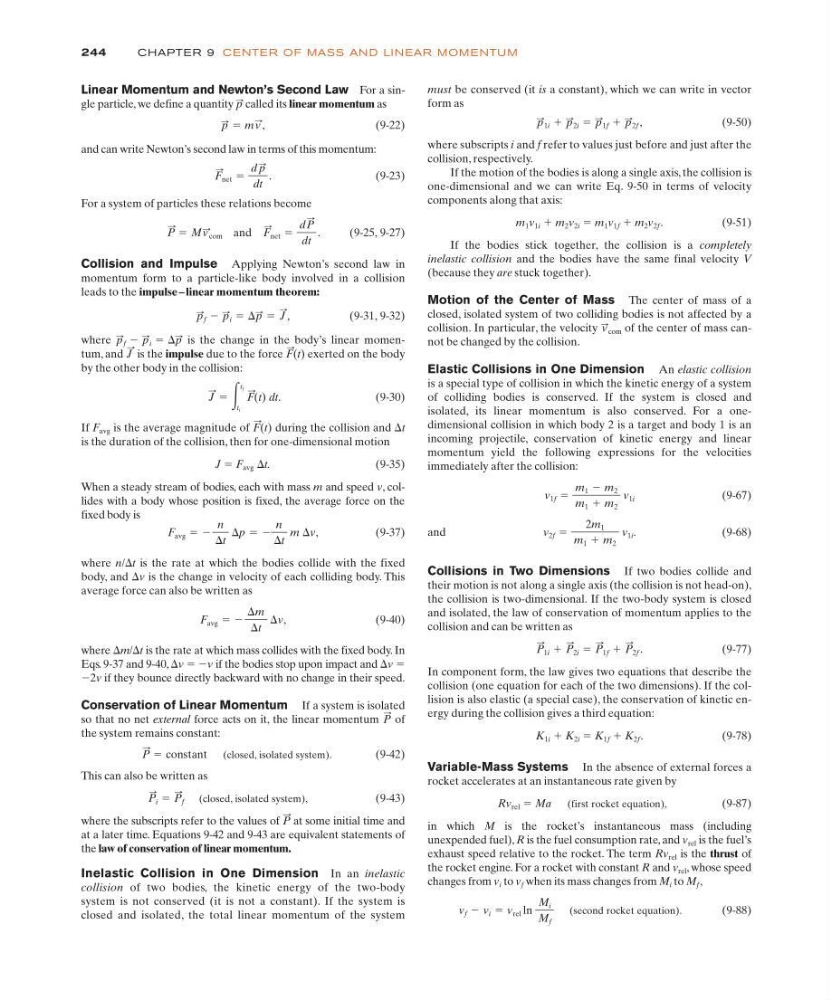
244
CHAPTE R 9 CE NTE R OF MASS AN D LI N EAR M OM E NTU M
must be conserved (it is a constant), which we can write in vector
form as
,
( 9 - 5 0 )
where subscripts i and f refer to values just before and just after the
collision, respectively.
If the motion of the bodies is along a single axis, the collision is
one-dimensional and we can write Eq. 9-50 in terms of velocity
components along that axis:
m 1 v 1i ϩ m 2 v 2i ϭ m 1 v 1f ϩ m 2 v 2f .
( 9 - 5 1 )
If the bodies stick together, the collision is a completely
inelastic collision and the bodies have the same final velocity V
(because they are stuck together).
Motion of the Center of Mass The center of mass of a
closed, isolated system of two colliding bodies is not affected by a
collision. In particular, the velocity
of the center of mass cannot be changed by the collision.
Elastic Collisions in One Dimension An elastic collision
is a special type of collision in which the kinetic energy of a system
of colliding bodies is conserved. If the system is closed and
isolated, its linear momentum is also conserved. For a onedimensional collision in which body 2 is a target and body 1 is an
incoming projectile, conservation of kinetic energy and linear
momentum yield the following expressions for the velocities
immediately after the collision:
(9-67)
and
(9-68)
Collisions in Two Dimensions If two bodies collide and
their motion is not along a single axis (the collision is not head-on),
the collision is two-dimensional. If the two-body system is closed
and isolated, the law of conservation of momentum applies to the
collision and can be written as
.
( 9 - 7 7 )
In component form, the law gives two equations that describe the
collision (one equation for each of the two dimensions). If the collision is also elastic (a special case), the conservation of kinetic energy during the collision gives a third equation:
K 1i ϩ K 2i ϭ K 1f ϩ K 2f .
(9-78)
Variable-Mass Systems In the absence of external forces a
rocket accelerates at an instantaneous rate given by
Rv rel ϭ Ma (first rocket equation),
(9-87)
in which M is the rocket’s instantaneous mass (including
unexpended fuel), R is the fuel consumption rate, and v rel is the fuel’s
exhaust speed relative to the rocket. The term Rv rel is the thrust of
the rocket engine. For a rocket with constant R and v rel , whose speed
changes from v i to v f when its mass changes from M i to M f ,
(second rocket equation).
(9-88)
v f Ϫ v i ϭ v rel ln
M i
M f
P
:
1i ϩ P
:
2i ϭ P
:
1f ϩ P
:
2f
v 2f ϭ
2m 1
m 1 ϩ m 2
v 1i .
v 1f ϭ
m 1 Ϫ m 2
m 1 ϩ m 2
v 1i
v
: com
p
: 1i ϩ p
: 2i ϭ p
: 1f ϩ p
:
2f
tum, and is the impulse due to the force
exerted on the body
by the other body in the collision:
(9-30)
If F avg is the average magnitude of
during the collision and ⌬t
is the duration of the collision, then for one-dimensional motion
J ϭ F avg ⌬t.
(9-35)
When a steady stream of bodies, each with mass m and speed v, collides with a body whose position is fixed, the average force on the
fixed body is
(9-37)
where n/⌬t is the rate at which the bodies collide with the fixed
body, and ⌬v is the change in velocity of each colliding body. This
average force can also be written as
(9-40)
where ⌬m/⌬t is the rate at which mass collides with the fixed body. In
Eqs. 9-37 and 9-40, ⌬v ϭ Ϫv if the bodies stop upon impact and ⌬v ϭ
Ϫ2v if they bounce directly backward with no change in their speed.
Conservation of Linear Momentum If a system is isolated
so that no net external force acts on it, the linear momentum of
the system remains constant:
(closed, isolated system).
(9-42)
This can also be written as
(closed, isolated system),
(9-43)
where the subscripts refer to the values of at some initial time and
at a later time. Equations 9-42 and 9-43 are equivalent statements of
the law of conservation of linear momentum.
Inelastic Collision in One Dimension In an inelastic
collision of two bodies, the kinetic energy of the two-body
system is not conserved (it is not a constant). If the system is
closed and isolated, the total linear momentum of the system
P
:
P
:
i ϭ P
:
f
P
: ϭ constant
P
:
F avg ϭ Ϫ
⌬m
⌬t
⌬v,
F avg ϭ Ϫ
n
⌬t
⌬p ϭ Ϫ
n
⌬t
m ⌬v,
F
:
(t)
J
: ϭ ͵
t f
t i
F
:
(t) dt.
F
:
(t)
J
:
Linear Momentum and Newton’s Second Law For a single particle, we define a quantity called its linear momentum as
,
( 9 - 2 2 )
and can write Newton’s second law in terms of this momentum:
(9-23)
For a system of particles these relations become
and
(9-25, 9-27)
Collision and Impulse Applying Newton’s second law in
momentum form to a particle-like body involved in a collision
leads to the impulse – linear momentum theorem:
,
( 9 - 3 1 , 9 - 3 2 )
where
is the change in the body’s linear momenp
:
f Ϫ p
:
i ϭ ⌬p
:
p
:
f Ϫ p
:
i ϭ ⌬p
: ϭ J
:
F
:
net ϭ
dP
:
dt
.
P
: ϭ Mv
:
com
F
:
net ϭ
d p
:
dt
.
p
: ϭ mv
:
p
:
CHAPTE R 9 CE NTE R OF MASS AN D LI N EAR M OM E NTU M
must be conserved (it is a constant), which we can write in vector
form as
,
( 9 - 5 0 )
where subscripts i and f refer to values just before and just after the
collision, respectively.
If the motion of the bodies is along a single axis, the collision is
one-dimensional and we can write Eq. 9-50 in terms of velocity
components along that axis:
m 1 v 1i ϩ m 2 v 2i ϭ m 1 v 1f ϩ m 2 v 2f .
( 9 - 5 1 )
If the bodies stick together, the collision is a completely
inelastic collision and the bodies have the same final velocity V
(because they are stuck together).
Motion of the Center of Mass The center of mass of a
closed, isolated system of two colliding bodies is not affected by a
collision. In particular, the velocity
of the center of mass cannot be changed by the collision.
Elastic Collisions in One Dimension An elastic collision
is a special type of collision in which the kinetic energy of a system
of colliding bodies is conserved. If the system is closed and
isolated, its linear momentum is also conserved. For a onedimensional collision in which body 2 is a target and body 1 is an
incoming projectile, conservation of kinetic energy and linear
momentum yield the following expressions for the velocities
immediately after the collision:
(9-67)
and
(9-68)
Collisions in Two Dimensions If two bodies collide and
their motion is not along a single axis (the collision is not head-on),
the collision is two-dimensional. If the two-body system is closed
and isolated, the law of conservation of momentum applies to the
collision and can be written as
.
( 9 - 7 7 )
In component form, the law gives two equations that describe the
collision (one equation for each of the two dimensions). If the collision is also elastic (a special case), the conservation of kinetic energy during the collision gives a third equation:
K 1i ϩ K 2i ϭ K 1f ϩ K 2f .
(9-78)
Variable-Mass Systems In the absence of external forces a
rocket accelerates at an instantaneous rate given by
Rv rel ϭ Ma (first rocket equation),
(9-87)
in which M is the rocket’s instantaneous mass (including
unexpended fuel), R is the fuel consumption rate, and v rel is the fuel’s
exhaust speed relative to the rocket. The term Rv rel is the thrust of
the rocket engine. For a rocket with constant R and v rel , whose speed
changes from v i to v f when its mass changes from M i to M f ,
(second rocket equation).
(9-88)
v f Ϫ v i ϭ v rel ln
M i
M f
P
:
1i ϩ P
:
2i ϭ P
:
1f ϩ P
:
2f
v 2f ϭ
2m 1
m 1 ϩ m 2
v 1i .
v 1f ϭ
m 1 Ϫ m 2
m 1 ϩ m 2
v 1i
v
: com
p
: 1i ϩ p
: 2i ϭ p
: 1f ϩ p
:
2f
tum, and is the impulse due to the force
exerted on the body
by the other body in the collision:
(9-30)
If F avg is the average magnitude of
during the collision and ⌬t
is the duration of the collision, then for one-dimensional motion
J ϭ F avg ⌬t.
(9-35)
When a steady stream of bodies, each with mass m and speed v, collides with a body whose position is fixed, the average force on the
fixed body is
(9-37)
where n/⌬t is the rate at which the bodies collide with the fixed
body, and ⌬v is the change in velocity of each colliding body. This
average force can also be written as
(9-40)
where ⌬m/⌬t is the rate at which mass collides with the fixed body. In
Eqs. 9-37 and 9-40, ⌬v ϭ Ϫv if the bodies stop upon impact and ⌬v ϭ
Ϫ2v if they bounce directly backward with no change in their speed.
Conservation of Linear Momentum If a system is isolated
so that no net external force acts on it, the linear momentum of
the system remains constant:
(closed, isolated system).
(9-42)
This can also be written as
(closed, isolated system),
(9-43)
where the subscripts refer to the values of at some initial time and
at a later time. Equations 9-42 and 9-43 are equivalent statements of
the law of conservation of linear momentum.
Inelastic Collision in One Dimension In an inelastic
collision of two bodies, the kinetic energy of the two-body
system is not conserved (it is not a constant). If the system is
closed and isolated, the total linear momentum of the system
P
:
P
:
i ϭ P
:
f
P
: ϭ constant
P
:
F avg ϭ Ϫ
⌬m
⌬t
⌬v,
F avg ϭ Ϫ
n
⌬t
⌬p ϭ Ϫ
n
⌬t
m ⌬v,
F
:
(t)
J
: ϭ ͵
t f
t i
F
:
(t) dt.
F
:
(t)
J
:
Linear Momentum and Newton’s Second Law For a single particle, we define a quantity called its linear momentum as
,
( 9 - 2 2 )
and can write Newton’s second law in terms of this momentum:
(9-23)
For a system of particles these relations become
and
(9-25, 9-27)
Collision and Impulse Applying Newton’s second law in
momentum form to a particle-like body involved in a collision
leads to the impulse – linear momentum theorem:
,
( 9 - 3 1 , 9 - 3 2 )
where
is the change in the body’s linear momenp
:
f Ϫ p
:
i ϭ ⌬p
:
p
:
f Ϫ p
:
i ϭ ⌬p
: ϭ J
:
F
:
net ϭ
dP
:
dt
.
P
: ϭ Mv
:
com
F
:
net ϭ
d p
:
dt
.
p
: ϭ mv
:
p
: