

two-body system and one-dimensional collision of Fig. 9-14. From Eq. 9-25
, we can relate
to the total linear momentum of that two-body
system by writing
.
(9-54)
The total linear momentum is conserved during the collision; so it is given by
either side of Eq. 9-50. Let us use the left side to write
.
( 9 - 5 5 )
Substituting this expression for in Eq. 9-54 and solving for
give us
.
( 9 - 5 6 )
The right side of this equation is a constant, and
has that same constant value
before and after the collision.
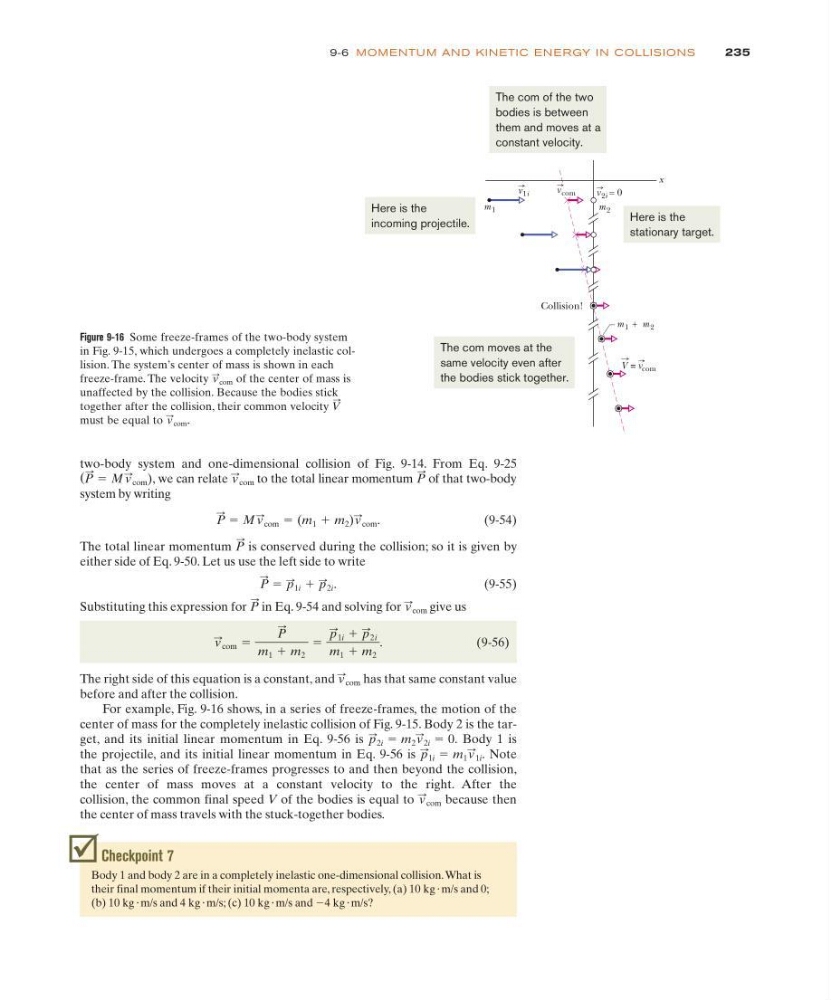
For example, Fig. 9-16 shows, in a series of freeze-frames, the motion of the
center of mass for the completely inelastic collision of Fig. 9-15. Body 2 is the target, and its initial linear momentum in Eq. 9-56 is
Body 1 is
the projectile, and its initial linear momentum in Eq. 9-56 is
Note
that as the series of freeze-frames progresses to and then beyond the collision,
the center of mass moves at a constant velocity to the right. After the
collision, the common final speed V of the bodies is equal to
because then
the center of mass travels with the stuck-together bodies.
v
:
com
p
:
1i ϭ m 1 v
:
1i .
p
:
2i ϭ m 2 v
:
2i ϭ 0.
v
:
com
v
:
com ϭ
P
:
m 1 ϩ m 2
ϭ
p
:
1i ϩ p
:
2i
m 1 ϩ m 2
v
:
com
P
:
P
: ϭ p
: 1i ϩ p
: 2i
P
:
P
: ϭ M v
:
com ϭ (m 1 ϩ m 2 )v
:
com
P
:
v
:
com
(P
: ϭ M v
:
com )
235
9-6 MOM ENTUM AND KINETIC ENERGY IN COLLISIONS
x
m 1
v 1i
v 2i = 0
m 2
m 1 + m 2
V = v com
Collision!
v com
The com of the two
bodies is between
them and moves at a
constant velocity.
Here is the
incoming projectile.
The com moves at the
same velocity even after
the bodies stick together.
Here is the
stationary target.
Figure 9-16 Some freeze-frames of the two-body system
in Fig. 9-15, which undergoes a completely inelastic collision. The system’s center of mass is shown in each
freeze-frame. The velocity
of the center of mass is
unaffected by the collision. Because the bodies stick
together after the collision, their common velocity
must be equal to
.
v
:
com
V
:
v
:
com
Checkpoint 7
Body 1 and body 2 are in a completely inelastic one-dimensional collision.What is
their final momentum if their initial momenta are, respectively, (a) 10 kg иm/s and 0;
(b) 10 kg иm/s and 4 kg иm/s; (c) 10 kg иm/s and Ϫ4 kg иm/s?
, we can relate
to the total linear momentum of that two-body
system by writing
.
(9-54)
The total linear momentum is conserved during the collision; so it is given by
either side of Eq. 9-50. Let us use the left side to write
.
( 9 - 5 5 )
Substituting this expression for in Eq. 9-54 and solving for
give us
.
( 9 - 5 6 )
The right side of this equation is a constant, and
has that same constant value
before and after the collision.
For example, Fig. 9-16 shows, in a series of freeze-frames, the motion of the
center of mass for the completely inelastic collision of Fig. 9-15. Body 2 is the target, and its initial linear momentum in Eq. 9-56 is
Body 1 is
the projectile, and its initial linear momentum in Eq. 9-56 is
Note
that as the series of freeze-frames progresses to and then beyond the collision,
the center of mass moves at a constant velocity to the right. After the
collision, the common final speed V of the bodies is equal to
because then
the center of mass travels with the stuck-together bodies.
v
:
com
p
:
1i ϭ m 1 v
:
1i .
p
:
2i ϭ m 2 v
:
2i ϭ 0.
v
:
com
v
:
com ϭ
P
:
m 1 ϩ m 2
ϭ
p
:
1i ϩ p
:
2i
m 1 ϩ m 2
v
:
com
P
:
P
: ϭ p
: 1i ϩ p
: 2i
P
:
P
: ϭ M v
:
com ϭ (m 1 ϩ m 2 )v
:
com
P
:
v
:
com
(P
: ϭ M v
:
com )
235
9-6 MOM ENTUM AND KINETIC ENERGY IN COLLISIONS
x
m 1
v 1i
v 2i = 0
m 2
m 1 + m 2
V = v com
Collision!
v com
The com of the two
bodies is between
them and moves at a
constant velocity.
Here is the
incoming projectile.
The com moves at the
same velocity even after
the bodies stick together.
Here is the
stationary target.
Figure 9-16 Some freeze-frames of the two-body system
in Fig. 9-15, which undergoes a completely inelastic collision. The system’s center of mass is shown in each
freeze-frame. The velocity
of the center of mass is
unaffected by the collision. Because the bodies stick
together after the collision, their common velocity
must be equal to
.
v
:
com
V
:
v
:
com
Checkpoint 7
Body 1 and body 2 are in a completely inelastic one-dimensional collision.What is
their final momentum if their initial momenta are, respectively, (a) 10 kg иm/s and 0;
(b) 10 kg иm/s and 4 kg иm/s; (c) 10 kg иm/s and Ϫ4 kg иm/s?