

Inelastic Collisions in One Dimension
One-Dimensional Inelastic Collision
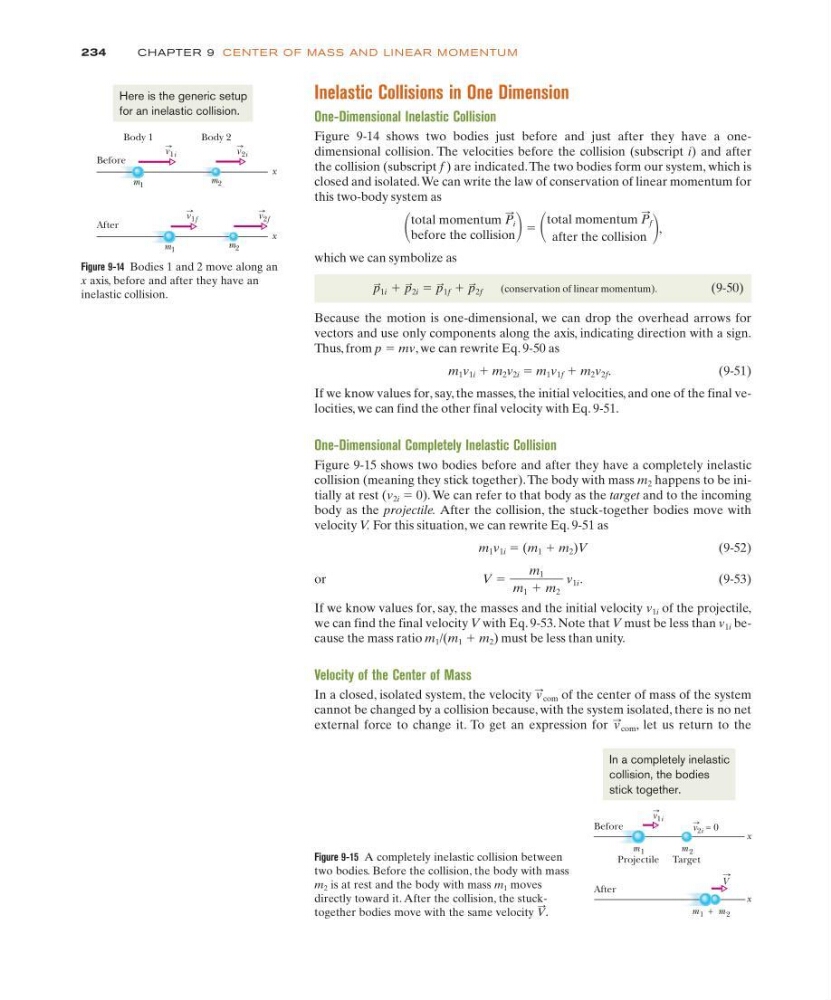
Figure 9-14 shows two bodies just before and just after they have a onedimensional collision. The velocities before the collision (subscript i) and after
the collision (subscript f ) are indicated. The two bodies form our system, which is
closed and isolated. We can write the law of conservation of linear momentum for
this two-body system as
,
which we can symbolize as
(conservation of linear momentum).
(9-50)
Because the motion is one-dimensional, we can drop the overhead arrows for
vectors and use only components along the axis, indicating direction with a sign.
Thus, from p ϭ mv, we can rewrite Eq. 9-50 as
m 1 v 1i ϩ m 2 v 2i ϭ m 1 v 1f ϩ m 2 v 2f .
(9-51)
If we know values for, say, the masses, the initial velocities, and one of the final velocities, we can find the other final velocity with Eq. 9-51.
One-Dimensional Completely Inelastic Collision
Figure 9-15 shows two bodies before and after they have a completely inelastic
collision (meaning they stick together). The body with mass m 2 happens to be initially at rest (v 2i ϭ 0). We can refer to that body as the target and to the incoming
body as the projectile. After the collision, the stuck-together bodies move with
velocity V. For this situation, we can rewrite Eq. 9-51 as
m 1 v 1i ϭ (m 1 ϩ m 2 )V
(9-52)
or
.
(9-53)
If we know values for, say, the masses and the initial velocity v 1i of the projectile,
we can find the final velocity V with Eq. 9-53. Note that V must be less than v 1i because the mass ratio m 1 /(m 1 ϩ m 2 ) must be less than unity.
Velocity of the Center of Mass
In a closed, isolated system, the velocity
of the center of mass of the system
cannot be changed by a collision because, with the system isolated, there is no net
external force to change it. To get an expression for
, let us return to the
v
:
com
v
:
com
V ϭ
m 1
m 1 ϩ m 2
v 1i
p
:
1i ϩ p
:
2i ϭ p
:
1f ϩ p
:
2f
total momentum P
:
i
before the collision ϭ
total momentum P
:
f
after the collision
234
CHAPTE R 9 CE NTE R OF MASS AN D LI N EAR M OM E NTU M
Figure 9-14 Bodies 1 and 2 move along an
x axis, before and after they have an
inelastic collision.
m 1
m 2
Before
Body 1
Body 2
x
v 1i
v 2i
m 1
m 2
After
x
v 1f
v 2f
Here is the generic setup
for an inelastic collision.
Figure 9-15 A completely inelastic collision between
two bodies. Before the collision, the body with mass
m 2 is at rest and the body with mass m 1 moves
directly toward it. After the collision, the stucktogether bodies move with the same velocity .
V
:
m 1
Projectile
m 2
Target
x
x
V
v 1i
After
Before
m 1 + m 2
v 2i = 0
In a completely inelastic
collision, the bodies
stick together.
One-Dimensional Inelastic Collision
Figure 9-14 shows two bodies just before and just after they have a onedimensional collision. The velocities before the collision (subscript i) and after
the collision (subscript f ) are indicated. The two bodies form our system, which is
closed and isolated. We can write the law of conservation of linear momentum for
this two-body system as
,
which we can symbolize as
(conservation of linear momentum).
(9-50)
Because the motion is one-dimensional, we can drop the overhead arrows for
vectors and use only components along the axis, indicating direction with a sign.
Thus, from p ϭ mv, we can rewrite Eq. 9-50 as
m 1 v 1i ϩ m 2 v 2i ϭ m 1 v 1f ϩ m 2 v 2f .
(9-51)
If we know values for, say, the masses, the initial velocities, and one of the final velocities, we can find the other final velocity with Eq. 9-51.
One-Dimensional Completely Inelastic Collision
Figure 9-15 shows two bodies before and after they have a completely inelastic
collision (meaning they stick together). The body with mass m 2 happens to be initially at rest (v 2i ϭ 0). We can refer to that body as the target and to the incoming
body as the projectile. After the collision, the stuck-together bodies move with
velocity V. For this situation, we can rewrite Eq. 9-51 as
m 1 v 1i ϭ (m 1 ϩ m 2 )V
(9-52)
or
.
(9-53)
If we know values for, say, the masses and the initial velocity v 1i of the projectile,
we can find the final velocity V with Eq. 9-53. Note that V must be less than v 1i because the mass ratio m 1 /(m 1 ϩ m 2 ) must be less than unity.
Velocity of the Center of Mass
In a closed, isolated system, the velocity
of the center of mass of the system
cannot be changed by a collision because, with the system isolated, there is no net
external force to change it. To get an expression for
, let us return to the
v
:
com
v
:
com
V ϭ
m 1
m 1 ϩ m 2
v 1i
p
:
1i ϩ p
:
2i ϭ p
:
1f ϩ p
:
2f
total momentum P
:
i
before the collision ϭ
total momentum P
:
f
after the collision
234
CHAPTE R 9 CE NTE R OF MASS AN D LI N EAR M OM E NTU M
Figure 9-14 Bodies 1 and 2 move along an
x axis, before and after they have an
inelastic collision.
m 1
m 2
Before
Body 1
Body 2
x
v 1i
v 2i
m 1
m 2
After
x
v 1f
v 2f
Here is the generic setup
for an inelastic collision.
Figure 9-15 A completely inelastic collision between
two bodies. Before the collision, the body with mass
m 2 is at rest and the body with mass m 1 moves
directly toward it. After the collision, the stucktogether bodies move with the same velocity .
V
:
m 1
Projectile
m 2
Target
x
x
V
v 1i
After
Before
m 1 + m 2
v 2i = 0
In a completely inelastic
collision, the bodies
stick together.