

232
CHAPTE R 9 CE NTE R OF MASS AN D LI N EAR M OM E NTU M
Calculations: Linear momentum is also conserved along
the x axis because there is no net external force acting on
the coconut and pieces along that axis. Thus we have
P ix ϭ P fx ,
( 9 - 4 9 )
where P ix ϭ 0 because the coconut is initially at rest. To
get P fx , we find the x components of the final momenta,
using the fact that piece A must have a mass of 0.50M
(ϭ M Ϫ 0.20M Ϫ 0.30M):
p fA,x ϭ Ϫ0.50Mv fA ,
p fB,x ϭ 0.20Mv fB,x ϭ 0.20Mv fB cos 50Њ,
p fC,x ϭ 0.30Mv fC,x ϭ 0.30Mv fC cos 80Њ.
Equation 9-49 for the conservation of momentum along the
x axis can now be written as
P ix ϭ P fx ϭ p fA,x ϩ p fB,x ϩ p fC,x .
Then, with v fC ϭ 5.0 m/s and v fB ϭ 9.64 m/s, we have
0 ϭ Ϫ0.50Mv fA ϩ 0.20M(9.64 m/s) cos 50Њ
ϩ 0.30M(5.0 m/s) cos 80Њ,
from which we find
v fA ϭ 3.0 m/s.
(Answer)
Sample Problem 9.06 Two-dimensional explosion, momentum, coconut
Two-dimensional explosion: A firecracker placed inside a
coconut of mass M, initially at rest on a frictionless floor,
blows the coconut into three pieces that slide across the floor.
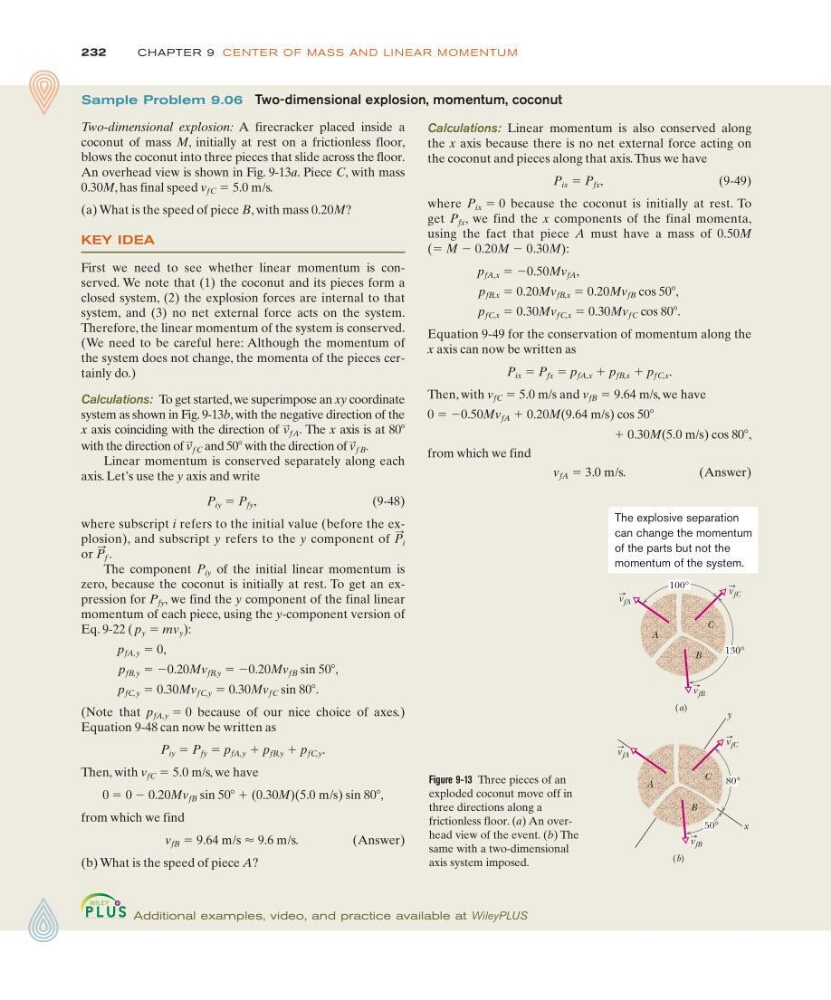
An overhead view is shown in Fig. 9-13a. Piece C, with mass
0.30M, has final speed v fC ϭ 5.0 m/s.
(a) What is the speed of piece B, with mass 0.20M?
KEY IDEA
First we need to see whether linear momentum is conserved. We note that (1) the coconut and its pieces form a
closed system, (2) the explosion forces are internal to that
system, and (3) no net external force acts on the system.
Therefore, the linear momentum of the system is conserved.
(We need to be careful here: Although the momentum of
the system does not change, the momenta of the pieces certainly do.)
Calculations: To get started, we superimpose an xy coordinate
system as shown in Fig. 9-13b, with the negative direction of the
x axis coinciding with the direction of
The x axis is at 80Њ
v
:
fA .
Additional examples, video, and practice available at WileyPLUS
Figure 9-13 Three pieces of an
exploded coconut move off in
three directions along a
frictionless floor. (a) An overhead view of the event. (b) The
same with a two-dimensional
axis system imposed.
with the direction of
and 50Њ with the direction of .
Linear momentum is conserved separately along each
axis. Let’s use the y axis and write
P iy ϭ P fy ,
( 9 - 4 8 )
where subscript i refers to the initial value (before the explosion), and subscript y refers to the y component of
or .
The component P iy of the initial linear momentum is
zero, because the coconut is initially at rest. To get an expression for P fy , we find the y component of the final linear
momentum of each piece, using the y-component version of
Eq. 9-22 ( p y ϭ mv y ):
p fA,y ϭ 0,
p fB,y ϭ Ϫ0.20Mv fB,y ϭ Ϫ0.20Mv fB sin 50Њ,
p fC,y ϭ 0.30Mv fC,y ϭ 0.30Mv fC sin 80Њ.
(Note that p fA,y ϭ 0 because of our nice choice of axes.)
Equation 9-48 can now be written as
P iy ϭ P fy ϭ p fA,y ϩ p fB,y ϩ p fC,y .
Then, with v fC ϭ 5.0 m/s, we have
0 ϭ 0 Ϫ 0.20Mv fB sin 50Њ ϩ (0.30M)(5.0 m/s) sin 80Њ,
from which we find
v fB ϭ 9.64 m/s Ϸ 9.6 m/s.
(Answer)
(b) What is the speed of piece A?
P f
:
P i
:
v
:
f B
v
:
f C
A
B
C
v fB
v fC
v fA
100°
130°
(a)
B
C
v fB
v fC
v fA
80°
(b)
x
y
50°
A
The explosive separation
can change the momentum
of the parts but not the
momentum of the system.
CHAPTE R 9 CE NTE R OF MASS AN D LI N EAR M OM E NTU M
Calculations: Linear momentum is also conserved along
the x axis because there is no net external force acting on
the coconut and pieces along that axis. Thus we have
P ix ϭ P fx ,
( 9 - 4 9 )
where P ix ϭ 0 because the coconut is initially at rest. To
get P fx , we find the x components of the final momenta,
using the fact that piece A must have a mass of 0.50M
(ϭ M Ϫ 0.20M Ϫ 0.30M):
p fA,x ϭ Ϫ0.50Mv fA ,
p fB,x ϭ 0.20Mv fB,x ϭ 0.20Mv fB cos 50Њ,
p fC,x ϭ 0.30Mv fC,x ϭ 0.30Mv fC cos 80Њ.
Equation 9-49 for the conservation of momentum along the
x axis can now be written as
P ix ϭ P fx ϭ p fA,x ϩ p fB,x ϩ p fC,x .
Then, with v fC ϭ 5.0 m/s and v fB ϭ 9.64 m/s, we have
0 ϭ Ϫ0.50Mv fA ϩ 0.20M(9.64 m/s) cos 50Њ
ϩ 0.30M(5.0 m/s) cos 80Њ,
from which we find
v fA ϭ 3.0 m/s.
(Answer)
Sample Problem 9.06 Two-dimensional explosion, momentum, coconut
Two-dimensional explosion: A firecracker placed inside a
coconut of mass M, initially at rest on a frictionless floor,
blows the coconut into three pieces that slide across the floor.
An overhead view is shown in Fig. 9-13a. Piece C, with mass
0.30M, has final speed v fC ϭ 5.0 m/s.
(a) What is the speed of piece B, with mass 0.20M?
KEY IDEA
First we need to see whether linear momentum is conserved. We note that (1) the coconut and its pieces form a
closed system, (2) the explosion forces are internal to that
system, and (3) no net external force acts on the system.
Therefore, the linear momentum of the system is conserved.
(We need to be careful here: Although the momentum of
the system does not change, the momenta of the pieces certainly do.)
Calculations: To get started, we superimpose an xy coordinate
system as shown in Fig. 9-13b, with the negative direction of the
x axis coinciding with the direction of
The x axis is at 80Њ
v
:
fA .
Additional examples, video, and practice available at WileyPLUS
Figure 9-13 Three pieces of an
exploded coconut move off in
three directions along a
frictionless floor. (a) An overhead view of the event. (b) The
same with a two-dimensional
axis system imposed.
with the direction of
and 50Њ with the direction of .
Linear momentum is conserved separately along each
axis. Let’s use the y axis and write
P iy ϭ P fy ,
( 9 - 4 8 )
where subscript i refers to the initial value (before the explosion), and subscript y refers to the y component of
or .
The component P iy of the initial linear momentum is
zero, because the coconut is initially at rest. To get an expression for P fy , we find the y component of the final linear
momentum of each piece, using the y-component version of
Eq. 9-22 ( p y ϭ mv y ):
p fA,y ϭ 0,
p fB,y ϭ Ϫ0.20Mv fB,y ϭ Ϫ0.20Mv fB sin 50Њ,
p fC,y ϭ 0.30Mv fC,y ϭ 0.30Mv fC sin 80Њ.
(Note that p fA,y ϭ 0 because of our nice choice of axes.)
Equation 9-48 can now be written as
P iy ϭ P fy ϭ p fA,y ϩ p fB,y ϩ p fC,y .
Then, with v fC ϭ 5.0 m/s, we have
0 ϭ 0 Ϫ 0.20Mv fB sin 50Њ ϩ (0.30M)(5.0 m/s) sin 80Њ,
from which we find
v fB ϭ 9.64 m/s Ϸ 9.6 m/s.
(Answer)
(b) What is the speed of piece A?
P f
:
P i
:
v
:
f B
v
:
f C
A
B
C
v fB
v fC
v fA
100°
130°
(a)
B
C
v fB
v fC
v fA
80°
(b)
x
y
50°
A
The explosive separation
can change the momentum
of the parts but not the
momentum of the system.