

momentum of the grapefruit changes, but since no horizontal external force acts on
the grapefruit, the horizontal component of the linear momentum cannot change.
Note that we focus on the external forces acting on a closed system.
Although internal forces can change the linear momentum of portions of the system, they cannot change the total linear momentum of the entire system. For example, there are plenty of forces acting between the organs of your body, but they
do not propel you across the room (thankfully).
The sample problems in this module involve explosions that are either onedimensional (meaning that the motions before and after the explosion are along
a single axis) or two-dimensional (meaning that they are in a plane containing
two axes). In the following modules we consider collisions.
231
9-5 CONSE RVATION OF LI N EAR M OM E NTU M
We can relate the v MS to the known velocities with
.
In symbols, this gives us
v HS ϭ v rel ϩ v MS
(9-47)
or
v MS ϭ v HS Ϫ v rel .
Substituting this expression for v MS into Eq. 9-46, and then
substituting Eqs. 9-45 and 9-46 into Eq. 9-44, we find
Mv i ϭ 0.20M(v HS Ϫ v rel ) ϩ 0.80Mv HS ,
which gives us
v HS ϭ v i ϩ 0.20v rel ,
or
v HS ϭ 2100 km/h ϩ (0.20)(500 km/h)
ϭ 2200 km/h.
(Answer)
velocity of
hauler relative
to Sun
ϭ
velocity of
hauler relative
to module
ϩ
velocity of
module relative
to Sun
Sample Problem 9.05 One-dimensional explosion, relative velocity, space hauler
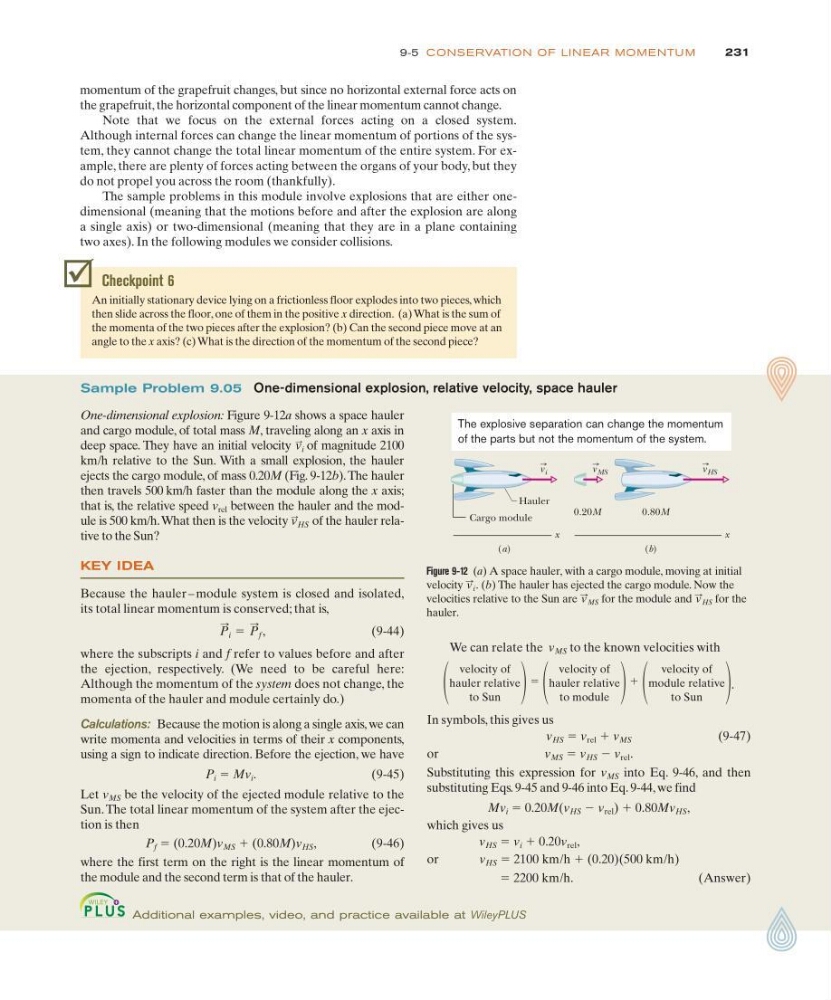
One-dimensional explosion: Figure 9-12a shows a space hauler
and cargo module, of total mass M, traveling along an x axis in
deep space. They have an initial velocity of magnitude 2100
km/h relative to the Sun. With a small explosion, the hauler
ejects the cargo module, of mass 0.20M (Fig. 9-12b). The hauler
then travels 500 km/h faster than the module along the x axis;
that is, the relative speed v rel between the hauler and the module is 500 km/h.What then is the velocity
of the hauler relative to the Sun?
KEY IDEA
Because the hauler – module system is closed and isolated,
its total linear momentum is conserved; that is,
,
( 9 - 4 4 )
where the subscripts i and f refer to values before and after
the ejection, respectively. (We need to be careful here:
Although the momentum of the system does not change, the
momenta of the hauler and module certainly do.)
Calculations: Because the motion is along a single axis, we can
write momenta and velocities in terms of their x components,
using a sign to indicate direction. Before the ejection, we have
P i ϭ Mv i .
(9-45)
Let v MS be the velocity of the ejected module relative to the
Sun. The total linear momentum of the system after the ejection is then
P f ϭ (0.20M)v MS ϩ (0.80M)v HS ,
( 9 - 4 6 )
where the first term on the right is the linear momentum of
the module and the second term is that of the hauler.
P
:
i ϭ P
:
f
v
:
HS
v
:
i
Figure 9-12 (a) A space hauler, with a cargo module, moving at initial
velocity
(b) The hauler has ejected the cargo module. Now the
velocities relative to the Sun are
for the module and
for the
hauler.
v
:
HS
v
:
MS
v
:
i .
(a)
( b)
Cargo module
Hauler
0.20M
v MS
v HS
v i
0.80M
x
x
The explosive separation can change the momentum
of the parts but not the momentum of the system.
Additional examples, video, and practice available at WileyPLUS
Checkpoint 6
An initially stationary device lying on a frictionless floor explodes into two pieces, which
then slide across the floor, one of them in the positive x direction. (a) What is the sum of
the momenta of the two pieces after the explosion? (b) Can the second piece move at an
angle to the x axis? (c) What is the direction of the momentum of the second piece?
the grapefruit, the horizontal component of the linear momentum cannot change.
Note that we focus on the external forces acting on a closed system.
Although internal forces can change the linear momentum of portions of the system, they cannot change the total linear momentum of the entire system. For example, there are plenty of forces acting between the organs of your body, but they
do not propel you across the room (thankfully).
The sample problems in this module involve explosions that are either onedimensional (meaning that the motions before and after the explosion are along
a single axis) or two-dimensional (meaning that they are in a plane containing
two axes). In the following modules we consider collisions.
231
9-5 CONSE RVATION OF LI N EAR M OM E NTU M
We can relate the v MS to the known velocities with
.
In symbols, this gives us
v HS ϭ v rel ϩ v MS
(9-47)
or
v MS ϭ v HS Ϫ v rel .
Substituting this expression for v MS into Eq. 9-46, and then
substituting Eqs. 9-45 and 9-46 into Eq. 9-44, we find
Mv i ϭ 0.20M(v HS Ϫ v rel ) ϩ 0.80Mv HS ,
which gives us
v HS ϭ v i ϩ 0.20v rel ,
or
v HS ϭ 2100 km/h ϩ (0.20)(500 km/h)
ϭ 2200 km/h.
(Answer)
velocity of
hauler relative
to Sun
ϭ
velocity of
hauler relative
to module
ϩ
velocity of
module relative
to Sun
Sample Problem 9.05 One-dimensional explosion, relative velocity, space hauler
One-dimensional explosion: Figure 9-12a shows a space hauler
and cargo module, of total mass M, traveling along an x axis in
deep space. They have an initial velocity of magnitude 2100
km/h relative to the Sun. With a small explosion, the hauler
ejects the cargo module, of mass 0.20M (Fig. 9-12b). The hauler
then travels 500 km/h faster than the module along the x axis;
that is, the relative speed v rel between the hauler and the module is 500 km/h.What then is the velocity
of the hauler relative to the Sun?
KEY IDEA
Because the hauler – module system is closed and isolated,
its total linear momentum is conserved; that is,
,
( 9 - 4 4 )
where the subscripts i and f refer to values before and after
the ejection, respectively. (We need to be careful here:
Although the momentum of the system does not change, the
momenta of the hauler and module certainly do.)
Calculations: Because the motion is along a single axis, we can
write momenta and velocities in terms of their x components,
using a sign to indicate direction. Before the ejection, we have
P i ϭ Mv i .
(9-45)
Let v MS be the velocity of the ejected module relative to the
Sun. The total linear momentum of the system after the ejection is then
P f ϭ (0.20M)v MS ϩ (0.80M)v HS ,
( 9 - 4 6 )
where the first term on the right is the linear momentum of
the module and the second term is that of the hauler.
P
:
i ϭ P
:
f
v
:
HS
v
:
i
Figure 9-12 (a) A space hauler, with a cargo module, moving at initial
velocity
(b) The hauler has ejected the cargo module. Now the
velocities relative to the Sun are
for the module and
for the
hauler.
v
:
HS
v
:
MS
v
:
i .
(a)
( b)
Cargo module
Hauler
0.20M
v MS
v HS
v i
0.80M
x
x
The explosive separation can change the momentum
of the parts but not the momentum of the system.
Additional examples, video, and practice available at WileyPLUS
Checkpoint 6
An initially stationary device lying on a frictionless floor explodes into two pieces, which
then slide across the floor, one of them in the positive x direction. (a) What is the sum of
the momenta of the two pieces after the explosion? (b) Can the second piece move at an
angle to the x axis? (c) What is the direction of the momentum of the second piece?