

229
9-4 COLLISION AN D I M PU LSE
Impulse: The impulse is then
(Answer)
which means the impulse magnitude is
The angle of is given by
(Answer)
which a calculator evaluates as 75.4Њ. Recall that the physically correct result of an inverse tangent might be the
displayed answer plus 180Њ. We can tell which is correct here
by drawing the components of (Fig. 9-11c). We find that u
is actually 75.4Њ ϩ 180Њ ϭ 255.4Њ, which we can write as
u ϭ Ϫ105Њ.
( A n s w e r )
(b) The collision lasts for 14 ms. What is the magnitude of
the average force on the driver during the collision?
KEY IDEA
From Eq. 9-35 (J ϭ F avg ⌬t), the magnitude F avg of the average force is the ratio of the impulse magnitude J to the duration ⌬t of the collision.
Calculations: We have
.
(Answer)
Using F ϭ ma with m ϭ 80 kg, you can show that the magnitude of the driver’s average acceleration during the collision
is about 3.22 ϫ 10
3
m/s
2 ϭ 329g, which is fatal.
Surviving: Mechanical engineers attempt to reduce the
chances of a fatality by designing and building racetrack
walls with more “give,” so that a collision lasts longer. For
example, if the collision here lasted 10 times longer and the
other data remained the same, the magnitudes of the average force and average acceleration would be 10 times less
and probably survivable.
ϭ 2.583 ϫ 10
5
N Ϸ 2.6 ϫ 10
5
N
F avg ϭ
J
⌬t
ϭ
3616 kgиm/s
0.014 s
J
:
u ϭ tan
Ϫ1
J y
J x
,
J
:
J ϭ 2J x
2 ϩ J y
2 ϭ 3616 kg иm/s Ϸ 3600 kgиm/s.
J
: ϭ (Ϫ910i ˆ Ϫ 3500 j ˆ ) kg иm/s,
Sample Problem 9.04 Two-dimensional impulse, race car–wall collision
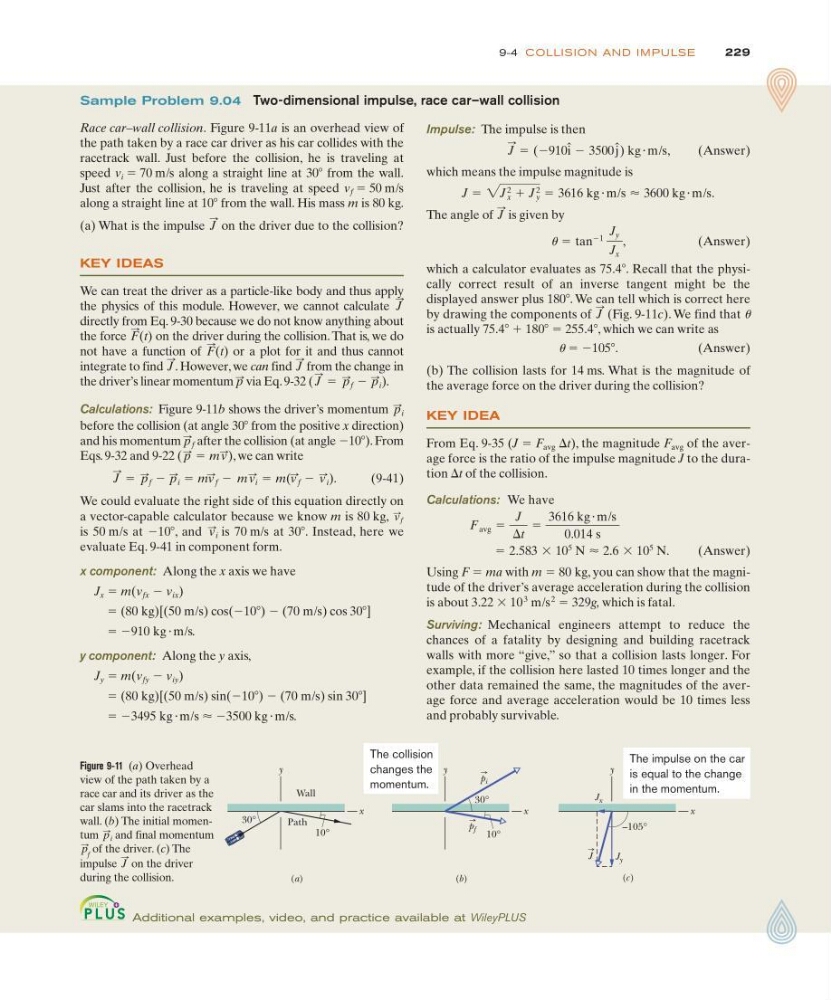
Figure 9-11a is an overhead view of
the path taken by a race car driver as his car collides with the
racetrack wall. Just before the collision, he is traveling at
speed v i ϭ 70 m/s along a straight line at 30Њ from the wall.
Just after the collision, he is traveling at speed v f ϭ 50 m/s
along a straight line at 10Њ from the wall. His mass m is 80 kg.
(a) What is the impulse on the driver due to the collision?
KEY IDEAS
We can treat the driver as a particle-like body and thus apply
the physics of this module. However, we cannot calculate
directly from Eq. 9-30 because we do not know anything about
the force
on the driver during the collision. That is, we do
not have a function of
or a plot for it and thus cannot
integrate to find . However, we can find from the change in
the driver’s linear momentum via Eq. 9-32
.
Calculations: Figure 9-11b shows the driver’s momentum p
:
i
( J
: ϭ p
:
f Ϫ p
:
i )
p
:
J
:
J
:
F
: (t)
F
: (t)
J
:
J
:
Race car–wall collision.
Wall
x
y
30°
10°
30°
Path
(a)
x
y
10°
(b)
p i
p f
–105°
x
y
(c)
J y
J x
J
The impulse on the car
is equal to the change
in the momentum.
The collision
changes the
momentum.
Figure 9-11 (a) Overhead
view of the path taken by a
race car and its driver as the
car slams into the racetrack
wall. (b) The initial momentum and final momentum
of the driver. (c) The
impulse on the driver
during the collision.
J
:
p
:
f
p
:
i
Additional examples, video, and practice available at WileyPLUS
before the collision (at angle 30Њ from the positive x direction)
and his momentum after the collision (at angle 10Њ). From
Eqs. 9-32 and 9-22
, we can write
(9-41)
We could evaluate the right side of this equation directly on
a vector-capable calculator because we know m is 80 kg,
is 50 m/s at Ϫ10Њ, and
is 70 m/s at 30Њ. Instead, here we
evaluate Eq. 9-41 in component form.
x component: Along the x axis we have
J x ϭ m(v fx Ϫ v ix )
ϭ (80 kg)[(50 m/s) cos(Ϫ10Њ) Ϫ (70 m/s) cos 30Њ]
ϭ Ϫ910 kg иm/s.
y component: Along the y axis,
J y ϭ m(v fy Ϫ v iy )
ϭ (80 kg)[(50 m/s) sin(Ϫ10Њ) Ϫ (70 m/s) sin 30Њ]
ϭ Ϫ3495 kg иm/s Ϸ Ϫ3500 kg иm/s.
v
:
i
v
:
f
J
: ϭ p
:
f Ϫ p
:
i ϭ mv
:
f Ϫ mv i
: ϭ m(v
:
f Ϫ v
:
i ).
mv
:
)
( p
: ϭ
Ϫ
p
:
f
9-4 COLLISION AN D I M PU LSE
Impulse: The impulse is then
(Answer)
which means the impulse magnitude is
The angle of is given by
(Answer)
which a calculator evaluates as 75.4Њ. Recall that the physically correct result of an inverse tangent might be the
displayed answer plus 180Њ. We can tell which is correct here
by drawing the components of (Fig. 9-11c). We find that u
is actually 75.4Њ ϩ 180Њ ϭ 255.4Њ, which we can write as
u ϭ Ϫ105Њ.
( A n s w e r )
(b) The collision lasts for 14 ms. What is the magnitude of
the average force on the driver during the collision?
KEY IDEA
From Eq. 9-35 (J ϭ F avg ⌬t), the magnitude F avg of the average force is the ratio of the impulse magnitude J to the duration ⌬t of the collision.
Calculations: We have
.
(Answer)
Using F ϭ ma with m ϭ 80 kg, you can show that the magnitude of the driver’s average acceleration during the collision
is about 3.22 ϫ 10
3
m/s
2 ϭ 329g, which is fatal.
Surviving: Mechanical engineers attempt to reduce the
chances of a fatality by designing and building racetrack
walls with more “give,” so that a collision lasts longer. For
example, if the collision here lasted 10 times longer and the
other data remained the same, the magnitudes of the average force and average acceleration would be 10 times less
and probably survivable.
ϭ 2.583 ϫ 10
5
N Ϸ 2.6 ϫ 10
5
N
F avg ϭ
J
⌬t
ϭ
3616 kgиm/s
0.014 s
J
:
u ϭ tan
Ϫ1
J y
J x
,
J
:
J ϭ 2J x
2 ϩ J y
2 ϭ 3616 kg иm/s Ϸ 3600 kgиm/s.
J
: ϭ (Ϫ910i ˆ Ϫ 3500 j ˆ ) kg иm/s,
Sample Problem 9.04 Two-dimensional impulse, race car–wall collision
Figure 9-11a is an overhead view of
the path taken by a race car driver as his car collides with the
racetrack wall. Just before the collision, he is traveling at
speed v i ϭ 70 m/s along a straight line at 30Њ from the wall.
Just after the collision, he is traveling at speed v f ϭ 50 m/s
along a straight line at 10Њ from the wall. His mass m is 80 kg.
(a) What is the impulse on the driver due to the collision?
KEY IDEAS
We can treat the driver as a particle-like body and thus apply
the physics of this module. However, we cannot calculate
directly from Eq. 9-30 because we do not know anything about
the force
on the driver during the collision. That is, we do
not have a function of
or a plot for it and thus cannot
integrate to find . However, we can find from the change in
the driver’s linear momentum via Eq. 9-32
.
Calculations: Figure 9-11b shows the driver’s momentum p
:
i
( J
: ϭ p
:
f Ϫ p
:
i )
p
:
J
:
J
:
F
: (t)
F
: (t)
J
:
J
:
Race car–wall collision.
Wall
x
y
30°
10°
30°
Path
(a)
x
y
10°
(b)
p i
p f
–105°
x
y
(c)
J y
J x
J
The impulse on the car
is equal to the change
in the momentum.
The collision
changes the
momentum.
Figure 9-11 (a) Overhead
view of the path taken by a
race car and its driver as the
car slams into the racetrack
wall. (b) The initial momentum and final momentum
of the driver. (c) The
impulse on the driver
during the collision.
J
:
p
:
f
p
:
i
Additional examples, video, and practice available at WileyPLUS
before the collision (at angle 30Њ from the positive x direction)
and his momentum after the collision (at angle 10Њ). From
Eqs. 9-32 and 9-22
, we can write
(9-41)
We could evaluate the right side of this equation directly on
a vector-capable calculator because we know m is 80 kg,
is 50 m/s at Ϫ10Њ, and
is 70 m/s at 30Њ. Instead, here we
evaluate Eq. 9-41 in component form.
x component: Along the x axis we have
J x ϭ m(v fx Ϫ v ix )
ϭ (80 kg)[(50 m/s) cos(Ϫ10Њ) Ϫ (70 m/s) cos 30Њ]
ϭ Ϫ910 kg иm/s.
y component: Along the y axis,
J y ϭ m(v fy Ϫ v iy )
ϭ (80 kg)[(50 m/s) sin(Ϫ10Њ) Ϫ (70 m/s) sin 30Њ]
ϭ Ϫ3495 kg иm/s Ϸ Ϫ3500 kg иm/s.
v
:
i
v
:
f
J
: ϭ p
:
f Ϫ p
:
i ϭ mv
:
f Ϫ mv i
: ϭ m(v
:
f Ϫ v
:
i ).
mv
:
)
( p
: ϭ
Ϫ
p
:
f