

189
8-3 READING A POTENTIAL ENERGY CURVE
6
5
4
3
2
1
U (J)
x
x 2
x 1
x 3
x 4
x 5
(a)
U(x)
+
–
x
(b)
x 2
x 1
x 3 x 4
x 5
F (N)
Mild force, –x direction
Strong force, +x direction
This is a plot of the potential
energy U versus position x.
Force is equal to the negative of
the slope of the U(x) plot.
6
5
4
3
2
1
U (J), E mec (J)
x
x 2
x 1
x 3
x 4
x 5
(c)
E mec = 5.0 J
U(x)
The flat line shows a given value of
the total mechanical energy E mec .
The difference between the total energy
and the potential energy is the
kinetic energy K.
6
5
4
3
2
1
U (J), E mec (J)
x
x 2
x 1
x 3
x 4
x 5
(d)
E mec = 5.0 J
U(x)
K
6
5
4
3
2
1
x
(f )
x 2
x 1
x 3
x 4
x 5
U (J), E mec (J)
At this position, K is greatest and
the particle is moving the fastest.
At this position, K is zero (a turning point).
The particle cannot go farther to the left.
For either of these three choices for E mec ,
the particle is trapped (cannot escape
left or right).
6
5
4
3
2
1
U (J), E mec (J)
x
x 2
x 1
x 3
x 4
x 5
(e)
E mec = 5.0 J
K = 1.0 J at x > x 5
K = 5.0 J at x 2
A
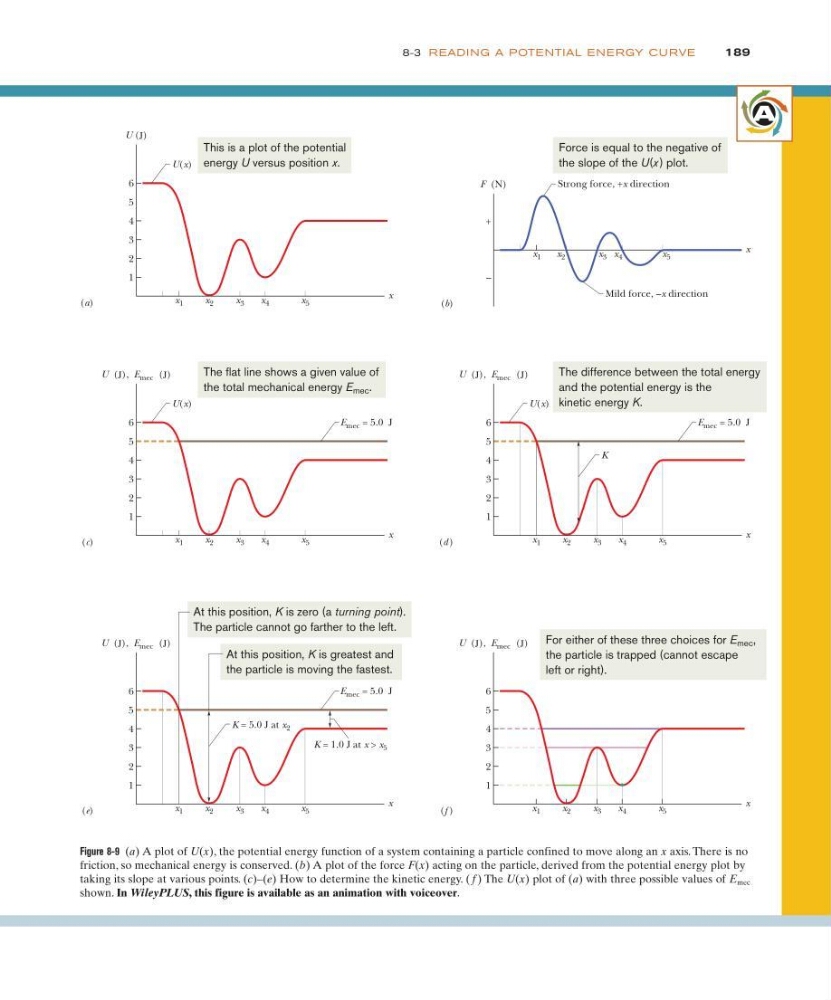
Figure 8-9 (a) A plot of U(x), the potential energy function of a system containing a particle confined to move along an x axis. There is no
friction, so mechanical energy is conserved. (b) A plot of the force F(x) acting on the particle, derived from the potential energy plot by
taking its slope at various points. (c)–(e) How to determine the kinetic energy. ( f ) The U(x) plot of (a) with three possible values of E mec
shown. In WileyPLUS, this figure is available as an animation with voiceover.
8-3 READING A POTENTIAL ENERGY CURVE
6
5
4
3
2
1
U (J)
x
x 2
x 1
x 3
x 4
x 5
(a)
U(x)
+
–
x
(b)
x 2
x 1
x 3 x 4
x 5
F (N)
Mild force, –x direction
Strong force, +x direction
This is a plot of the potential
energy U versus position x.
Force is equal to the negative of
the slope of the U(x) plot.
6
5
4
3
2
1
U (J), E mec (J)
x
x 2
x 1
x 3
x 4
x 5
(c)
E mec = 5.0 J
U(x)
The flat line shows a given value of
the total mechanical energy E mec .
The difference between the total energy
and the potential energy is the
kinetic energy K.
6
5
4
3
2
1
U (J), E mec (J)
x
x 2
x 1
x 3
x 4
x 5
(d)
E mec = 5.0 J
U(x)
K
6
5
4
3
2
1
x
(f )
x 2
x 1
x 3
x 4
x 5
U (J), E mec (J)
At this position, K is greatest and
the particle is moving the fastest.
At this position, K is zero (a turning point).
The particle cannot go farther to the left.
For either of these three choices for E mec ,
the particle is trapped (cannot escape
left or right).
6
5
4
3
2
1
U (J), E mec (J)
x
x 2
x 1
x 3
x 4
x 5
(e)
E mec = 5.0 J
K = 1.0 J at x > x 5
K = 5.0 J at x 2
A
Figure 8-9 (a) A plot of U(x), the potential energy function of a system containing a particle confined to move along an x axis. There is no
friction, so mechanical energy is conserved. (b) A plot of the force F(x) acting on the particle, derived from the potential energy plot by
taking its slope at various points. (c)–(e) How to determine the kinetic energy. ( f ) The U(x) plot of (a) with three possible values of E mec
shown. In WileyPLUS, this figure is available as an animation with voiceover.