

169
QU ESTIONS
F x
F 1
–F 1
x 1 x
(a)
F x
F 1
–F 1
x 1 x
(b)
F x
F 1
–F 1
x 1 x
(c)
F x
F 1
–F 1
x 1
x
(d)
Figure 7-18
Question 5.
Spring Force The force from a spring is
(Hooke’s law),
(7-20)
where is the displacement of the spring’s free end from its position when the spring is in its relaxed state (neither compressed nor
extended), and k is the spring constant (a measure of the spring’s
stiffness). If an x axis lies along the spring, with the origin at the location of the spring’s free end when the spring is in its relaxed
state, Eq. 7-20 can be written as
F x ϭ Ϫkx (Hooke’s law).
(7-21)
A spring force is thus a variable force: It varies with the
displacement of the spring’s free end.
Work Done by a Spring Force If an object is attached to
the spring’s free end, the work W s done on the object by the spring
force when the object is moved from an initial position x i to a final
position x f is
(7-25)
If x i ϭ 0 and x f ϭ x, then Eq. 7-25 becomes
(7-26)
Work Done by a Variable Force When the force on a particlelike object depends on the position of the object, the work done by
on the object while the object moves from an initial position r i with coordinates (x i , y i , z i ) to a final position r f with coordinates (x f , y f , z f )
F
:
F
:
W s ϭ Ϫ
1
2 kx
2
.
W s ϭ
1
2 kx i
2 Ϫ
1
2 kx f
2
.
d
:
F
:
s ϭ Ϫkd
:
F
:
s
must be found by integrating the force. If we assume that component
F x may depend on x but not on y or z, component F y may depend on y
but not on x or z, and component F z may depend on z but not on x or
y, then the work is
(7-36)
If has only an x component, then Eq. 7-36 reduces to
(7-32)
Power The power due to a force is the rate at which that force
does work on an object. If the force does work W during a time interval ⌬t, the average power due to the force over that time interval is
(7-42)
Instantaneous power is the instantaneous rate of doing work:
(7-43)
For a force at an angle f to the direction of travel of the instantaneous velocity , the instantaneous power is
.
( 7 - 4 7 , 7 - 4 8 )
P ϭ Fv cos ϭ F
:
ؒ v
:
v
:
F
:
P ϭ
dW
dt
.
P avg ϭ
W
⌬t
.
W ϭ ͵
x f
x i
F(x) dx.
F
:
W ϭ ͵
x f
x i
F x dx ϩ ͵
y f
y i
F y dy ϩ ͵
z f
z i
F z dz.
Questions
1 Rank the following velocities according to the kinetic energy a
particle will have with each velocity, greatest first: (a)
,
(b)
, (c)
, (d)
, (e)
,
v
: ϭ 5i ˆ
3i ˆ Ϫ 4j ˆ
v
: ϭ
v
: ϭ Ϫ3i ˆ ϩ 4j ˆ
v
: ϭ Ϫ4i ˆ ϩ 3j ˆ
v
: ϭ 4i ˆ ϩ 3j ˆ
F 2
F 1
(a)
(b)
3
2
1
K
t
Figure 7-16 Question 2.
3 Is positive or negative work done by a constant force on a particle during a straight-line displacement if (a) the angle between
and is 30Њ; (b) the angle is 100Њ; (c)
and
?
4 In three situations, a briefly applied horizontal force changes the
velocity of a hockey puck that slides over frictionless ice. The overhead views of Fig. 7-17 indicate, for each situation, the puck’s initial
speed v i , its final speed v f , and the directions of the corresponding velocity vectors. Rank the situations according to the work done on the
puck by the applied force, most positive first and most negative last.
d
: ϭ Ϫ4i ˆ
F
: ϭ 2i ˆ Ϫ 3j ˆ
d
:
F
:
d
:
F
:
Figure 7-17 Question 4.
and (f) v 5 m/s at 30Њ to the horizontal.
2 Figure 7-16a shows two horizontal forces that act on a block
that is sliding to the right across a frictionless floor. Figure 7-16b
shows three plots of the block’s kinetic energy K versus time t.
Which of the plots best corresponds to the following three situations: (a) F 1 ϭ F 2 , (b) F 1 Ͼ F 2 , (c) F 1 Ͻ F 2 ?
ϭ
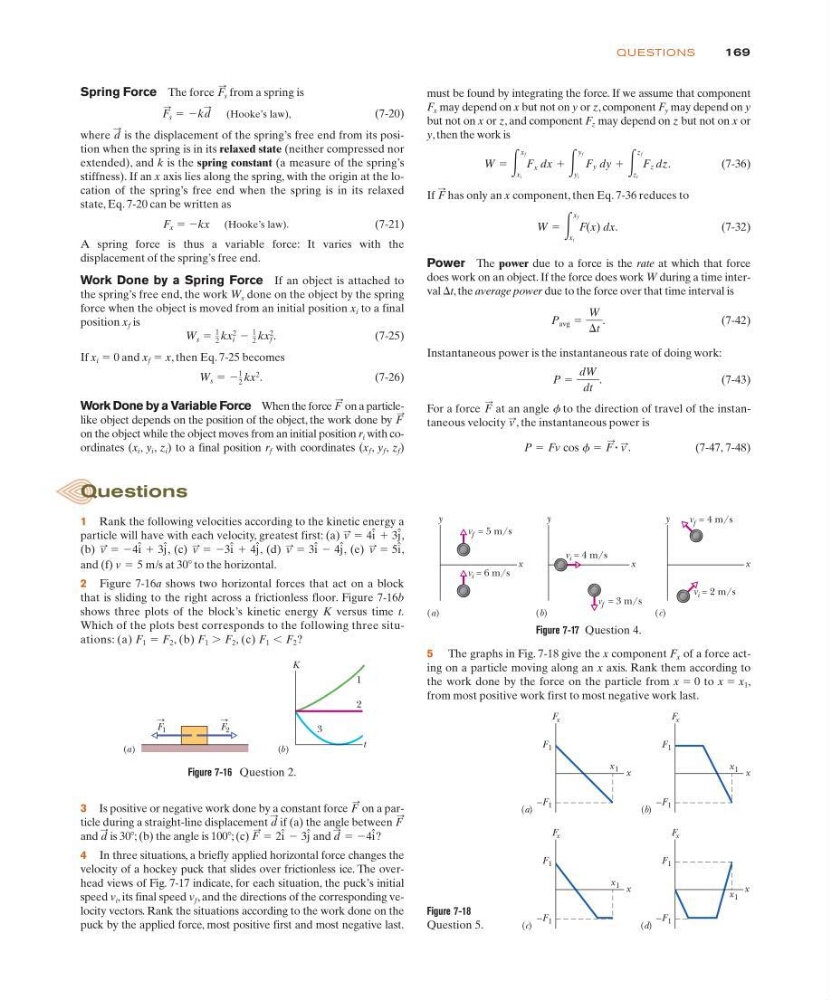
5 The graphs in Fig. 7-18 give the x component F x of a force acting on a particle moving along an x axis. Rank them according to
the work done by the force on the particle from x ϭ 0 to x ϭ x 1 ,
from most positive work first to most negative work last.
(a)
( b)
( c)
y
v f = 5 m/s
v i = 6 m/s
x
y
v f = 3 m/s
v i = 4 m/s
x
y
v f = 4 m/s
v i = 2 m/s
x
QU ESTIONS
F x
F 1
–F 1
x 1 x
(a)
F x
F 1
–F 1
x 1 x
(b)
F x
F 1
–F 1
x 1 x
(c)
F x
F 1
–F 1
x 1
x
(d)
Figure 7-18
Question 5.
Spring Force The force from a spring is
(Hooke’s law),
(7-20)
where is the displacement of the spring’s free end from its position when the spring is in its relaxed state (neither compressed nor
extended), and k is the spring constant (a measure of the spring’s
stiffness). If an x axis lies along the spring, with the origin at the location of the spring’s free end when the spring is in its relaxed
state, Eq. 7-20 can be written as
F x ϭ Ϫkx (Hooke’s law).
(7-21)
A spring force is thus a variable force: It varies with the
displacement of the spring’s free end.
Work Done by a Spring Force If an object is attached to
the spring’s free end, the work W s done on the object by the spring
force when the object is moved from an initial position x i to a final
position x f is
(7-25)
If x i ϭ 0 and x f ϭ x, then Eq. 7-25 becomes
(7-26)
Work Done by a Variable Force When the force on a particlelike object depends on the position of the object, the work done by
on the object while the object moves from an initial position r i with coordinates (x i , y i , z i ) to a final position r f with coordinates (x f , y f , z f )
F
:
F
:
W s ϭ Ϫ
1
2 kx
2
.
W s ϭ
1
2 kx i
2 Ϫ
1
2 kx f
2
.
d
:
F
:
s ϭ Ϫkd
:
F
:
s
must be found by integrating the force. If we assume that component
F x may depend on x but not on y or z, component F y may depend on y
but not on x or z, and component F z may depend on z but not on x or
y, then the work is
(7-36)
If has only an x component, then Eq. 7-36 reduces to
(7-32)
Power The power due to a force is the rate at which that force
does work on an object. If the force does work W during a time interval ⌬t, the average power due to the force over that time interval is
(7-42)
Instantaneous power is the instantaneous rate of doing work:
(7-43)
For a force at an angle f to the direction of travel of the instantaneous velocity , the instantaneous power is
.
( 7 - 4 7 , 7 - 4 8 )
P ϭ Fv cos ϭ F
:
ؒ v
:
v
:
F
:
P ϭ
dW
dt
.
P avg ϭ
W
⌬t
.
W ϭ ͵
x f
x i
F(x) dx.
F
:
W ϭ ͵
x f
x i
F x dx ϩ ͵
y f
y i
F y dy ϩ ͵
z f
z i
F z dz.
Questions
1 Rank the following velocities according to the kinetic energy a
particle will have with each velocity, greatest first: (a)
,
(b)
, (c)
, (d)
, (e)
,
v
: ϭ 5i ˆ
3i ˆ Ϫ 4j ˆ
v
: ϭ
v
: ϭ Ϫ3i ˆ ϩ 4j ˆ
v
: ϭ Ϫ4i ˆ ϩ 3j ˆ
v
: ϭ 4i ˆ ϩ 3j ˆ
F 2
F 1
(a)
(b)
3
2
1
K
t
Figure 7-16 Question 2.
3 Is positive or negative work done by a constant force on a particle during a straight-line displacement if (a) the angle between
and is 30Њ; (b) the angle is 100Њ; (c)
and
?
4 In three situations, a briefly applied horizontal force changes the
velocity of a hockey puck that slides over frictionless ice. The overhead views of Fig. 7-17 indicate, for each situation, the puck’s initial
speed v i , its final speed v f , and the directions of the corresponding velocity vectors. Rank the situations according to the work done on the
puck by the applied force, most positive first and most negative last.
d
: ϭ Ϫ4i ˆ
F
: ϭ 2i ˆ Ϫ 3j ˆ
d
:
F
:
d
:
F
:
Figure 7-17 Question 4.
and (f) v 5 m/s at 30Њ to the horizontal.
2 Figure 7-16a shows two horizontal forces that act on a block
that is sliding to the right across a frictionless floor. Figure 7-16b
shows three plots of the block’s kinetic energy K versus time t.
Which of the plots best corresponds to the following three situations: (a) F 1 ϭ F 2 , (b) F 1 Ͼ F 2 , (c) F 1 Ͻ F 2 ?
ϭ
5 The graphs in Fig. 7-18 give the x component F x of a force acting on a particle moving along an x axis. Rank them according to
the work done by the force on the particle from x ϭ 0 to x ϭ x 1 ,
from most positive work first to most negative work last.
(a)
( b)
( c)
y
v f = 5 m/s
v i = 6 m/s
x
y
v f = 3 m/s
v i = 4 m/s
x
y
v f = 4 m/s
v i = 2 m/s
x