

168
CHAPTE R 7 KI N ETIC E N E RGY AN D WOR K
Calculation: We use Eq. 7-47 for each force. For force , at
angle f 1 ϭ 180Њ to velocity , we have
P 1 ϭ F 1 v cos f 1 ϭ (2.0 N)(3.0 m/s) cos 180Њ
ϭ Ϫ6.0 W.
(Answer)
This negative result tells us that force
is transferring energy from the box at the rate of 6.0 J/s.
For force , at angle f 2 ϭ 60Њ to velocity , we have
P 2 ϭ F 2 v cos f 2 ϭ (4.0 N)(3.0 m/s) cos 60Њ
ϭ 6.0 W.
(Answer)
This positive result tells us that force
is transferring energy to the box at the rate of 6.0 J/s.
The net power is the sum of the individual powers
(complete with their algebraic signs):
P net ϭ P 1 ϩ P 2
ϭ Ϫ6.0 W ϩ 6.0 W ϭ 0,
(Answer)
which tells us that the net rate of transfer of energy to
or from the box is zero. Thus, the kinetic energy
of the box is not changing, and so the speed of the box will
remain at 3.0 m/s. With neither the forces
and
nor the
velocity changing, we see from Eq. 7-48 that P 1 and P 2 are
constant and thus so is P net .
v
:
F
:
2
F
:
1
(K ϭ
1
2 mv
2
)
F
:
2
v
:
F
:
2
F
:
1
v
:
F
:
1
Sample Problem 7.09 Power, force, and velocity
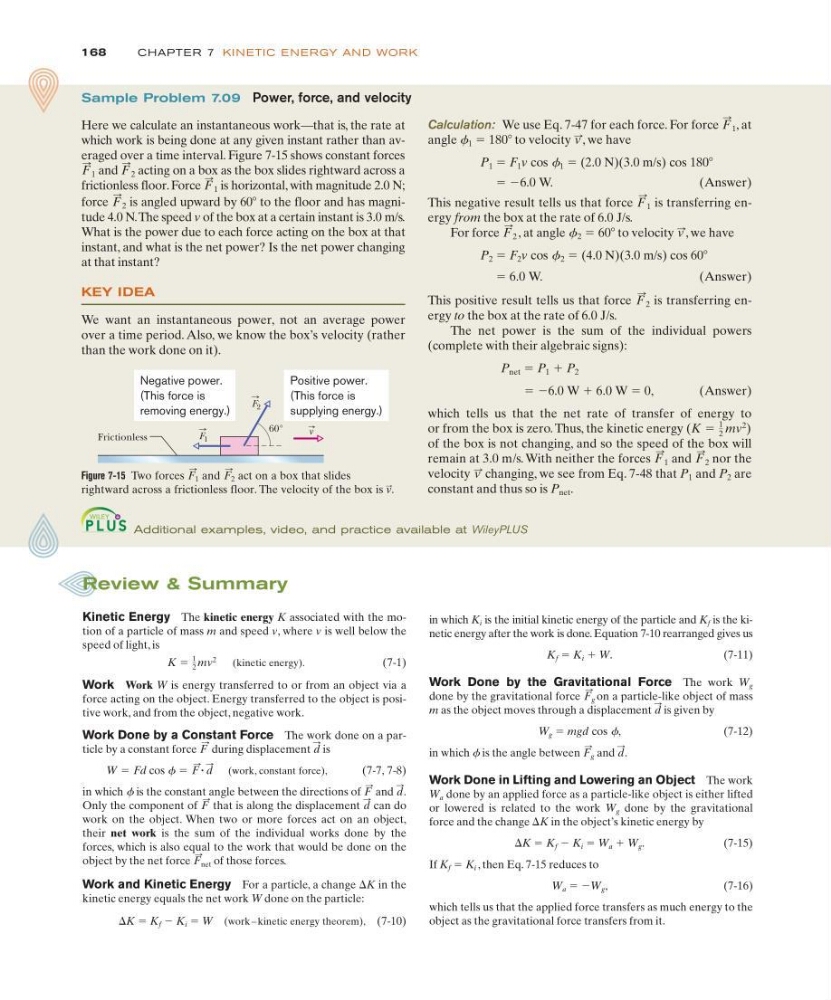
Here we calculate an instantaneous work—that is, the rate at
which work is being done at any given instant rather than averaged over a time interval. Figure 7-15 shows constant forces
and
acting on a box as the box slides rightward across a
frictionless floor. Force
is horizontal, with magnitude 2.0 N;
F
:
1
F
:
2
F
:
1
Additional examples, video, and practice available at WileyPLUS
Figure 7-15 Two forces
and
act on a box that slides
rightward across a frictionless floor. The velocity of the box is .
v
:
F
:
2
F
:
1
60°
Frictionless
F 1
F 2
v
Negative power.
(This force is
removing energy.)
Positive power.
(This force is
supplying energy.)
Kinetic Energy The kinetic energy K associated with the motion of a particle of mass m and speed v, where v is well below the
speed of light, is
(kinetic energy).
(7-1)
Work Work W is energy transferred to or from an object via a
force acting on the object. Energy transferred to the object is positive work, and from the object, negative work.
Work Done by a Constant Force The work done on a particle by a constant force during displacement is
(work, constant force),
(7-7, 7-8)
in which f is the constant angle between the directions of and .
Only the component of that is along the displacement can do
work on the object. When two or more forces act on an object,
their net work is the sum of the individual works done by the
forces, which is also equal to the work that would be done on the
object by the net force
of those forces.
Work and Kinetic Energy For a particle, a change ⌬K in the
kinetic energy equals the net work W done on the particle:
⌬K ϭ K f Ϫ K i ϭ W (work – kinetic energy theorem), (7-10)
F
:
net
d
:
F
:
d
:
F
:
W ϭ Fd cos ϭ F
:
ؒ d
:
d
:
F
:
K ϭ
1
2 mv
2
Review & Summary
in which K i is the initial kinetic energy of the particle and K f is the kinetic energy after the work is done. Equation 7-10 rearranged gives us
K f ϭ K i ϩ W.
( 7 - 1 1 )
Work Done by the Gravitational Force The work W g
done by the gravitational force on a particle-like object of mass
m as the object moves through a displacement is given by
W g ϭ mgd cos f,
( 7 - 1 2 )
in which f is the angle between and .
Work Done in Lifting and Lowering an Object The work
W a done by an applied force as a particle-like object is either lifted
or lowered is related to the work W g done by the gravitational
force and the change ⌬K in the object’s kinetic energy by
⌬K ϭ K f Ϫ K i ϭ W a ϩ W g .
( 7 - 1 5 )
If K f ϭ K i , then Eq. 7-15 reduces to
W a ϭ ϪW g ,
( 7 - 1 6 )
which tells us that the applied force transfers as much energy to the
object as the gravitational force transfers from it.
d
:
F
:
g
d
:
F
:
g
force
is angled upward by 60Њ to the floor and has magnitude 4.0 N.The speed v of the box at a certain instant is 3.0 m/s.
What is the power due to each force acting on the box at that
instant, and what is the net power? Is the net power changing
at that instant?
KEY IDEA
We want an instantaneous power, not an average power
over a time period. Also, we know the box’s velocity (rather
than the work done on it).
F
:
2
CHAPTE R 7 KI N ETIC E N E RGY AN D WOR K
Calculation: We use Eq. 7-47 for each force. For force , at
angle f 1 ϭ 180Њ to velocity , we have
P 1 ϭ F 1 v cos f 1 ϭ (2.0 N)(3.0 m/s) cos 180Њ
ϭ Ϫ6.0 W.
(Answer)
This negative result tells us that force
is transferring energy from the box at the rate of 6.0 J/s.
For force , at angle f 2 ϭ 60Њ to velocity , we have
P 2 ϭ F 2 v cos f 2 ϭ (4.0 N)(3.0 m/s) cos 60Њ
ϭ 6.0 W.
(Answer)
This positive result tells us that force
is transferring energy to the box at the rate of 6.0 J/s.
The net power is the sum of the individual powers
(complete with their algebraic signs):
P net ϭ P 1 ϩ P 2
ϭ Ϫ6.0 W ϩ 6.0 W ϭ 0,
(Answer)
which tells us that the net rate of transfer of energy to
or from the box is zero. Thus, the kinetic energy
of the box is not changing, and so the speed of the box will
remain at 3.0 m/s. With neither the forces
and
nor the
velocity changing, we see from Eq. 7-48 that P 1 and P 2 are
constant and thus so is P net .
v
:
F
:
2
F
:
1
(K ϭ
1
2 mv
2
)
F
:
2
v
:
F
:
2
F
:
1
v
:
F
:
1
Sample Problem 7.09 Power, force, and velocity
Here we calculate an instantaneous work—that is, the rate at
which work is being done at any given instant rather than averaged over a time interval. Figure 7-15 shows constant forces
and
acting on a box as the box slides rightward across a
frictionless floor. Force
is horizontal, with magnitude 2.0 N;
F
:
1
F
:
2
F
:
1
Additional examples, video, and practice available at WileyPLUS
Figure 7-15 Two forces
and
act on a box that slides
rightward across a frictionless floor. The velocity of the box is .
v
:
F
:
2
F
:
1
60°
Frictionless
F 1
F 2
v
Negative power.
(This force is
removing energy.)
Positive power.
(This force is
supplying energy.)
Kinetic Energy The kinetic energy K associated with the motion of a particle of mass m and speed v, where v is well below the
speed of light, is
(kinetic energy).
(7-1)
Work Work W is energy transferred to or from an object via a
force acting on the object. Energy transferred to the object is positive work, and from the object, negative work.
Work Done by a Constant Force The work done on a particle by a constant force during displacement is
(work, constant force),
(7-7, 7-8)
in which f is the constant angle between the directions of and .
Only the component of that is along the displacement can do
work on the object. When two or more forces act on an object,
their net work is the sum of the individual works done by the
forces, which is also equal to the work that would be done on the
object by the net force
of those forces.
Work and Kinetic Energy For a particle, a change ⌬K in the
kinetic energy equals the net work W done on the particle:
⌬K ϭ K f Ϫ K i ϭ W (work – kinetic energy theorem), (7-10)
F
:
net
d
:
F
:
d
:
F
:
W ϭ Fd cos ϭ F
:
ؒ d
:
d
:
F
:
K ϭ
1
2 mv
2
Review & Summary
in which K i is the initial kinetic energy of the particle and K f is the kinetic energy after the work is done. Equation 7-10 rearranged gives us
K f ϭ K i ϩ W.
( 7 - 1 1 )
Work Done by the Gravitational Force The work W g
done by the gravitational force on a particle-like object of mass
m as the object moves through a displacement is given by
W g ϭ mgd cos f,
( 7 - 1 2 )
in which f is the angle between and .
Work Done in Lifting and Lowering an Object The work
W a done by an applied force as a particle-like object is either lifted
or lowered is related to the work W g done by the gravitational
force and the change ⌬K in the object’s kinetic energy by
⌬K ϭ K f Ϫ K i ϭ W a ϩ W g .
( 7 - 1 5 )
If K f ϭ K i , then Eq. 7-15 reduces to
W a ϭ ϪW g ,
( 7 - 1 6 )
which tells us that the applied force transfers as much energy to the
object as the gravitational force transfers from it.
d
:
F
:
g
d
:
F
:
g
force
is angled upward by 60Њ to the floor and has magnitude 4.0 N.The speed v of the box at a certain instant is 3.0 m/s.
What is the power due to each force acting on the box at that
instant, and what is the net power? Is the net power changing
at that instant?
KEY IDEA
We want an instantaneous power, not an average power
over a time period. Also, we know the box’s velocity (rather
than the work done on it).
F
:
2