

156
CHAPTE R 7 KI N ETIC E N E RGY AN D WOR K
Work Done by the Gravitational Force
We next examine the work done on an object by the gravitational force acting on
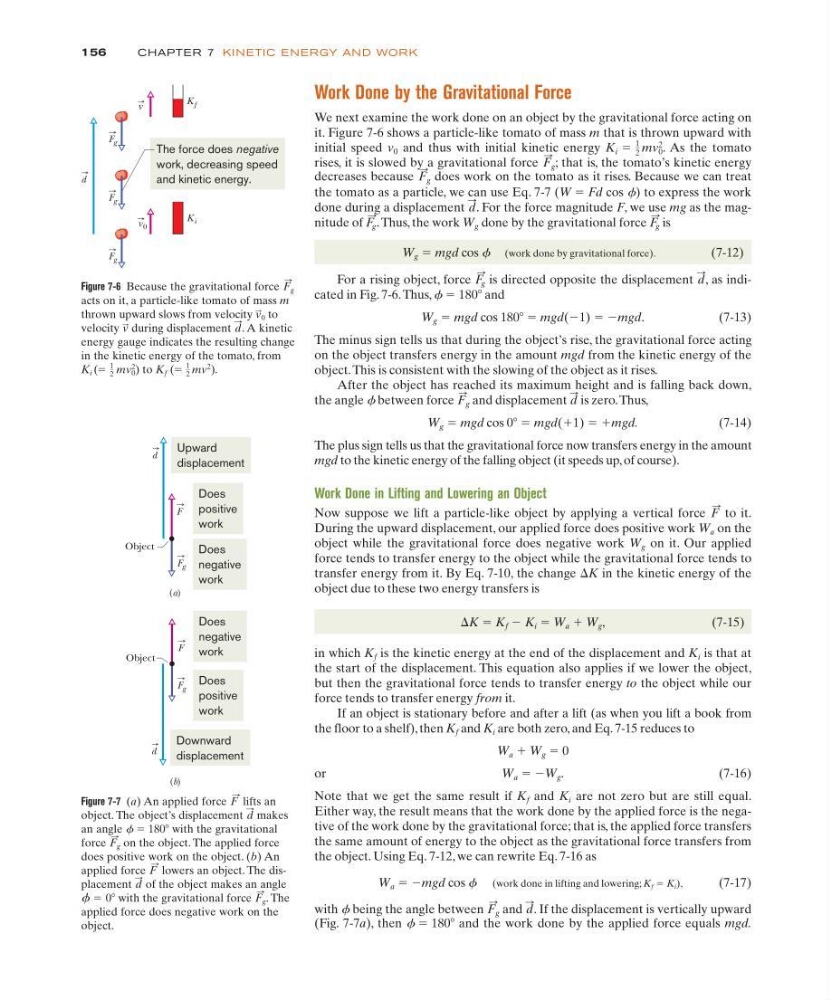
it. Figure 7-6 shows a particle-like tomato of mass m that is thrown upward with
initial speed v 0 and thus with initial kinetic energy
. As the tomato
K i ϭ
1
2 mv
2
0
Figure 7-6 Because the gravitational force
acts on it, a particle-like tomato of mass m
thrown upward slows from velocity to
velocity during displacement . A kinetic
energy gauge indicates the resulting change
in the kinetic energy of the tomato, from
to
.
K f (ϭ
1
2 mv
2
)
K i (ϭ
1
2 mv
2
0 )
d
:
v
:
v
:
0
F
:
g
K f
K i
F g
F g
F g
v 0
v
d
The force does negative
work, decreasing speed
and kinetic energy.
rises, it is slowed by a gravitational force ; that is, the tomato’s kinetic energy
F
:
g
decreases because
does work on the tomato as it rises. Because we can treat
F
:
g
Figure 7-7 (a) An applied force lifts an
object. The object’s displacement makes
an angle f ϭ 180Њ with the gravitational
force
on the object. The applied force
does positive work on the object. (b) An
applied force lowers an object. The displacement of the object makes an angle
f
with the gravitational force . The
applied force does negative work on the
object.
F
:
g
ϭ 0Њ
d
:
F
:
F
:
g
d
:
F
:
(Fig. 7-7a), then f ϭ 180Њ and the work done by the applied force equals mgd.
the tomato as a particle, we can use Eq. 7-7 (W ϭ Fd cos f) to express the work
done during a displacement . For the force magnitude F, we use mg as the magnitude of F
:
g .Thus, the work W g done by the gravitational force F
:
g is
W g ϭ mgd cos f (work done by gravitational force).
(7-12)
For a rising object, force F
:
g is directed opposite the displacement , as indicated in Fig. 7-6. Thus, f ϭ 180Њ and
W g ϭ mgd cos 180Њ ϭ mgd(Ϫ1) ϭ Ϫmgd.
( 7 - 1 3 )
The minus sign tells us that during the object’s rise, the gravitational force acting
on the object transfers energy in the amount mgd from the kinetic energy of the
object. This is consistent with the slowing of the object as it rises.
After the object has reached its maximum height and is falling back down,
the angle f between force and displacement is zero. Thus,
W g ϭ mgd cos 0Њ ϭ mgd(ϩ1) ϭ ϩmgd.
(7-14)
The plus sign tells us that the gravitational force now transfers energy in the amount
mgd to the kinetic energy of the falling object (it speeds up, of course).
Work Done in Lifting and Lowering an Object
Now suppose we lift a particle-like object by applying a vertical force
to it.
During the upward displacement, our applied force does positive work W a on the
object while the gravitational force does negative work W g on it. Our applied
force tends to transfer energy to the object while the gravitational force tends to
transfer energy from it. By Eq. 7-10, the change ⌬K in the kinetic energy of the
object due to these two energy transfers is
⌬K ϭ K f Ϫ K i ϭ W a ϩ W g ,
( 7 - 1 5 )
in which K f is the kinetic energy at the end of the displacement and K i is that at
the start of the displacement. This equation also applies if we lower the object,
but then the gravitational force tends to transfer energy to the object while our
force tends to transfer energy from it.
If an object is stationary before and after a lift (as when you lift a book from
the floor to a shelf), then K f and K i are both zero, and Eq. 7-15 reduces to
W a ϩ W g ϭ 0
or
W a ϭ ϪW g .
( 7 - 1 6 )
Note that we get the same result if K f and K i are not zero but are still equal.
Either way, the result means that the work done by the applied force is the negative of the work done by the gravitational force; that is, the applied force transfers
the same amount of energy to the object as the gravitational force transfers from
the object. Using Eq. 7-12, we can rewrite Eq. 7-16 as
W a ϭ Ϫmgd cos f (work done in lifting and lowering; K f ϭ K i ),
(7-17)
with f being the angle between and . If the displacement is vertically upward
d
:
F
:
g
F
:
d
:
F
:
g
d
:
d
:
(a)
F g
F
d
Object
Does
positive
work
Upward
displacement
Does
negative
work
(b)
F g
F
d
Object
Does
positive
work
Downward
displacement
Does
negative
work
CHAPTE R 7 KI N ETIC E N E RGY AN D WOR K
Work Done by the Gravitational Force
We next examine the work done on an object by the gravitational force acting on
it. Figure 7-6 shows a particle-like tomato of mass m that is thrown upward with
initial speed v 0 and thus with initial kinetic energy
. As the tomato
K i ϭ
1
2 mv
2
0
Figure 7-6 Because the gravitational force
acts on it, a particle-like tomato of mass m
thrown upward slows from velocity to
velocity during displacement . A kinetic
energy gauge indicates the resulting change
in the kinetic energy of the tomato, from
to
.
K f (ϭ
1
2 mv
2
)
K i (ϭ
1
2 mv
2
0 )
d
:
v
:
v
:
0
F
:
g
K f
K i
F g
F g
F g
v 0
v
d
The force does negative
work, decreasing speed
and kinetic energy.
rises, it is slowed by a gravitational force ; that is, the tomato’s kinetic energy
F
:
g
decreases because
does work on the tomato as it rises. Because we can treat
F
:
g
Figure 7-7 (a) An applied force lifts an
object. The object’s displacement makes
an angle f ϭ 180Њ with the gravitational
force
on the object. The applied force
does positive work on the object. (b) An
applied force lowers an object. The displacement of the object makes an angle
f
with the gravitational force . The
applied force does negative work on the
object.
F
:
g
ϭ 0Њ
d
:
F
:
F
:
g
d
:
F
:
(Fig. 7-7a), then f ϭ 180Њ and the work done by the applied force equals mgd.
the tomato as a particle, we can use Eq. 7-7 (W ϭ Fd cos f) to express the work
done during a displacement . For the force magnitude F, we use mg as the magnitude of F
:
g .Thus, the work W g done by the gravitational force F
:
g is
W g ϭ mgd cos f (work done by gravitational force).
(7-12)
For a rising object, force F
:
g is directed opposite the displacement , as indicated in Fig. 7-6. Thus, f ϭ 180Њ and
W g ϭ mgd cos 180Њ ϭ mgd(Ϫ1) ϭ Ϫmgd.
( 7 - 1 3 )
The minus sign tells us that during the object’s rise, the gravitational force acting
on the object transfers energy in the amount mgd from the kinetic energy of the
object. This is consistent with the slowing of the object as it rises.
After the object has reached its maximum height and is falling back down,
the angle f between force and displacement is zero. Thus,
W g ϭ mgd cos 0Њ ϭ mgd(ϩ1) ϭ ϩmgd.
(7-14)
The plus sign tells us that the gravitational force now transfers energy in the amount
mgd to the kinetic energy of the falling object (it speeds up, of course).
Work Done in Lifting and Lowering an Object
Now suppose we lift a particle-like object by applying a vertical force
to it.
During the upward displacement, our applied force does positive work W a on the
object while the gravitational force does negative work W g on it. Our applied
force tends to transfer energy to the object while the gravitational force tends to
transfer energy from it. By Eq. 7-10, the change ⌬K in the kinetic energy of the
object due to these two energy transfers is
⌬K ϭ K f Ϫ K i ϭ W a ϩ W g ,
( 7 - 1 5 )
in which K f is the kinetic energy at the end of the displacement and K i is that at
the start of the displacement. This equation also applies if we lower the object,
but then the gravitational force tends to transfer energy to the object while our
force tends to transfer energy from it.
If an object is stationary before and after a lift (as when you lift a book from
the floor to a shelf), then K f and K i are both zero, and Eq. 7-15 reduces to
W a ϩ W g ϭ 0
or
W a ϭ ϪW g .
( 7 - 1 6 )
Note that we get the same result if K f and K i are not zero but are still equal.
Either way, the result means that the work done by the applied force is the negative of the work done by the gravitational force; that is, the applied force transfers
the same amount of energy to the object as the gravitational force transfers from
the object. Using Eq. 7-12, we can rewrite Eq. 7-16 as
W a ϭ Ϫmgd cos f (work done in lifting and lowering; K f ϭ K i ),
(7-17)
with f being the angle between and . If the displacement is vertically upward
d
:
F
:
g
F
:
d
:
F
:
g
d
:
d
:
(a)
F g
F
d
Object
Does
positive
work
Upward
displacement
Does
negative
work
(b)
F g
F
d
Object
Does
positive
work
Downward
displacement
Does
negative
work