

155
7-3 WOR K DON E BY TH E G RAVITATIONAL FORCE
Calculations: We relate the speed to the work done by
combining Eqs. 7-10 (the work–kinetic energy theorem) and
7-1 (the definition of kinetic energy):
The initial speed v i is zero, and we now know that the work
W ϭ K f Ϫ K i ϭ
1
2 mv f
2 Ϫ
1
2 mv i
2
.
done is 153.4 J. Solving for v f and then substituting known
data, we find that
(Answer)
ϭ 1.17 m/s.
v f ϭ A
2W
m
ϭ A
2(153.4 J)
225 kg
Sample Problem 7.03 Work done by a constant force in unit-vector notation
During a storm, a crate of crepe is sliding across a slick,
oily parking lot through a displacement
while a steady wind pushes against the crate with a force
. The situation and coordinate
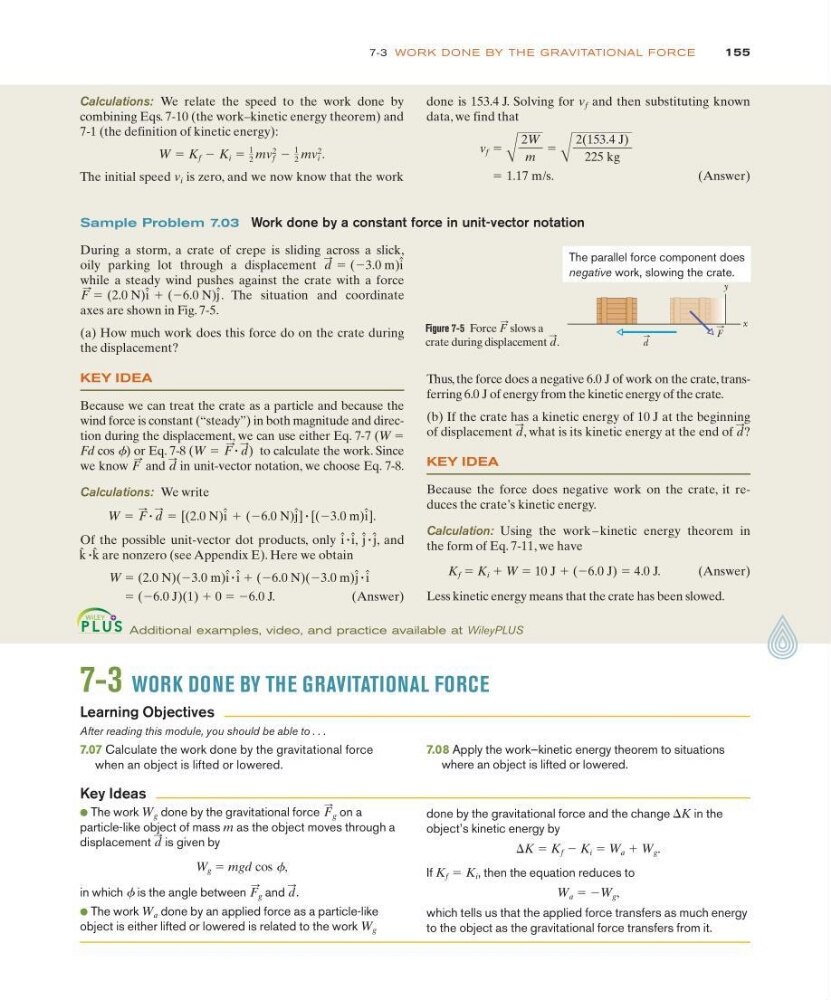
axes are shown in Fig. 7-5.
(a) How much work does this force do on the crate during
the displacement?
KEY IDEA
Because we can treat the crate as a particle and because the
wind force is constant (“steady”) in both magnitude and direction during the displacement, we can use either Eq. 7-7 (W ϭ
Fd cos f) or Eq. 7-8
to calculate the work. Since
we know and in unit-vector notation, we choose Eq. 7-8.
Calculations: We write
Of the possible unit-vector dot products, only i ˆ ؒi ˆ , ˆ j ؒ ˆ j, and
ˆ
k ؒ ˆ
k are nonzero (see Appendix E). Here we obtain
W ϭ (2.0 N)(Ϫ3.0 m)i ˆ ؒi ˆ ϩ (Ϫ6.0 N)(Ϫ3.0 m) ˆ j ؒi ˆ
ϭ (Ϫ6.0 J)(1) ϩ 0 ϭ Ϫ6.0 J.
(Answer)
W ϭ F
: ؒ d
: ϭ [(2.0 N)i ˆ ϩ (Ϫ6.0 N)j ˆ ] ؒ [(Ϫ3.0 m)i ˆ ].
d
:
F
:
(W ϭ F
:
ؒ d
: )
(2.0 N)i ˆ ϩ (Ϫ6.0 N)j ˆ
F
: ϭ
d
: ϭ (Ϫ3.0 m)i ˆ
Figure 7-5 Force slows a
crate during displacement .
d
:
F
:
y
x
F
d
The parallel force component does
negative work, slowing the crate.
Thus, the force does a negative 6.0 J of work on the crate, transferring 6.0 J of energy from the kinetic energy of the crate.
(b) If the crate has a kinetic energy of 10 J at the beginning
of displacement , what is its kinetic energy at the end of ?
KEY IDEA
Because the force does negative work on the crate, it reduces the crate’s kinetic energy.
Calculation: Using the work – kinetic energy theorem in
the form of Eq. 7-11, we have
K f ϭ K i ϩ W ϭ 10 J ϩ (Ϫ6.0 J) ϭ 4.0 J.
(Answer)
Less kinetic energy means that the crate has been slowed.
d
:
d
:
Additional examples, video, and practice available at WileyPLUS
7-3 WORK DONE BY THE GRAVITATIONAL FORCE
Learning Objectives
7.08 Apply the work–kinetic energy theorem to situations
where an object is lifted or lowered.
● The work W g done by the gravitational force
on a
particle-like object of mass m as the object moves through a
displacement is given by
W g ϭ mgd cos f,
in which f is the angle between and .
● The work W a done by an applied force as a particle-like
object is either lifted or lowered is related to the work W g
d
:
F
:
g
d
:
F
:
g
done by the gravitational force and the change ⌬K in the
object’s kinetic energy by
⌬K ϭ K f Ϫ K i ϭ W a ϩ W g .
If K f ϭ K i , then the equation reduces to
W a ϭ ϪW g ,
which tells us that the applied force transfers as much energy
to the object as the gravitational force transfers from it.
After reading this module, you should be able to . . .
7.07 Calculate the work done by the gravitational force
when an object is lifted or lowered.
Key Ideas
7-3 WOR K DON E BY TH E G RAVITATIONAL FORCE
Calculations: We relate the speed to the work done by
combining Eqs. 7-10 (the work–kinetic energy theorem) and
7-1 (the definition of kinetic energy):
The initial speed v i is zero, and we now know that the work
W ϭ K f Ϫ K i ϭ
1
2 mv f
2 Ϫ
1
2 mv i
2
.
done is 153.4 J. Solving for v f and then substituting known
data, we find that
(Answer)
ϭ 1.17 m/s.
v f ϭ A
2W
m
ϭ A
2(153.4 J)
225 kg
Sample Problem 7.03 Work done by a constant force in unit-vector notation
During a storm, a crate of crepe is sliding across a slick,
oily parking lot through a displacement
while a steady wind pushes against the crate with a force
. The situation and coordinate
axes are shown in Fig. 7-5.
(a) How much work does this force do on the crate during
the displacement?
KEY IDEA
Because we can treat the crate as a particle and because the
wind force is constant (“steady”) in both magnitude and direction during the displacement, we can use either Eq. 7-7 (W ϭ
Fd cos f) or Eq. 7-8
to calculate the work. Since
we know and in unit-vector notation, we choose Eq. 7-8.
Calculations: We write
Of the possible unit-vector dot products, only i ˆ ؒi ˆ , ˆ j ؒ ˆ j, and
ˆ
k ؒ ˆ
k are nonzero (see Appendix E). Here we obtain
W ϭ (2.0 N)(Ϫ3.0 m)i ˆ ؒi ˆ ϩ (Ϫ6.0 N)(Ϫ3.0 m) ˆ j ؒi ˆ
ϭ (Ϫ6.0 J)(1) ϩ 0 ϭ Ϫ6.0 J.
(Answer)
W ϭ F
: ؒ d
: ϭ [(2.0 N)i ˆ ϩ (Ϫ6.0 N)j ˆ ] ؒ [(Ϫ3.0 m)i ˆ ].
d
:
F
:
(W ϭ F
:
ؒ d
: )
(2.0 N)i ˆ ϩ (Ϫ6.0 N)j ˆ
F
: ϭ
d
: ϭ (Ϫ3.0 m)i ˆ
Figure 7-5 Force slows a
crate during displacement .
d
:
F
:
y
x
F
d
The parallel force component does
negative work, slowing the crate.
Thus, the force does a negative 6.0 J of work on the crate, transferring 6.0 J of energy from the kinetic energy of the crate.
(b) If the crate has a kinetic energy of 10 J at the beginning
of displacement , what is its kinetic energy at the end of ?
KEY IDEA
Because the force does negative work on the crate, it reduces the crate’s kinetic energy.
Calculation: Using the work – kinetic energy theorem in
the form of Eq. 7-11, we have
K f ϭ K i ϩ W ϭ 10 J ϩ (Ϫ6.0 J) ϭ 4.0 J.
(Answer)
Less kinetic energy means that the crate has been slowed.
d
:
d
:
Additional examples, video, and practice available at WileyPLUS
7-3 WORK DONE BY THE GRAVITATIONAL FORCE
Learning Objectives
7.08 Apply the work–kinetic energy theorem to situations
where an object is lifted or lowered.
● The work W g done by the gravitational force
on a
particle-like object of mass m as the object moves through a
displacement is given by
W g ϭ mgd cos f,
in which f is the angle between and .
● The work W a done by an applied force as a particle-like
object is either lifted or lowered is related to the work W g
d
:
F
:
g
d
:
F
:
g
done by the gravitational force and the change ⌬K in the
object’s kinetic energy by
⌬K ϭ K f Ϫ K i ϭ W a ϩ W g .
If K f ϭ K i , then the equation reduces to
W a ϭ ϪW g ,
which tells us that the applied force transfers as much energy
to the object as the gravitational force transfers from it.
After reading this module, you should be able to . . .
7.07 Calculate the work done by the gravitational force
when an object is lifted or lowered.
Key Ideas