

129
6-1 FR ICTION
Inserting the initial speed v 0 ϭ 10.0 m/s, the final speed v ϭ 0,
and the coefficient of kinetic friction m k ϭ 0.60, we find that
the car’s stopping distance is
x Ϫ x 0 ϭ 8.50 m 8.5 m.
(Answer)
(b) What is the stopping distance if the road is covered with
ice with m k ϭ 0.10?
Calculation: Our solution is perfectly fine through Eq. 6-12
but now we substitute this new m k , finding
x Ϫ x 0 ϭ 51 m.
(Answer)
Thus, a much longer clear path would be needed to avoid
the car hitting something along the way.
(c) Now let’s have the car sliding down an icy hill with an inclination of u ϭ 5.00Њ (a mild incline, nothing like the hills of
San Francisco). The free-body diagram shown in Fig. 6-4c is
like the ramp in Sample Problem 5.04 except, to be consistent with Fig. 6-4b, the positive direction of the x axis is
down the ramp. What now is the stopping distance?
Calculations: Switching from Fig. 6-4b to c involves two major changes. (1) Now a component of the gravitational force is
along the tilted x axis, pulling the car down the hill. From
Sample Problem 5.04 and Fig. 5-15, that down-the-hill component is mg sin u, which is in the positive direction of the x
axis in Fig. 6-4c. (2) The normal force (still perpendicular to
the road) now balances only a component of the gravitational
Ϸ
Sample Problem 6.02 Sliding to a stop on icy roads, horizontal and inclined
Some of the funniest videos on the web involve motorists
sliding uncontrollably on icy roads. Here let’s compare the
typical stopping distances for a car sliding to a stop from an
initial speed of 10.0 m/s on a dry horizontal road, an icy horizontal road, and (everyone’s favorite) an icy hill.
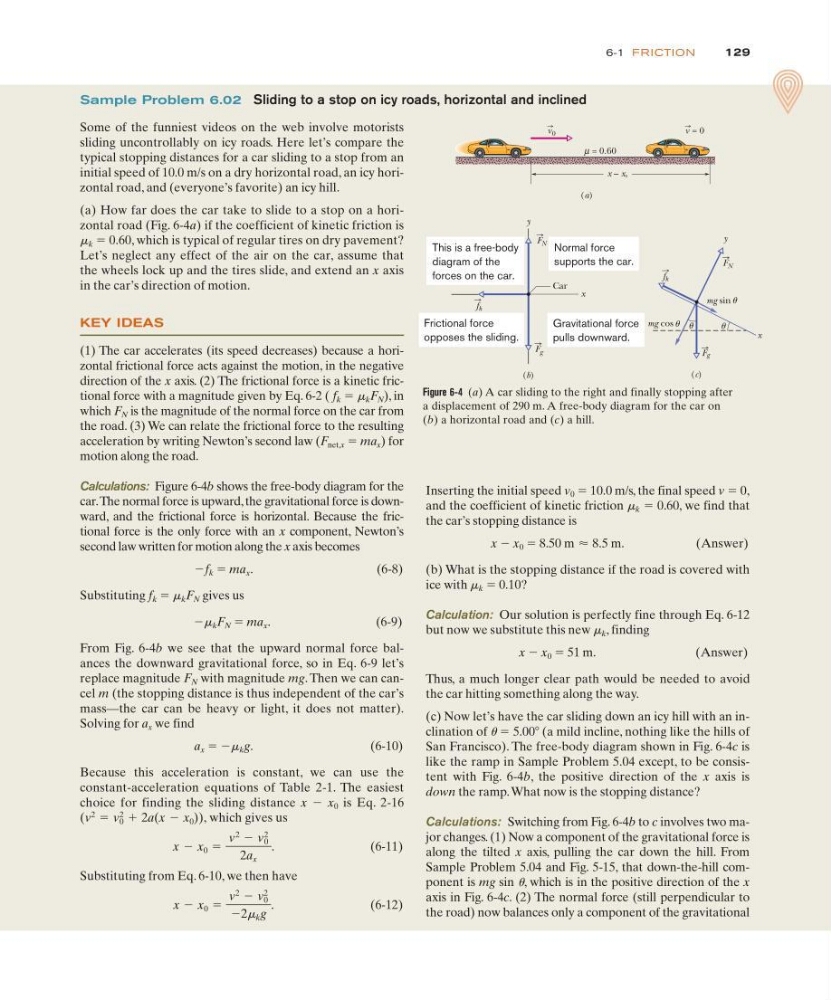
(a) How far does the car take to slide to a stop on a horizontal road (Fig. 6-4a) if the coefficient of kinetic friction is
m k ϭ 0.60, which is typical of regular tires on dry pavement?
Let’s neglect any effect of the air on the car, assume that
the wheels lock up and the tires slide, and extend an x axis
in the car’s direction of motion.
KEY IDEAS
(1) The car accelerates (its speed decreases) because a horizontal frictional force acts against the motion, in the negative
direction of the x axis. (2) The frictional force is a kinetic frictional force with a magnitude given by Eq. 6-2 ( f k ϭ m k F N ), in
which F N is the magnitude of the normal force on the car from
the road. (3) We can relate the frictional force to the resulting
acceleration by writing Newton’s second law (F net,x ϭ ma x ) for
motion along the road.
Calculations: Figure 6-4b shows the free-body diagram for the
car.The normal force is upward, the gravitational force is downward, and the frictional force is horizontal. Because the frictional force is the only force with an x component, Newton’s
second law written for motion along the x axis becomes
Ϫf k ϭ ma x .
( 6 - 8 )
Substituting f k ϭ m k F N gives us
Ϫm k F N ϭ ma x .
( 6 - 9 )
From Fig. 6-4b we see that the upward normal force balances the downward gravitational force, so in Eq. 6-9 let’s
replace magnitude F N with magnitude mg. Then we can cancel m (the stopping distance is thus independent of the car’s
mass—the car can be heavy or light, it does not matter).
Solving for a x we find
a x ϭ Ϫm k g.
( 6 - 1 0 )
Because this acceleration is constant, we can use the
constant-acceleration equations of Table 2-1. The easiest
choice for finding the sliding distance x Ϫ x 0 is Eq. 2-16
which gives us
(6-11)
Substituting from Eq. 6-10, we then have
(6-12)
x Ϫ x 0 ϭ
v
2 Ϫ v
2
0
Ϫ2m k g
.
x Ϫ x 0 ϭ
v
2 Ϫ v
2
0
2a x
.
(v
2 ϭ v
2
0 ϩ 2a(x Ϫ x 0 )),
x – x0
v 0
= 0.60
(a)
µ
v = 0
f k
F g
F N
Car x
y
x
(b)
y
This is a free-body
diagram of the
forces on the car.
Frictional force
opposes the sliding.
Normal force
supports the car.
Gravitational force
pulls downward.
f k
F N
Fg
mg cos
(c)
u u
u
mg sin u
Figure 6-4 (a) A car sliding to the right and finally stopping after
a displacement of 290 m. A free-body diagram for the car on
(b) a horizontal road and (c) a hill.
6-1 FR ICTION
Inserting the initial speed v 0 ϭ 10.0 m/s, the final speed v ϭ 0,
and the coefficient of kinetic friction m k ϭ 0.60, we find that
the car’s stopping distance is
x Ϫ x 0 ϭ 8.50 m 8.5 m.
(Answer)
(b) What is the stopping distance if the road is covered with
ice with m k ϭ 0.10?
Calculation: Our solution is perfectly fine through Eq. 6-12
but now we substitute this new m k , finding
x Ϫ x 0 ϭ 51 m.
(Answer)
Thus, a much longer clear path would be needed to avoid
the car hitting something along the way.
(c) Now let’s have the car sliding down an icy hill with an inclination of u ϭ 5.00Њ (a mild incline, nothing like the hills of
San Francisco). The free-body diagram shown in Fig. 6-4c is
like the ramp in Sample Problem 5.04 except, to be consistent with Fig. 6-4b, the positive direction of the x axis is
down the ramp. What now is the stopping distance?
Calculations: Switching from Fig. 6-4b to c involves two major changes. (1) Now a component of the gravitational force is
along the tilted x axis, pulling the car down the hill. From
Sample Problem 5.04 and Fig. 5-15, that down-the-hill component is mg sin u, which is in the positive direction of the x
axis in Fig. 6-4c. (2) The normal force (still perpendicular to
the road) now balances only a component of the gravitational
Ϸ
Sample Problem 6.02 Sliding to a stop on icy roads, horizontal and inclined
Some of the funniest videos on the web involve motorists
sliding uncontrollably on icy roads. Here let’s compare the
typical stopping distances for a car sliding to a stop from an
initial speed of 10.0 m/s on a dry horizontal road, an icy horizontal road, and (everyone’s favorite) an icy hill.
(a) How far does the car take to slide to a stop on a horizontal road (Fig. 6-4a) if the coefficient of kinetic friction is
m k ϭ 0.60, which is typical of regular tires on dry pavement?
Let’s neglect any effect of the air on the car, assume that
the wheels lock up and the tires slide, and extend an x axis
in the car’s direction of motion.
KEY IDEAS
(1) The car accelerates (its speed decreases) because a horizontal frictional force acts against the motion, in the negative
direction of the x axis. (2) The frictional force is a kinetic frictional force with a magnitude given by Eq. 6-2 ( f k ϭ m k F N ), in
which F N is the magnitude of the normal force on the car from
the road. (3) We can relate the frictional force to the resulting
acceleration by writing Newton’s second law (F net,x ϭ ma x ) for
motion along the road.
Calculations: Figure 6-4b shows the free-body diagram for the
car.The normal force is upward, the gravitational force is downward, and the frictional force is horizontal. Because the frictional force is the only force with an x component, Newton’s
second law written for motion along the x axis becomes
Ϫf k ϭ ma x .
( 6 - 8 )
Substituting f k ϭ m k F N gives us
Ϫm k F N ϭ ma x .
( 6 - 9 )
From Fig. 6-4b we see that the upward normal force balances the downward gravitational force, so in Eq. 6-9 let’s
replace magnitude F N with magnitude mg. Then we can cancel m (the stopping distance is thus independent of the car’s
mass—the car can be heavy or light, it does not matter).
Solving for a x we find
a x ϭ Ϫm k g.
( 6 - 1 0 )
Because this acceleration is constant, we can use the
constant-acceleration equations of Table 2-1. The easiest
choice for finding the sliding distance x Ϫ x 0 is Eq. 2-16
which gives us
(6-11)
Substituting from Eq. 6-10, we then have
(6-12)
x Ϫ x 0 ϭ
v
2 Ϫ v
2
0
Ϫ2m k g
.
x Ϫ x 0 ϭ
v
2 Ϫ v
2
0
2a x
.
(v
2 ϭ v
2
0 ϩ 2a(x Ϫ x 0 )),
x – x0
v 0
= 0.60
(a)
µ
v = 0
f k
F g
F N
Car x
y
x
(b)
y
This is a free-body
diagram of the
forces on the car.
Frictional force
opposes the sliding.
Normal force
supports the car.
Gravitational force
pulls downward.
f k
F N
Fg
mg cos
(c)
u u
u
mg sin u
Figure 6-4 (a) A car sliding to the right and finally stopping after
a displacement of 290 m. A free-body diagram for the car on
(b) a horizontal road and (c) a hill.