

128
CHAPTE R 6 FORCE AN D M OTION—I I
Checkpoint 1
A block lies on a floor. (a) What is the magnitude of the frictional force on it from the
floor? (b) If a horizontal force of 5 N is now applied to the block, but the block does
not move, what is the magnitude of the frictional force on it? (c) If the maximum
value f s,max of the static frictional force on the block is 10 N, will the block move if the
magnitude of the horizontally applied force is 8 N? (d) If it is 12 N? (e) What is the
magnitude of the frictional force in part (c)?
ond law as
F N Ϫ mg Ϫ F sin u ϭ m(0),
(6-4)
which gives us
F N ϭ mg ϩ F sin u.
( 6 - 5 )
Now we can evaluate f s,max ϭ m s F N :
f s,max ϭ m s (mg ϩ F sin u)
ϭ (0.700)((8.00 kg)(9.8 m/s
2
) ϩ (12.0 N)(sin 30Њ))
ϭ 59.08 N.
(6-6)
Because the magnitude F x (ϭ 10.39 N) of the force component attempting to slide the block is less than f s,max
(ϭ 59.08 N), the block remains stationary. That means that
the magnitude f s of the frictional force matches F x . From
Fig. 6-3d, we can write Newton’s second law for x components as
F x Ϫ f s ϭ m(0),
(6-7)
and thus
f s ϭ F x ϭ 10.39 N 10.4 N.
(Answer)
Ϸ
Sample Problem 6.01 Angled force applied to an initially stationary block
This sample problem involves a tilted applied force,
which requires that we work with components to find a
frictional force. The main challenge is to sort out all the
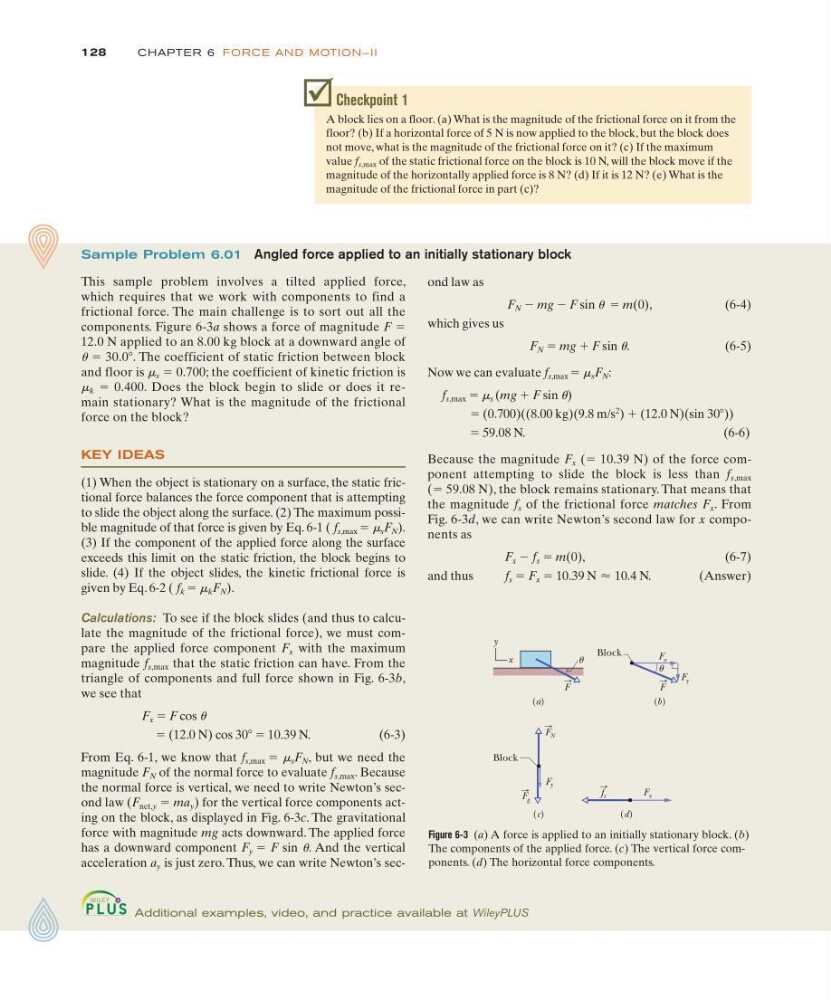
components. Figure 6-3a shows a force of magnitude F ϭ
12.0 N applied to an 8.00 kg block at a downward angle of
u ϭ 30.0Њ. The coefficient of static friction between block
and floor is m s ϭ 0.700; the coefficient of kinetic friction is
m k ϭ 0.400. Does the block begin to slide or does it remain stationary? What is the magnitude of the frictional
force on the block?
KEY IDEAS
(1) When the object is stationary on a surface, the static frictional force balances the force component that is attempting
to slide the object along the surface. (2) The maximum possible magnitude of that force is given by Eq. 6-1 ( f s,max ϭ m s F N ).
(3) If the component of the applied force along the surface
exceeds this limit on the static friction, the block begins to
slide. (4) If the object slides, the kinetic frictional force is
given by Eq. 6-2 ( f k ϭ m k F N ).
Calculations: To see if the block slides (and thus to calculate the magnitude of the frictional force), we must compare the applied force component F x with the maximum
magnitude f s,max that the static friction can have. From the
triangle of components and full force shown in Fig. 6-3b,
we see that
F x ϭ F cos u
ϭ (12.0 N) cos 30Њ ϭ 10.39 N.
(6-3)
From Eq. 6-1, we know that f s,max ϭ m s F N , but we need the
magnitude F N of the normal force to evaluate f s,max . Because
the normal force is vertical, we need to write Newton’s second law (F net,y ϭ ma y ) for the vertical force components acting on the block, as displayed in Fig. 6-3c. The gravitational
force with magnitude mg acts downward. The applied force
has a downward component F y ϭ F sin u. And the vertical
acceleration a y is just zero. Thus, we can write Newton’s secF
y
x
u
(a)
(c)
F g
F y
F N
Block
Block
u
F
F y
F x
(b)
f s
F x
(d)
Figure 6-3 (a) A force is applied to an initially stationary block. (b)
The components of the applied force. (c) The vertical force components. (d) The horizontal force components.
Additional examples, video, and practice available at WileyPLUS
CHAPTE R 6 FORCE AN D M OTION—I I
Checkpoint 1
A block lies on a floor. (a) What is the magnitude of the frictional force on it from the
floor? (b) If a horizontal force of 5 N is now applied to the block, but the block does
not move, what is the magnitude of the frictional force on it? (c) If the maximum
value f s,max of the static frictional force on the block is 10 N, will the block move if the
magnitude of the horizontally applied force is 8 N? (d) If it is 12 N? (e) What is the
magnitude of the frictional force in part (c)?
ond law as
F N Ϫ mg Ϫ F sin u ϭ m(0),
(6-4)
which gives us
F N ϭ mg ϩ F sin u.
( 6 - 5 )
Now we can evaluate f s,max ϭ m s F N :
f s,max ϭ m s (mg ϩ F sin u)
ϭ (0.700)((8.00 kg)(9.8 m/s
2
) ϩ (12.0 N)(sin 30Њ))
ϭ 59.08 N.
(6-6)
Because the magnitude F x (ϭ 10.39 N) of the force component attempting to slide the block is less than f s,max
(ϭ 59.08 N), the block remains stationary. That means that
the magnitude f s of the frictional force matches F x . From
Fig. 6-3d, we can write Newton’s second law for x components as
F x Ϫ f s ϭ m(0),
(6-7)
and thus
f s ϭ F x ϭ 10.39 N 10.4 N.
(Answer)
Ϸ
Sample Problem 6.01 Angled force applied to an initially stationary block
This sample problem involves a tilted applied force,
which requires that we work with components to find a
frictional force. The main challenge is to sort out all the
components. Figure 6-3a shows a force of magnitude F ϭ
12.0 N applied to an 8.00 kg block at a downward angle of
u ϭ 30.0Њ. The coefficient of static friction between block
and floor is m s ϭ 0.700; the coefficient of kinetic friction is
m k ϭ 0.400. Does the block begin to slide or does it remain stationary? What is the magnitude of the frictional
force on the block?
KEY IDEAS
(1) When the object is stationary on a surface, the static frictional force balances the force component that is attempting
to slide the object along the surface. (2) The maximum possible magnitude of that force is given by Eq. 6-1 ( f s,max ϭ m s F N ).
(3) If the component of the applied force along the surface
exceeds this limit on the static friction, the block begins to
slide. (4) If the object slides, the kinetic frictional force is
given by Eq. 6-2 ( f k ϭ m k F N ).
Calculations: To see if the block slides (and thus to calculate the magnitude of the frictional force), we must compare the applied force component F x with the maximum
magnitude f s,max that the static friction can have. From the
triangle of components and full force shown in Fig. 6-3b,
we see that
F x ϭ F cos u
ϭ (12.0 N) cos 30Њ ϭ 10.39 N.
(6-3)
From Eq. 6-1, we know that f s,max ϭ m s F N , but we need the
magnitude F N of the normal force to evaluate f s,max . Because
the normal force is vertical, we need to write Newton’s second law (F net,y ϭ ma y ) for the vertical force components acting on the block, as displayed in Fig. 6-3c. The gravitational
force with magnitude mg acts downward. The applied force
has a downward component F y ϭ F sin u. And the vertical
acceleration a y is just zero. Thus, we can write Newton’s secF
y
x
u
(a)
(c)
F g
F y
F N
Block
Block
u
F
F y
F x
(b)
f s
F x
(d)
Figure 6-3 (a) A force is applied to an initially stationary block. (b)
The components of the applied force. (c) The vertical force components. (d) The horizontal force components.
Additional examples, video, and practice available at WileyPLUS