

75
4-4 PROJ ECTI LE M OTION
Sample Problem 4.05 Launched into the air from a water slide
One of the most dramatic videos on the web (but entirely
fictitious) supposedly shows a man sliding along a long water slide and then being launched into the air to land in a
water pool. Let’s attach some reasonable numbers to such
a flight to calculate the velocity with which the man would
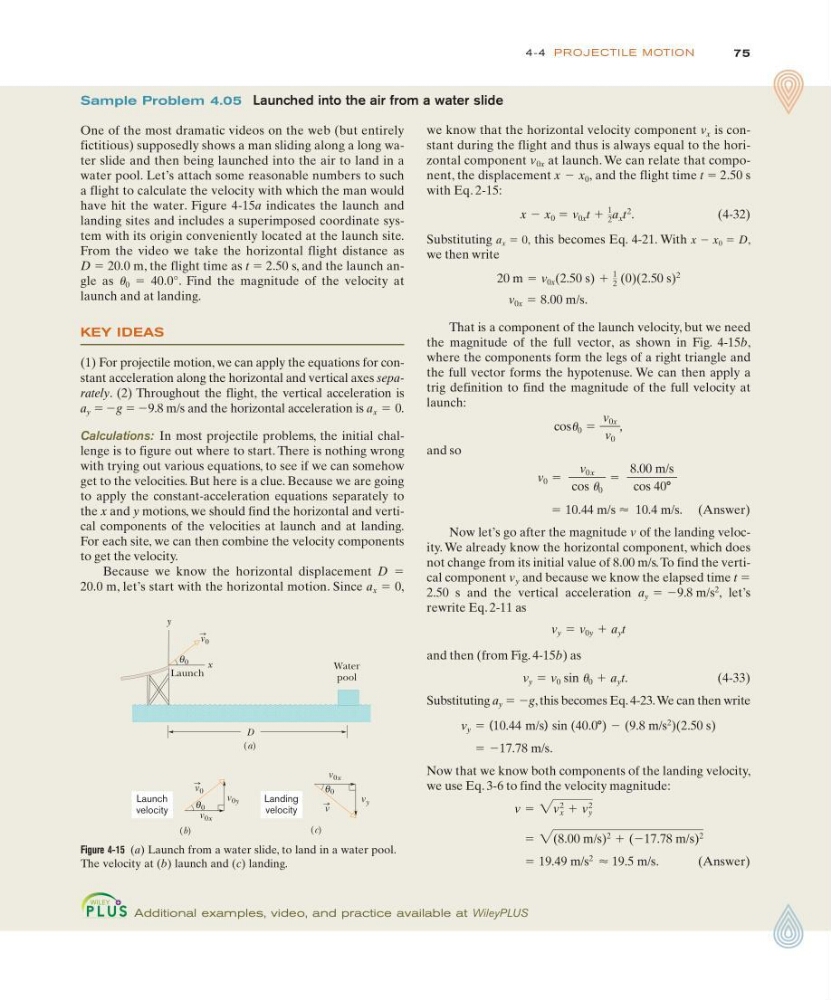
have hit the water. Figure 4-15a indicates the launch and
landing sites and includes a superimposed coordinate system with its origin conveniently located at the launch site.
From the video we take the horizontal flight distance as
D ϭ 20.0 m, the flight time as t ϭ 2.50 s, and the launch angle as 0 ϭ 40.0°. Find the magnitude of the velocity at
launch and at landing.
KEY IDEAS
(1) For projectile motion, we can apply the equations for constant acceleration along the horizontal and vertical axes separately. (2) Throughout the flight, the vertical acceleration is
a y ϭ Ϫg ϭ Ϫ9.8 m/s and the horizontal acceleration is
.
Calculations: In most projectile problems, the initial challenge is to figure out where to start. There is nothing wrong
with trying out various equations, to see if we can somehow
get to the velocities. But here is a clue. Because we are going
to apply the constant-acceleration equations separately to
the x and y motions, we should find the horizontal and vertical components of the velocities at launch and at landing.
For each site, we can then combine the velocity components
to get the velocity.
Because we know the horizontal displacement D ϭ
20.0 m, let’s start with the horizontal motion. Since
,
a x ϭ 0
a x ϭ 0
we know that the horizontal velocity component is constant during the flight and thus is always equal to the horizontal component v 0x at launch. We can relate that component, the displacement
and the flight time t ϭ 2.50 s
with Eq. 2-15:
(4-32)
Substituting
this becomes Eq. 4-21. With
we then write
That is a component of the launch velocity, but we need
the magnitude of the full vector, as shown in Fig. 4-15b,
where the components form the legs of a right triangle and
the full vector forms the hypotenuse. We can then apply a
trig definition to find the magnitude of the full velocity at
launch:
and so
(Answer)
Now let’s go after the magnitude v of the landing velocity. We already know the horizontal component, which does
not change from its initial value of 8.00 m/s. To find the vertical component v y and because we know the elapsed time t ϭ
2.50 s and the vertical acceleration
let’s
rewrite Eq. 2-11 as
and then (from Fig. 4-15b) as
(4-33)
Substituting a y ϭ Ϫg, this becomes Eq. 4-23.We can then write
Now that we know both components of the landing velocity,
we use Eq. 3-6 to find the velocity magnitude:
(Answer)
ϭ 19.49 m/s
2
Ϸ 19.5 m/s.
ϭ 2(8.00 m/s)
2 ϩ (Ϫ17.78 m/s)
2
v ϭ 2v x
2 ϩ v y
2
ϭ Ϫ17.78 m/s.
v y ϭ (10.44 m/s) sin (40.0؇) Ϫ (9.8 m/s
2
)(2.50 s)
v y ϭ v 0 sin 0 ϩ a y t.
v y ϭ v 0y ϩ a y t
a y ϭ Ϫ9.8 m/s
2
,
ϭ 10.44 m/s Ϸ 10.4 m/s.
v 0 ϭ
v 0x
cos u 0
ϭ
8.00 m/s
cos 40؇
cos 0 ϭ
v 0x
v 0
,
v 0x ϭ 8.00 m/s.
20 m ϭ v 0x (2.50 s) ϩ
1
2 (0)(2.50 s)
2
x Ϫ x 0 ϭ D,
a x ϭ 0,
x Ϫ x 0 ϭ v 0x t ϩ
1
2 a x t
2
.
x Ϫ x 0 ,
v x
D
θ 0
v 0
y
x
Launch
Water
pool
(a)
θ 0
v 0
v 0y
v 0x
θ 0
v
v y
v 0x
(b)
(c)
Landing
velocity
Launch
velocity
Figure 4-15 (a) Launch from a water slide, to land in a water pool.
The velocity at (b) launch and (c) landing.
Additional examples, video, and practice available at WileyPLUS
4-4 PROJ ECTI LE M OTION
Sample Problem 4.05 Launched into the air from a water slide
One of the most dramatic videos on the web (but entirely
fictitious) supposedly shows a man sliding along a long water slide and then being launched into the air to land in a
water pool. Let’s attach some reasonable numbers to such
a flight to calculate the velocity with which the man would
have hit the water. Figure 4-15a indicates the launch and
landing sites and includes a superimposed coordinate system with its origin conveniently located at the launch site.
From the video we take the horizontal flight distance as
D ϭ 20.0 m, the flight time as t ϭ 2.50 s, and the launch angle as 0 ϭ 40.0°. Find the magnitude of the velocity at
launch and at landing.
KEY IDEAS
(1) For projectile motion, we can apply the equations for constant acceleration along the horizontal and vertical axes separately. (2) Throughout the flight, the vertical acceleration is
a y ϭ Ϫg ϭ Ϫ9.8 m/s and the horizontal acceleration is
.
Calculations: In most projectile problems, the initial challenge is to figure out where to start. There is nothing wrong
with trying out various equations, to see if we can somehow
get to the velocities. But here is a clue. Because we are going
to apply the constant-acceleration equations separately to
the x and y motions, we should find the horizontal and vertical components of the velocities at launch and at landing.
For each site, we can then combine the velocity components
to get the velocity.
Because we know the horizontal displacement D ϭ
20.0 m, let’s start with the horizontal motion. Since
,
a x ϭ 0
a x ϭ 0
we know that the horizontal velocity component is constant during the flight and thus is always equal to the horizontal component v 0x at launch. We can relate that component, the displacement
and the flight time t ϭ 2.50 s
with Eq. 2-15:
(4-32)
Substituting
this becomes Eq. 4-21. With
we then write
That is a component of the launch velocity, but we need
the magnitude of the full vector, as shown in Fig. 4-15b,
where the components form the legs of a right triangle and
the full vector forms the hypotenuse. We can then apply a
trig definition to find the magnitude of the full velocity at
launch:
and so
(Answer)
Now let’s go after the magnitude v of the landing velocity. We already know the horizontal component, which does
not change from its initial value of 8.00 m/s. To find the vertical component v y and because we know the elapsed time t ϭ
2.50 s and the vertical acceleration
let’s
rewrite Eq. 2-11 as
and then (from Fig. 4-15b) as
(4-33)
Substituting a y ϭ Ϫg, this becomes Eq. 4-23.We can then write
Now that we know both components of the landing velocity,
we use Eq. 3-6 to find the velocity magnitude:
(Answer)
ϭ 19.49 m/s
2
Ϸ 19.5 m/s.
ϭ 2(8.00 m/s)
2 ϩ (Ϫ17.78 m/s)
2
v ϭ 2v x
2 ϩ v y
2
ϭ Ϫ17.78 m/s.
v y ϭ (10.44 m/s) sin (40.0؇) Ϫ (9.8 m/s
2
)(2.50 s)
v y ϭ v 0 sin 0 ϩ a y t.
v y ϭ v 0y ϩ a y t
a y ϭ Ϫ9.8 m/s
2
,
ϭ 10.44 m/s Ϸ 10.4 m/s.
v 0 ϭ
v 0x
cos u 0
ϭ
8.00 m/s
cos 40؇
cos 0 ϭ
v 0x
v 0
,
v 0x ϭ 8.00 m/s.
20 m ϭ v 0x (2.50 s) ϩ
1
2 (0)(2.50 s)
2
x Ϫ x 0 ϭ D,
a x ϭ 0,
x Ϫ x 0 ϭ v 0x t ϩ
1
2 a x t
2
.
x Ϫ x 0 ,
v x
D
θ 0
v 0
y
x
Launch
Water
pool
(a)
θ 0
v 0
v 0y
v 0x
θ 0
v
v y
v 0x
(b)
(c)
Landing
velocity
Launch
velocity
Figure 4-15 (a) Launch from a water slide, to land in a water pool.
The velocity at (b) launch and (c) landing.
Additional examples, video, and practice available at WileyPLUS