

74
CHAPTE R 4 MOTION IN TWO AND THREE DIM ENSIONS
Additional examples, video, and practice available at WileyPLUS
Sample Problem 4.04 Projectile dropped from airplane
Then Eq. 4-27 gives us
(Answer)
(b) As the capsule reaches the water, what is its velocity ?
KEY IDEAS
(1) The horizontal and vertical components of the capsule’s
velocity are independent. (2) Component v x does not change
from its initial value v 0x ϭ v 0 cos u 0 because there is no horizontal acceleration. (3) Component v y changes from its initial
value v 0y ϭ v 0 sin u 0 because there is a vertical acceleration.
Calculations: When the capsule reaches the water,
v x ϭ v 0 cos u 0 ϭ (55.0 m/s)(cos 0°) ϭ 55.0 m/s.
Using Eq. 4-23 and the capsule’s time of fall t ϭ 10.1 s, we
also find that when the capsule reaches the water,
v y ϭ v 0 sin u 0 Ϫ gt
ϭ (55.0 m/s)(sin 0°) Ϫ (9.8 m/s
2
)(10.1 s)
ϭ Ϫ99.0 m/s.
Thus, at the water
(Answer)
From Eq. 3-6, the magnitude and the angle of are
v ϭ 113 m/s and u ϭ Ϫ60.9°.
(Answer)
v
:
v
: ϭ (55.0 m /s)i ˆ Ϫ (99.0 m /s)j ˆ .
v
:
ϭ tan
Ϫ1
555.5 m
500 m
ϭ 48.0Њ.
In Fig. 4-14, a rescue plane flies at 198 km/h (ϭ 55.0 m/s) and
constant height h ϭ 500 m toward a point directly over a
victim, where a rescue capsule is to land.
(a) What should be the angle f of the pilot’s line of sight to
the victim when the capsule release is made?
KEY IDEAS
Once released, the capsule is a projectile, so its horizontal
and vertical motions can be considered separately (we need
not consider the actual curved path of the capsule).
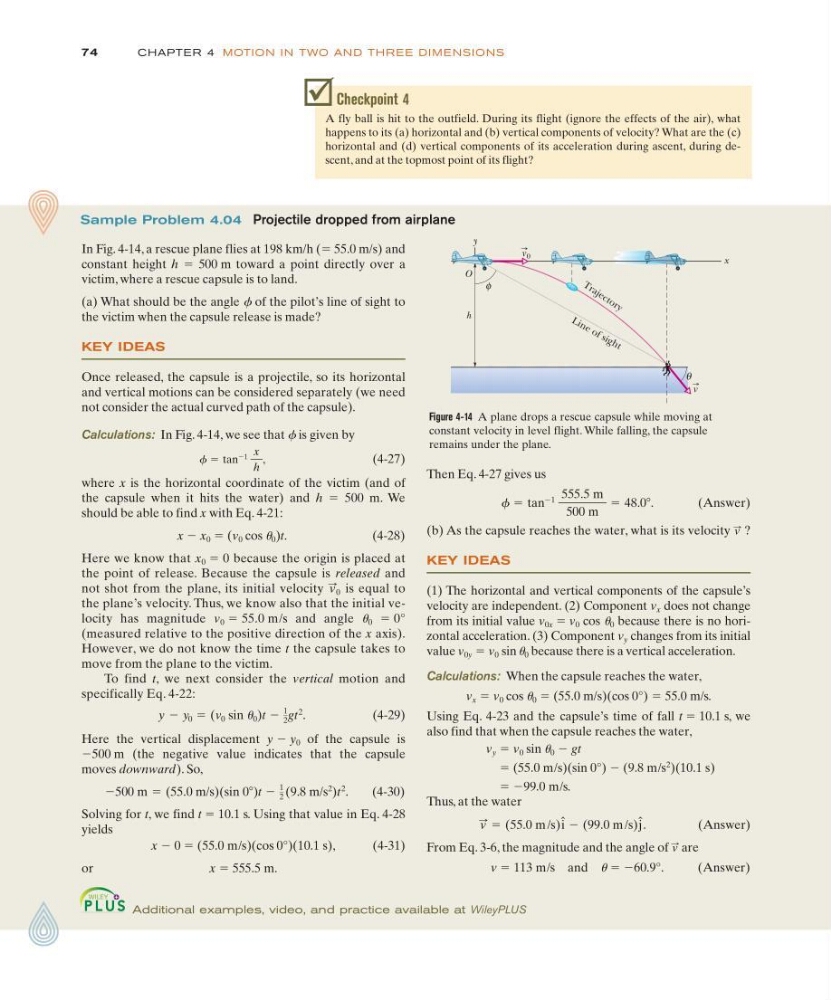
Calculations: In Fig. 4-14, we see that f is given by
(4-27)
where x is the horizontal coordinate of the victim (and of
the capsule when it hits the water) and h ϭ 500 m. We
should be able to find x with Eq. 4-21:
x Ϫ x 0 ϭ (v 0 cos u 0 )t.
( 4 - 2 8 )
Here we know that x 0 ϭ 0 because the origin is placed at
the point of release. Because the capsule is released and
not shot from the plane, its initial velocity
is equal to
the plane’s velocity. Thus, we know also that the initial velocity has magnitude v 0 ϭ 55.0 m/s and angle u 0 ϭ 0°
(measured relative to the positive direction of the x axis).
However, we do not know the time t the capsule takes to
move from the plane to the victim.
To find t, we next consider the vertical motion and
specifically Eq. 4-22:
(4-29)
Here the vertical displacement y Ϫ y 0 of the capsule is
Ϫ500 m (the negative value indicates that the capsule
moves downward). So,
(4-30)
Solving for t, we find t ϭ 10.1 s. Using that value in Eq. 4-28
yields
x Ϫ 0 ϭ (55.0 m/s)(cos 0°)(10.1 s),
(4-31)
or
x ϭ 555.5 m.
Ϫ500 m ϭ (55.0 m/s)(sin 0Њ)t Ϫ
1
2 (9.8 m/s
2
)t
2
.
y Ϫ y 0 ϭ (v 0 sin 0 )t Ϫ
1
2 gt
2
.
v
:
0
ϭ tan
Ϫ1
x
h
,
y
θ
φ
O
v 0
T r a j e c t o r y
L i n e o f s i g h t
h
x
v
Figure 4-14 A plane drops a rescue capsule while moving at
constant velocity in level flight. While falling, the capsule
remains under the plane.
Checkpoint 4
A fly ball is hit to the outfield. During its flight (ignore the effects of the air), what
happens to its (a) horizontal and (b) vertical components of velocity? What are the (c)
horizontal and (d) vertical components of its acceleration during ascent, during descent, and at the topmost point of its flight?
CHAPTE R 4 MOTION IN TWO AND THREE DIM ENSIONS
Additional examples, video, and practice available at WileyPLUS
Sample Problem 4.04 Projectile dropped from airplane
Then Eq. 4-27 gives us
(Answer)
(b) As the capsule reaches the water, what is its velocity ?
KEY IDEAS
(1) The horizontal and vertical components of the capsule’s
velocity are independent. (2) Component v x does not change
from its initial value v 0x ϭ v 0 cos u 0 because there is no horizontal acceleration. (3) Component v y changes from its initial
value v 0y ϭ v 0 sin u 0 because there is a vertical acceleration.
Calculations: When the capsule reaches the water,
v x ϭ v 0 cos u 0 ϭ (55.0 m/s)(cos 0°) ϭ 55.0 m/s.
Using Eq. 4-23 and the capsule’s time of fall t ϭ 10.1 s, we
also find that when the capsule reaches the water,
v y ϭ v 0 sin u 0 Ϫ gt
ϭ (55.0 m/s)(sin 0°) Ϫ (9.8 m/s
2
)(10.1 s)
ϭ Ϫ99.0 m/s.
Thus, at the water
(Answer)
From Eq. 3-6, the magnitude and the angle of are
v ϭ 113 m/s and u ϭ Ϫ60.9°.
(Answer)
v
:
v
: ϭ (55.0 m /s)i ˆ Ϫ (99.0 m /s)j ˆ .
v
:
ϭ tan
Ϫ1
555.5 m
500 m
ϭ 48.0Њ.
In Fig. 4-14, a rescue plane flies at 198 km/h (ϭ 55.0 m/s) and
constant height h ϭ 500 m toward a point directly over a
victim, where a rescue capsule is to land.
(a) What should be the angle f of the pilot’s line of sight to
the victim when the capsule release is made?
KEY IDEAS
Once released, the capsule is a projectile, so its horizontal
and vertical motions can be considered separately (we need
not consider the actual curved path of the capsule).
Calculations: In Fig. 4-14, we see that f is given by
(4-27)
where x is the horizontal coordinate of the victim (and of
the capsule when it hits the water) and h ϭ 500 m. We
should be able to find x with Eq. 4-21:
x Ϫ x 0 ϭ (v 0 cos u 0 )t.
( 4 - 2 8 )
Here we know that x 0 ϭ 0 because the origin is placed at
the point of release. Because the capsule is released and
not shot from the plane, its initial velocity
is equal to
the plane’s velocity. Thus, we know also that the initial velocity has magnitude v 0 ϭ 55.0 m/s and angle u 0 ϭ 0°
(measured relative to the positive direction of the x axis).
However, we do not know the time t the capsule takes to
move from the plane to the victim.
To find t, we next consider the vertical motion and
specifically Eq. 4-22:
(4-29)
Here the vertical displacement y Ϫ y 0 of the capsule is
Ϫ500 m (the negative value indicates that the capsule
moves downward). So,
(4-30)
Solving for t, we find t ϭ 10.1 s. Using that value in Eq. 4-28
yields
x Ϫ 0 ϭ (55.0 m/s)(cos 0°)(10.1 s),
(4-31)
or
x ϭ 555.5 m.
Ϫ500 m ϭ (55.0 m/s)(sin 0Њ)t Ϫ
1
2 (9.8 m/s
2
)t
2
.
y Ϫ y 0 ϭ (v 0 sin 0 )t Ϫ
1
2 gt
2
.
v
:
0
ϭ tan
Ϫ1
x
h
,
y
θ
φ
O
v 0
T r a j e c t o r y
L i n e o f s i g h t
h
x
v
Figure 4-14 A plane drops a rescue capsule while moving at
constant velocity in level flight. While falling, the capsule
remains under the plane.
Checkpoint 4
A fly ball is hit to the outfield. During its flight (ignore the effects of the air), what
happens to its (a) horizontal and (b) vertical components of velocity? What are the (c)
horizontal and (d) vertical components of its acceleration during ascent, during descent, and at the topmost point of its flight?