

Copyright © National Academy of Sciences. All rights reserved.
Solar and Space Physics: A Science for a Technological Society
60
SOLAR AND SPACE PHYSICS: A SCIENCE FOR A TECHNOLOGICAL SOCIETY
ciated ionospheric currents. These events inject plasma stored in the geomagnetic tail Earth-ward. This
plasma acts as the seed population for the radiation belts and drives the plasma waves that are responsible
for the scattering and loss of radiation belt electrons. In addition, storm-time ionospheric heating and
convection produce large changes in the neutral and plasma densities that alter ionospheric conductances
on a global scale.
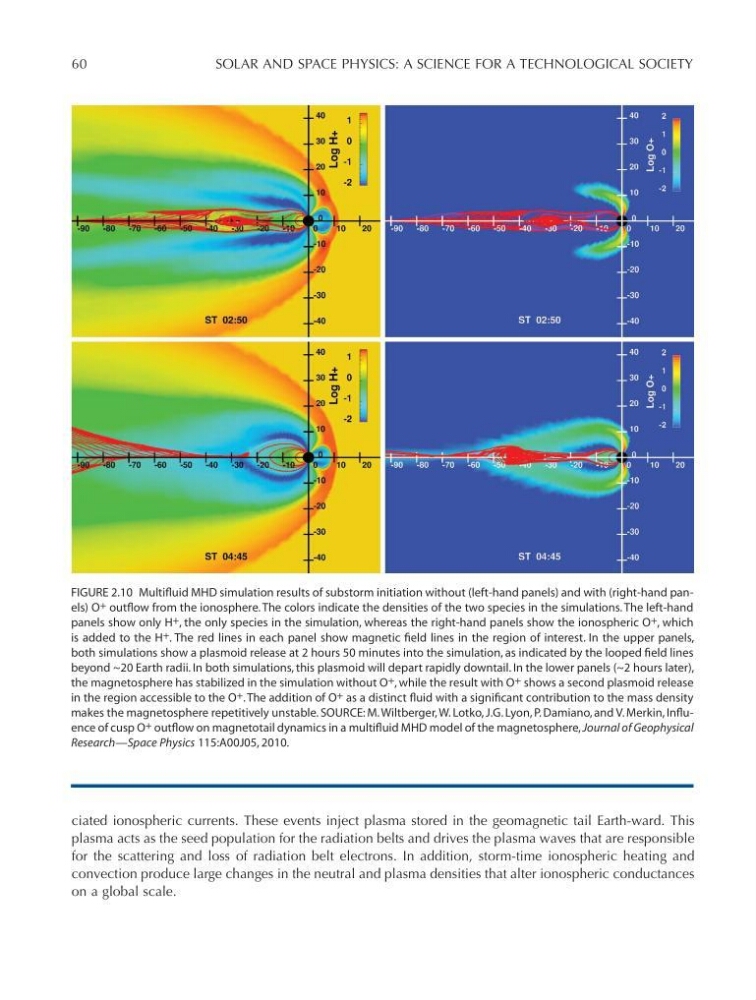
FIGURE 2.10 Multifluid MHD simulation results of substorm initiation without (left-hand panels) and with (right-hand panels) O + outflow from the ionosphere. The colors indicate the densities of the two species in the simulations. The left-hand
panels show only H + , the only species in the simulation, whereas the right-hand panels show the ionospheric O + , which
is added to the H + . The red lines in each panel show magnetic field lines in the region of interest. In the upper panels,
both simulations show a plasmoid release at 2 hours 50 minutes into the simulation, as indicated by the looped field lines
beyond ~20 Earth radii. In both simulations, this plasmoid will depart rapidly downtail. In the lower panels (~2 hours later),
the magnetosphere has stabilized in the simulation without O + , while the result with O + shows a second plasmoid release
in the region accessible to the O + . The addition of O + as a distinct fluid with a significant contribution to the mass density
makes the magnetosphere repetitively unstable. SOURCE: M. Wiltberger, W. Lotko, J.G. Lyon, P. Damiano, and V. Merkin, Influence of cusp O + outflow on magnetotail dynamics in a multifluid MHD model of the magnetosphere, Journal of Geophysical
Research—Space Physics 115:A00J05, 2010.
Figure 2-10 and 9-5
Solar and Space Physics: A Science for a Technological Society
60
SOLAR AND SPACE PHYSICS: A SCIENCE FOR A TECHNOLOGICAL SOCIETY
ciated ionospheric currents. These events inject plasma stored in the geomagnetic tail Earth-ward. This
plasma acts as the seed population for the radiation belts and drives the plasma waves that are responsible
for the scattering and loss of radiation belt electrons. In addition, storm-time ionospheric heating and
convection produce large changes in the neutral and plasma densities that alter ionospheric conductances
on a global scale.
FIGURE 2.10 Multifluid MHD simulation results of substorm initiation without (left-hand panels) and with (right-hand panels) O + outflow from the ionosphere. The colors indicate the densities of the two species in the simulations. The left-hand
panels show only H + , the only species in the simulation, whereas the right-hand panels show the ionospheric O + , which
is added to the H + . The red lines in each panel show magnetic field lines in the region of interest. In the upper panels,
both simulations show a plasmoid release at 2 hours 50 minutes into the simulation, as indicated by the looped field lines
beyond ~20 Earth radii. In both simulations, this plasmoid will depart rapidly downtail. In the lower panels (~2 hours later),
the magnetosphere has stabilized in the simulation without O + , while the result with O + shows a second plasmoid release
in the region accessible to the O + . The addition of O + as a distinct fluid with a significant contribution to the mass density
makes the magnetosphere repetitively unstable. SOURCE: M. Wiltberger, W. Lotko, J.G. Lyon, P. Damiano, and V. Merkin, Influence of cusp O + outflow on magnetotail dynamics in a multifluid MHD model of the magnetosphere, Journal of Geophysical
Research—Space Physics 115:A00J05, 2010.
Figure 2-10 and 9-5