

Copyright © National Academy of Sciences. All rights reserved.
Solar and Space Physics: A Science for a Technological Society
SOLAR AND SPACE PHYSICS: RECENT DISCOVERIES, FUTURE FRONTIERS
59
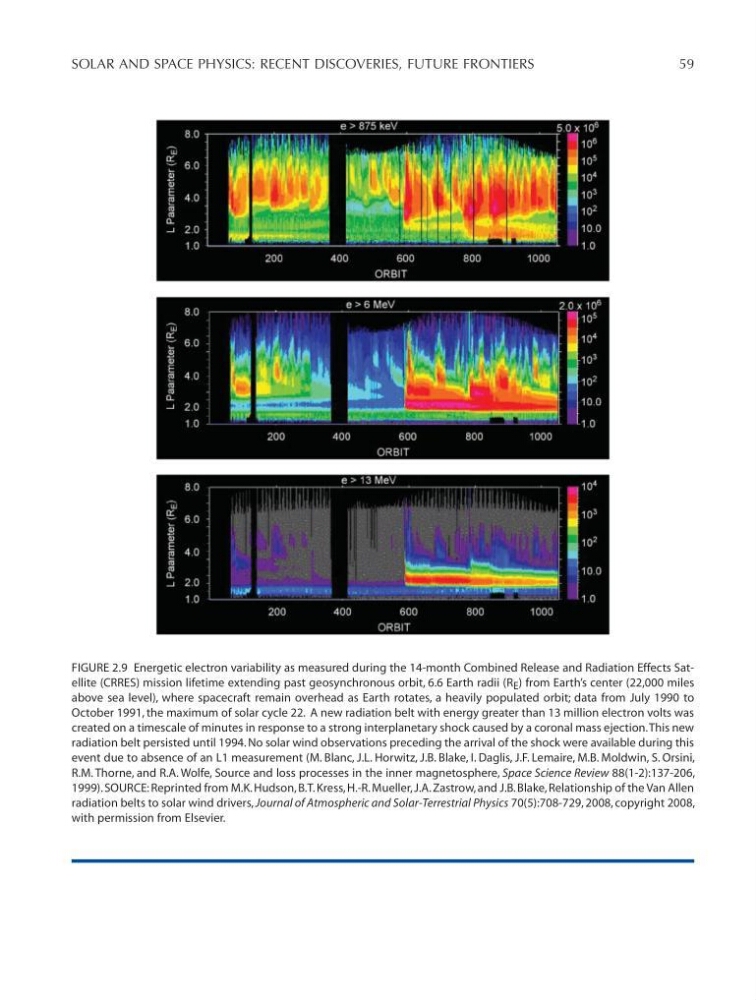
FIGURE 2.9 Energetic electron variability as measured during the 14-month Combined Release and Radiation Effects Satellite (CRRES) mission lifetime extending past geosynchronous orbit, 6.6 Earth radii (R E ) from Earth’s center (22,000 miles
above sea level), where spacecraft remain overhead as Earth rotates, a heavily populated orbit; data from July 1990 to
October 1991, the maximum of solar cycle 22. A new radiation belt with energy greater than 13 million electron volts was
created on a timescale of minutes in response to a strong interplanetary shock caused by a coronal mass ejection. This new
radiation belt persisted until 1994. No solar wind observations preceding the arrival of the shock were available during this
event due to absence of an L1 measurement (M. Blanc, J.L. Horwitz, J.B. Blake, I. Daglis, J.F. Lemaire, M.B. Moldwin, S. Orsini,
R.M. Thorne, and R.A. Wolfe, Source and loss processes in the inner magnetosphere, Space Science Review 88(1-2):137-206,
1999). SOURCE: Reprinted from M.K. Hudson, B.T. Kress, H.-R. Mueller, J.A. Zastrow, and J.B. Blake, Relationship of the Van Allen
radiation belts to solar wind drivers, Journal of Atmospheric and Solar-Terrestrial Physics 70(5):708-729, 2008, copyright 2008,
with permission from Elsevier.
Figure 2-9
Solar and Space Physics: A Science for a Technological Society
SOLAR AND SPACE PHYSICS: RECENT DISCOVERIES, FUTURE FRONTIERS
59
FIGURE 2.9 Energetic electron variability as measured during the 14-month Combined Release and Radiation Effects Satellite (CRRES) mission lifetime extending past geosynchronous orbit, 6.6 Earth radii (R E ) from Earth’s center (22,000 miles
above sea level), where spacecraft remain overhead as Earth rotates, a heavily populated orbit; data from July 1990 to
October 1991, the maximum of solar cycle 22. A new radiation belt with energy greater than 13 million electron volts was
created on a timescale of minutes in response to a strong interplanetary shock caused by a coronal mass ejection. This new
radiation belt persisted until 1994. No solar wind observations preceding the arrival of the shock were available during this
event due to absence of an L1 measurement (M. Blanc, J.L. Horwitz, J.B. Blake, I. Daglis, J.F. Lemaire, M.B. Moldwin, S. Orsini,
R.M. Thorne, and R.A. Wolfe, Source and loss processes in the inner magnetosphere, Space Science Review 88(1-2):137-206,
1999). SOURCE: Reprinted from M.K. Hudson, B.T. Kress, H.-R. Mueller, J.A. Zastrow, and J.B. Blake, Relationship of the Van Allen
radiation belts to solar wind drivers, Journal of Atmospheric and Solar-Terrestrial Physics 70(5):708-729, 2008, copyright 2008,
with permission from Elsevier.
Figure 2-9