

Copyright © National Academy of Sciences. All rights reserved.
Solar and Space Physics: A Science for a Technological Society
24
SOLAR AND SPACE PHYSICS: A SCIENCE FOR A TECHNOLOGICAL SOCIETY
Sun ejects billions of tons of material with embedded magnetic fields. These coronal mass ejections (CMEs),
when aimed at Earth, can reach our planet in less than a day at speeds more than five times that of the
background solar wind, the expanding solar atmosphere that fills the entire solar system and heliosphere.
CMEs can cause large geomagnetic storms that affect terrestrial systems such as electric power grids. They
are often associated with solar flares, the most intense explosions in the solar system.
Solar flares bathe Earth in excess radiation across the electromagnetic spectrum, but it is the intense
X-ray and ultraviolet radiation that significantly affects Earth’s dayside ionosphere and the communication
and navigation systems that are vulnerable to the state of the ionosphere. Flares release enormous energy
in minutes and can remain intense over many hours. While the largest flares occur about once per solar
cycle, several hundred per solar cycle are categorized as strong to extreme. Solar particle events are yet
another signature of the variable Sun. Relativistic-energy particles, created near the Sun and by shock
waves propagating toward Earth, can arrive at Earth in as little as 15 minutes. Historically, the most intense
events occur about once per solar cycle, whereas strong to extreme particle storms occur about 15 times
per cycle. Extreme particle storms affect human and robotic activities in space; they can also disrupt airline
operations over polar routes, and they have potentially important long-term health impacts on flight crews.
Almost every aspect of the Sun is variable and affects life on Earth.
The most recent solar minimum (comprising the end of cycle 23) was longer and deeper than any in
the past century. Cycle 24 started 13 years after cycle 23 and may be weaker than any during the space
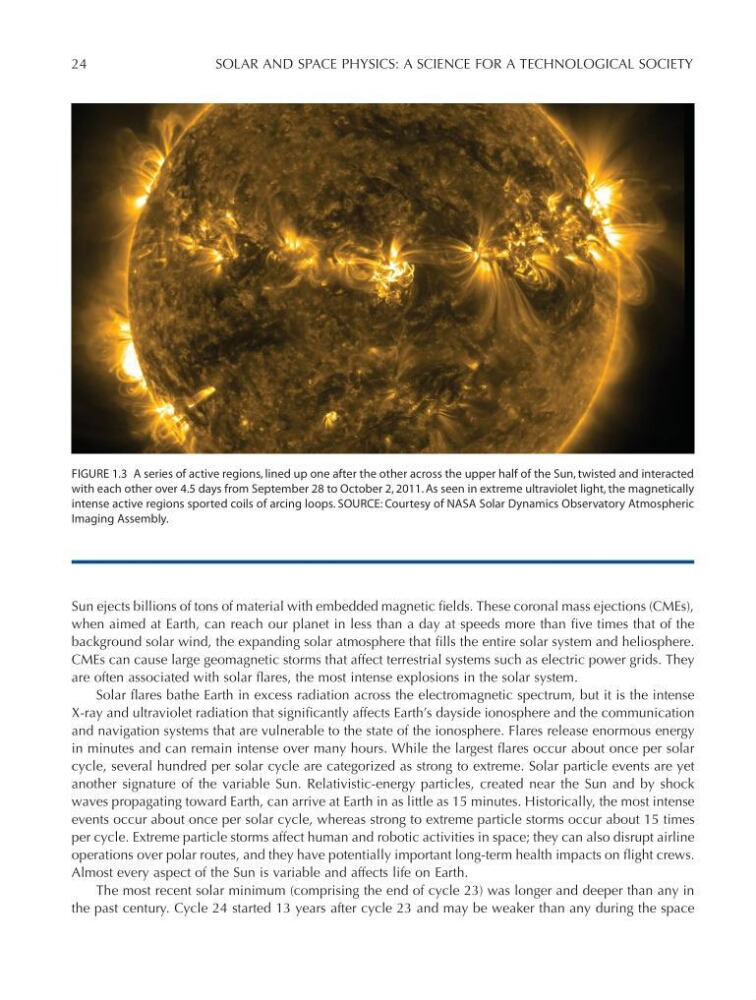
FIGURE 1.3 A series of active regions, lined up one after the other across the upper half of the Sun, twisted and interacted
with each other over 4.5 days from September 28 to October 2, 2011. As seen in extreme ultraviolet light, the magnetically
intense active regions sported coils of arcing loops. SOURCE: Courtesy of NASA Solar Dynamics Observatory Atmospheric
Imaging Assembly.
Figure 1-3
Solar and Space Physics: A Science for a Technological Society
24
SOLAR AND SPACE PHYSICS: A SCIENCE FOR A TECHNOLOGICAL SOCIETY
Sun ejects billions of tons of material with embedded magnetic fields. These coronal mass ejections (CMEs),
when aimed at Earth, can reach our planet in less than a day at speeds more than five times that of the
background solar wind, the expanding solar atmosphere that fills the entire solar system and heliosphere.
CMEs can cause large geomagnetic storms that affect terrestrial systems such as electric power grids. They
are often associated with solar flares, the most intense explosions in the solar system.
Solar flares bathe Earth in excess radiation across the electromagnetic spectrum, but it is the intense
X-ray and ultraviolet radiation that significantly affects Earth’s dayside ionosphere and the communication
and navigation systems that are vulnerable to the state of the ionosphere. Flares release enormous energy
in minutes and can remain intense over many hours. While the largest flares occur about once per solar
cycle, several hundred per solar cycle are categorized as strong to extreme. Solar particle events are yet
another signature of the variable Sun. Relativistic-energy particles, created near the Sun and by shock
waves propagating toward Earth, can arrive at Earth in as little as 15 minutes. Historically, the most intense
events occur about once per solar cycle, whereas strong to extreme particle storms occur about 15 times
per cycle. Extreme particle storms affect human and robotic activities in space; they can also disrupt airline
operations over polar routes, and they have potentially important long-term health impacts on flight crews.
Almost every aspect of the Sun is variable and affects life on Earth.
The most recent solar minimum (comprising the end of cycle 23) was longer and deeper than any in
the past century. Cycle 24 started 13 years after cycle 23 and may be weaker than any during the space
FIGURE 1.3 A series of active regions, lined up one after the other across the upper half of the Sun, twisted and interacted
with each other over 4.5 days from September 28 to October 2, 2011. As seen in extreme ultraviolet light, the magnetically
intense active regions sported coils of arcing loops. SOURCE: Courtesy of NASA Solar Dynamics Observatory Atmospheric
Imaging Assembly.
Figure 1-3