

Copyright © National Academy of Sciences. All rights reserved.
Solar and Space Physics: A Science for a Technological Society
APPENDIX E
377
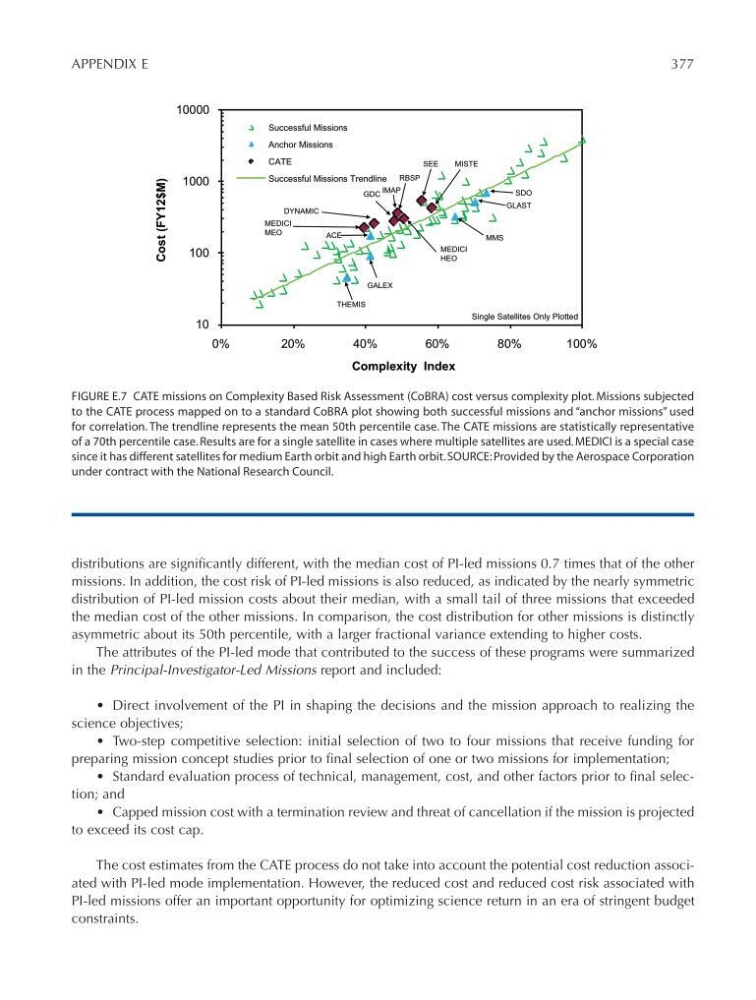
FIGURE E.7 CATE missions on Complexity Based Risk Assessment (CoBRA) cost versus complexity plot. Missions subjected
to the CATE process mapped on to a standard CoBRA plot showing both successful missions and “anchor missions” used
for correlation. The trendline represents the mean 50th percentile case. The CATE missions are statistically representative
of a 70th percentile case. Results are for a single satellite in cases where multiple satellites are used. MEDICI is a special case
since it has different satellites for medium Earth orbit and high Earth orbit. SOURCE: Provided by the Aerospace Corporation
under contract with the National Research Council.
10
100
1000
10000
0%
20%
4 0%
60%
8 0%
100%
Cost (FY12$M)
Complexity Index
Successful Missions
Anchor Missions
CATE
Successful Missions Trendline
MEDICI
MEO
SEE
MEDICI
HEO
DYNAMIC
IMAP
GDC
MISTE
MMS
RBSP
ACE
GALEX
THEMIS
SDO
GLAST
Single Satellites Only Plotted
Figure E-7
distributions are significantly different, with the median cost of PI-led missions 0.7 times that of the other
missions. In addition, the cost risk of PI-led missions is also reduced, as indicated by the nearly symmetric
distribution of PI-led mission costs about their median, with a small tail of three missions that exceeded
the median cost of the other missions. In comparison, the cost distribution for other missions is distinctly
asymmetric about its 50th percentile, with a larger fractional variance extending to higher costs.
The attributes of the PI-led mode that contributed to the success of these programs were summarized
in the Principal-Investigator-Led Missions report and included:
• Direct involvement of the PI in shaping the decisions and the mission approach to realizing the
science objectives;
• Two-step competitive selection: initial selection of two to four missions that receive funding for
preparing mission concept studies prior to final selection of one or two missions for implementation;
• Standard evaluation process of technical, management, cost, and other factors prior to final selection; and
• Capped mission cost with a termination review and threat of cancellation if the mission is projected
to exceed its cost cap.
The cost estimates from the CATE process do not take into account the potential cost reduction associated with PI-led mode implementation. However, the reduced cost and reduced cost risk associated with
PI-led missions offer an important opportunity for optimizing science return in an era of stringent budget
constraints.
Solar and Space Physics: A Science for a Technological Society
APPENDIX E
377
FIGURE E.7 CATE missions on Complexity Based Risk Assessment (CoBRA) cost versus complexity plot. Missions subjected
to the CATE process mapped on to a standard CoBRA plot showing both successful missions and “anchor missions” used
for correlation. The trendline represents the mean 50th percentile case. The CATE missions are statistically representative
of a 70th percentile case. Results are for a single satellite in cases where multiple satellites are used. MEDICI is a special case
since it has different satellites for medium Earth orbit and high Earth orbit. SOURCE: Provided by the Aerospace Corporation
under contract with the National Research Council.
10
100
1000
10000
0%
20%
4 0%
60%
8 0%
100%
Cost (FY12$M)
Complexity Index
Successful Missions
Anchor Missions
CATE
Successful Missions Trendline
MEDICI
MEO
SEE
MEDICI
HEO
DYNAMIC
IMAP
GDC
MISTE
MMS
RBSP
ACE
GALEX
THEMIS
SDO
GLAST
Single Satellites Only Plotted
Figure E-7
distributions are significantly different, with the median cost of PI-led missions 0.7 times that of the other
missions. In addition, the cost risk of PI-led missions is also reduced, as indicated by the nearly symmetric
distribution of PI-led mission costs about their median, with a small tail of three missions that exceeded
the median cost of the other missions. In comparison, the cost distribution for other missions is distinctly
asymmetric about its 50th percentile, with a larger fractional variance extending to higher costs.
The attributes of the PI-led mode that contributed to the success of these programs were summarized
in the Principal-Investigator-Led Missions report and included:
• Direct involvement of the PI in shaping the decisions and the mission approach to realizing the
science objectives;
• Two-step competitive selection: initial selection of two to four missions that receive funding for
preparing mission concept studies prior to final selection of one or two missions for implementation;
• Standard evaluation process of technical, management, cost, and other factors prior to final selection; and
• Capped mission cost with a termination review and threat of cancellation if the mission is projected
to exceed its cost cap.
The cost estimates from the CATE process do not take into account the potential cost reduction associated with PI-led mode implementation. However, the reduced cost and reduced cost risk associated with
PI-led missions offer an important opportunity for optimizing science return in an era of stringent budget
constraints.