

Copyright © National Academy of Sciences. All rights reserved.
Solar and Space Physics: A Science for a Technological Society
306
SOLAR AND SPACE PHYSICS: A SCIENCE FOR A TECHNOLOGICAL SOCIETY
altitudes, including the SEP seed population down to about 4 keV, with about 1,000 times STEREO’s sensitivity. ENASI should also detect ENAs from ions accelerated in impulsive SEP events in the corona.
• Gamma-Ray Imaging Spectrometer (GRIS). Provides imaging of a few to hundreds of millions of
electron-volt flare-accelerated ions through their gamma-ray line emissions with sufficient spatial resolution (about 7 arcsec), spectral resolution (a few thousand-electron-volt FWHM), and sensitivity to follow
the evolution of the ion footpoints, even for normal-size flares.
• UV-EUV Imaging Spectrometer (EUVIS). Provides measurements of the ambient density, electron
and ion temperatures, ionization states, composition, and flow and turbulent velocities in the flare energyrelease particle-acceleration region with high-cadence imaging (less than about 10 arcsec) spectroscopy
(l/Dl over 3,000) up to about 1.2 R S . EUVIS should also detect downward-going protons accelerated over
10 keV through their redshifted Lyman alpha emission.
• UV Coronagraph Spectrometer (UVCS II). Provides the same measurements as EUVIS but from about
1.2 to 10 R S .
• White-Light Coronagraph (WLC). Provides imaging of CME structure and evolution from 1.5 to 15 R s .
SEE would operate autonomously in a store-and-dump mode (like RHESSI) with a large onboard
memory. Some SEE measurements (such as HXR or ENA of near-Sun SEP intensities) may be good precursors of these major eruptions; near-real-time data could be downlinked for space weather warnings.
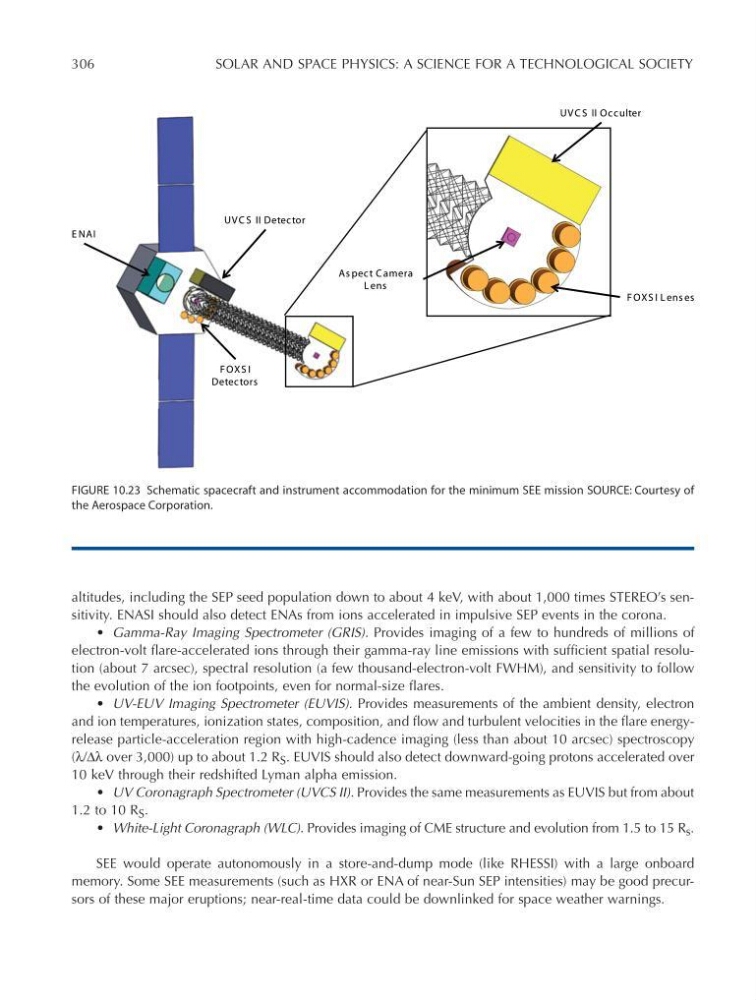
FIGURE 10.23 Schematic spacecraft and instrument accommodation for the minimum SEE mission SOURCE: Courtesy of
the Aerospace Corporation.
E NAI
F OXS I
Detectors
UV C S II Detector
F OXS I L ens es
As pect C amera
L ens
UV C S II Occulter
Figure 10-23
Solar and Space Physics: A Science for a Technological Society
306
SOLAR AND SPACE PHYSICS: A SCIENCE FOR A TECHNOLOGICAL SOCIETY
altitudes, including the SEP seed population down to about 4 keV, with about 1,000 times STEREO’s sensitivity. ENASI should also detect ENAs from ions accelerated in impulsive SEP events in the corona.
• Gamma-Ray Imaging Spectrometer (GRIS). Provides imaging of a few to hundreds of millions of
electron-volt flare-accelerated ions through their gamma-ray line emissions with sufficient spatial resolution (about 7 arcsec), spectral resolution (a few thousand-electron-volt FWHM), and sensitivity to follow
the evolution of the ion footpoints, even for normal-size flares.
• UV-EUV Imaging Spectrometer (EUVIS). Provides measurements of the ambient density, electron
and ion temperatures, ionization states, composition, and flow and turbulent velocities in the flare energyrelease particle-acceleration region with high-cadence imaging (less than about 10 arcsec) spectroscopy
(l/Dl over 3,000) up to about 1.2 R S . EUVIS should also detect downward-going protons accelerated over
10 keV through their redshifted Lyman alpha emission.
• UV Coronagraph Spectrometer (UVCS II). Provides the same measurements as EUVIS but from about
1.2 to 10 R S .
• White-Light Coronagraph (WLC). Provides imaging of CME structure and evolution from 1.5 to 15 R s .
SEE would operate autonomously in a store-and-dump mode (like RHESSI) with a large onboard
memory. Some SEE measurements (such as HXR or ENA of near-Sun SEP intensities) may be good precursors of these major eruptions; near-real-time data could be downlinked for space weather warnings.
FIGURE 10.23 Schematic spacecraft and instrument accommodation for the minimum SEE mission SOURCE: Courtesy of
the Aerospace Corporation.
E NAI
F OXS I
Detectors
UV C S II Detector
F OXS I L ens es
As pect C amera
L ens
UV C S II Occulter
Figure 10-23