

Copyright © National Academy of Sciences. All rights reserved.
Solar and Space Physics: A Science for a Technological Society
REPORT OF THE PANEL ON SOLAR AND HELIOSPHERIC PHYSICS
305
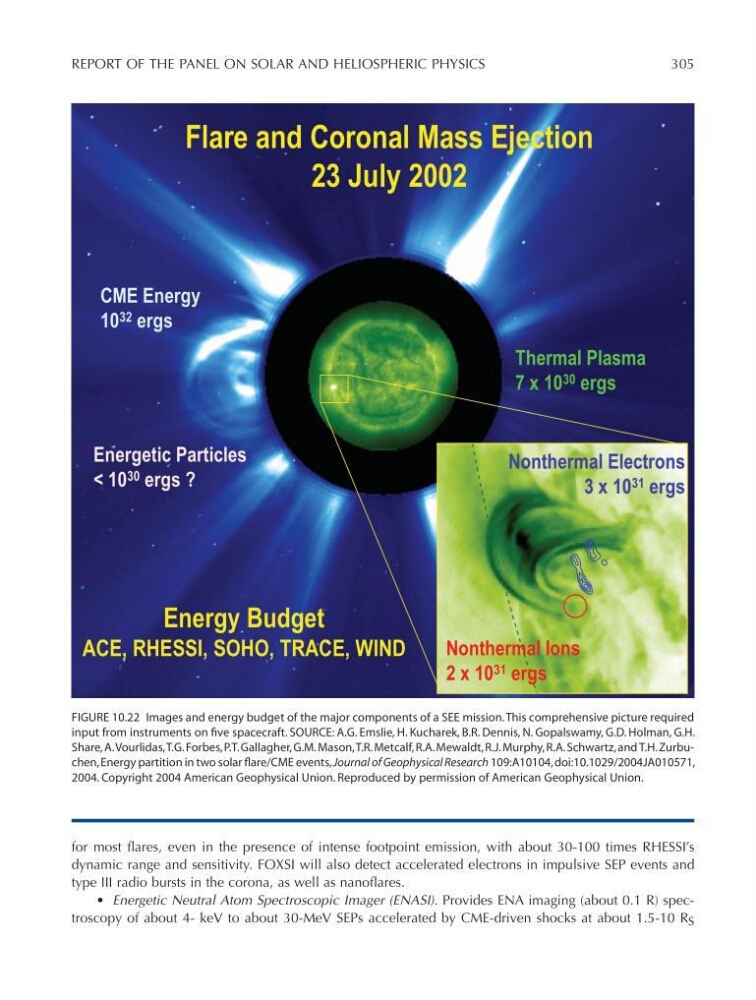
FIGURE 10.22 Images and energy budget of the major components of a SEE mission. This comprehensive picture required
input from instruments on five spacecraft. SOURCE: A.G. Emslie, H. Kucharek, B.R. Dennis, N. Gopalswamy, G.D. Holman, G.H.
Share, A. Vourlidas, T.G. Forbes, P.T. Gallagher, G.M. Mason, T.R. Metcalf, R.A. Mewaldt, R.J. Murphy, R.A. Schwartz, and T.H. Zurbuchen, Energy partition in two solar flare/CME events, Journal of Geophysical Research 109:A10104, doi:10.1029/2004JA010571,
2004. Copyright 2004 American Geophysical Union. Reproduced by permission of American Geophysical Union.
for most flares, even in the presence of intense footpoint emission, with about 30-100 times RHESSI’s
dynamic range and sensitivity. FOXSI will also detect accelerated electrons in impulsive SEP events and
type III radio bursts in the corona, as well as nanoflares.
• Energetic Neutral Atom Spectroscopic Imager (ENASI). Provides ENA imaging (about 0.1 R) spectroscopy of about 4- keV to about 30-MeV SEPs accelerated by CME-driven shocks at about 1.5-10 R S
Figure 10-22
Solar and Space Physics: A Science for a Technological Society
REPORT OF THE PANEL ON SOLAR AND HELIOSPHERIC PHYSICS
305
FIGURE 10.22 Images and energy budget of the major components of a SEE mission. This comprehensive picture required
input from instruments on five spacecraft. SOURCE: A.G. Emslie, H. Kucharek, B.R. Dennis, N. Gopalswamy, G.D. Holman, G.H.
Share, A. Vourlidas, T.G. Forbes, P.T. Gallagher, G.M. Mason, T.R. Metcalf, R.A. Mewaldt, R.J. Murphy, R.A. Schwartz, and T.H. Zurbuchen, Energy partition in two solar flare/CME events, Journal of Geophysical Research 109:A10104, doi:10.1029/2004JA010571,
2004. Copyright 2004 American Geophysical Union. Reproduced by permission of American Geophysical Union.
for most flares, even in the presence of intense footpoint emission, with about 30-100 times RHESSI’s
dynamic range and sensitivity. FOXSI will also detect accelerated electrons in impulsive SEP events and
type III radio bursts in the corona, as well as nanoflares.
• Energetic Neutral Atom Spectroscopic Imager (ENASI). Provides ENA imaging (about 0.1 R) spectroscopy of about 4- keV to about 30-MeV SEPs accelerated by CME-driven shocks at about 1.5-10 R S
Figure 10-22