

Copyright © National Academy of Sciences. All rights reserved.
Solar and Space Physics: A Science for a Technological Society
302
SOLAR AND SPACE PHYSICS: A SCIENCE FOR A TECHNOLOGICAL SOCIETY
• Underlying time variations of ubiquitous suprathermal ions;
• SEP composition, injection, and acceleration;
• Suprathermal and energetic-particle transport;
• ACR/GCR modulation and evolution with time; and
• L1 environmental monitoring and solar wind input for magnetospheric and atmospheric science.
IMAP spacecraft and instrument implementation is based largely on ACE with ENA imaging infused
from IBEX. IMAP is a Sun-pointed spinner, with spin-axis readjustment every few days to provide all-sky
maps every 6 months. The L1 placement avoids magnetospheric ENA backgrounds and allows continuous
interplanetary observations. Mission goals are achieved with a 2-year baseline, including transit to L1, with
possible extension to longer operation. IMAP combines the following measurement capabilities, for which
no further development effort is required:
• High-resolution ENA maps. Two ENA cameras produce new ENA observations of the heliospheric
boundary over an extended energy range (0.3-20 keV, 3-200 keV) with substantially improved sensitivity
(≈80 times the combined sensitivity and duty cycle of IBEX-Hi and CASSINI/INCA), spatial (10 times the
IBEX-Hi angular resolution), and energy and time resolution (for example, oversampling of polar regions
with few-day time resolution) compared with prior observations.
• High-resolution and high-sensitivity ISM flow collection. An ISM neutral atom camera and the first
dedicated PUI sensor will take coordinated high-sensitivity observations of the interstellar gas flow through
the inner solar system. The ISM neutral camera provides ISM flow observations of H, D, He, O, and Ne
at 5-1,000 eV with pointing knowledge of 0.05° and over 10 times the combined sensitivity or duty cycle
of IBEX-Lo, also extending the ENA maps to <0.3 keV. The PUI sensor provides distributions of interstellar
H + , 3 He + , 4 He + , N + , O + , 20 Ne + , 22 Ne + , and Ar + and inner-source C + , O + , Mg + , and Si + over 100 eV to
100 keV/e with a combined sensitivity or duty cycle 100 times that of SWICS, also providing solar wind
heavy-ion composition.
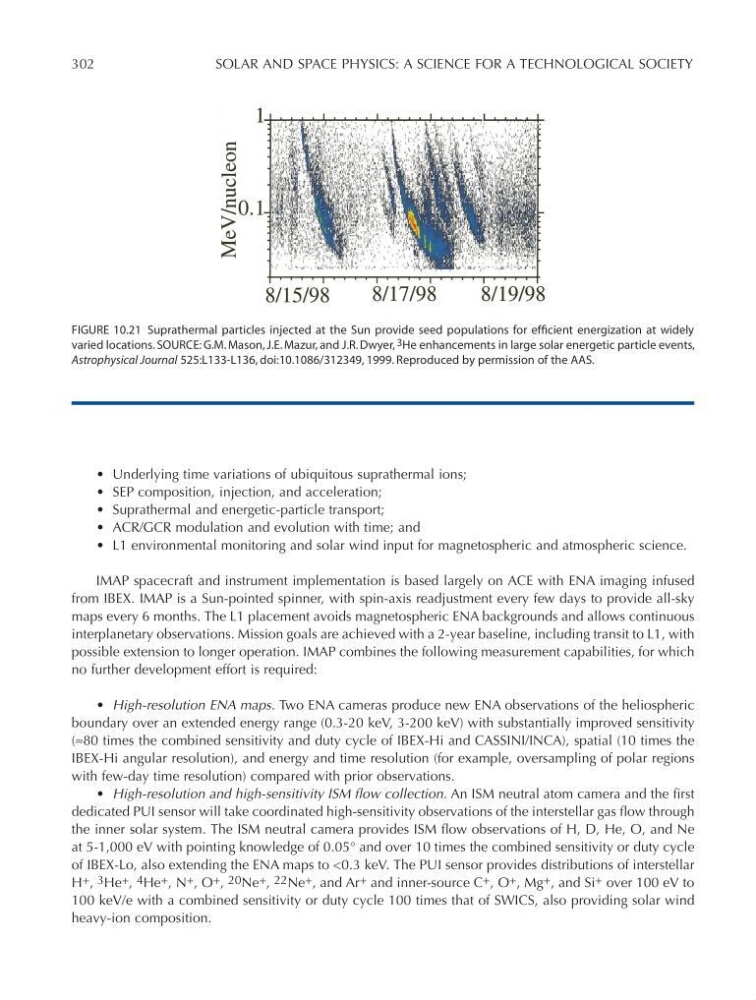
FIGURE 10.21 Suprathermal particles injected at the Sun provide seed populations for efficient energization at widely
varied locations. SOURCE: G.M. Mason, J.E. Mazur, and J.R. Dwyer, 3 He enhancements in large solar energetic particle events,
Astrophysical Journal 525:L133-L136, doi:10.1086/312349, 1999. Reproduced by permission of the AAS.
Figure 10-21
Solar and Space Physics: A Science for a Technological Society
302
SOLAR AND SPACE PHYSICS: A SCIENCE FOR A TECHNOLOGICAL SOCIETY
• Underlying time variations of ubiquitous suprathermal ions;
• SEP composition, injection, and acceleration;
• Suprathermal and energetic-particle transport;
• ACR/GCR modulation and evolution with time; and
• L1 environmental monitoring and solar wind input for magnetospheric and atmospheric science.
IMAP spacecraft and instrument implementation is based largely on ACE with ENA imaging infused
from IBEX. IMAP is a Sun-pointed spinner, with spin-axis readjustment every few days to provide all-sky
maps every 6 months. The L1 placement avoids magnetospheric ENA backgrounds and allows continuous
interplanetary observations. Mission goals are achieved with a 2-year baseline, including transit to L1, with
possible extension to longer operation. IMAP combines the following measurement capabilities, for which
no further development effort is required:
• High-resolution ENA maps. Two ENA cameras produce new ENA observations of the heliospheric
boundary over an extended energy range (0.3-20 keV, 3-200 keV) with substantially improved sensitivity
(≈80 times the combined sensitivity and duty cycle of IBEX-Hi and CASSINI/INCA), spatial (10 times the
IBEX-Hi angular resolution), and energy and time resolution (for example, oversampling of polar regions
with few-day time resolution) compared with prior observations.
• High-resolution and high-sensitivity ISM flow collection. An ISM neutral atom camera and the first
dedicated PUI sensor will take coordinated high-sensitivity observations of the interstellar gas flow through
the inner solar system. The ISM neutral camera provides ISM flow observations of H, D, He, O, and Ne
at 5-1,000 eV with pointing knowledge of 0.05° and over 10 times the combined sensitivity or duty cycle
of IBEX-Lo, also extending the ENA maps to <0.3 keV. The PUI sensor provides distributions of interstellar
H + , 3 He + , 4 He + , N + , O + , 20 Ne + , 22 Ne + , and Ar + and inner-source C + , O + , Mg + , and Si + over 100 eV to
100 keV/e with a combined sensitivity or duty cycle 100 times that of SWICS, also providing solar wind
heavy-ion composition.
FIGURE 10.21 Suprathermal particles injected at the Sun provide seed populations for efficient energization at widely
varied locations. SOURCE: G.M. Mason, J.E. Mazur, and J.R. Dwyer, 3 He enhancements in large solar energetic particle events,
Astrophysical Journal 525:L133-L136, doi:10.1086/312349, 1999. Reproduced by permission of the AAS.
Figure 10-21