

Copyright © National Academy of Sciences. All rights reserved.
Solar and Space Physics: A Science for a Technological Society
REPORT OF THE PANEL ON SOLAR AND HELIOSPHERIC PHYSICS
301
• Properties of interstellar neutral gas flow and its composition for H (including isotopes), He, O, and
Ne (also to address big bang cosmology with the first in situ D/H observations) and properties of the outer
heliosheath;
• PUI composition (implications for big bang cosmology and nucleosynthesis with a dedicated PUI
instrument: He 3 /He 4 and Ne 22 /Ne 20 with better than 5 percent accuracy);
• Seed populations of energetic particles with high time resolution (several minutes) (Figure 10.21);
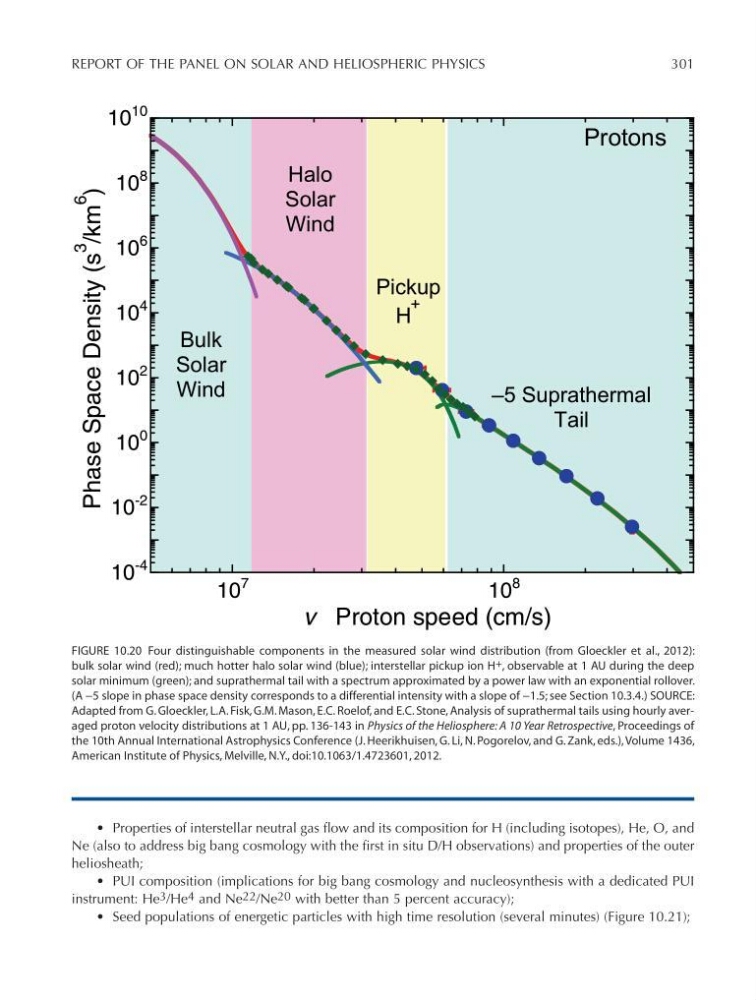
FIGURE 10.20 Four distinguishable components in the measured solar wind distribution (from Gloeckler et al., 2012):
bulk solar wind (red); much hotter halo solar wind (blue); interstellar pickup ion H + , observable at 1 AU during the deep
solar minimum (green); and suprathermal tail with a spectrum approximated by a power law with an exponential rollover.
(A −5 slope in phase space density corresponds to a differential intensity with a slope of −1.5; see Section 10.3.4.) SOURCE:
Adapted from G. Gloeckler, L.A. Fisk, G.M. Mason, E.C. Roelof, and E.C. Stone, Analysis of suprathermal tails using hourly averaged proton velocity distributions at 1 AU, pp. 136-143 in Physics of the Heliosphere: A 10 Year Retrospective, Proceedings of
the 10th Annual International Astrophysics Conference (J. Heerikhuisen, G. Li, N. Pogorelov, and G. Zank, eds.), Volume 1436,
American Institute of Physics, Melville, N.Y., doi:10.1063/1.4723601, 2012.
10
-4
10
-2
10
0
10
2
10
4
10
6
10
8
10
10
10
7
10
8
Phase Space Density (s
3
/km
6
)
v Proton speed (cm/s)
Protons
Bulk
Solar
Wind
Halo
Solar
Wind
H
+
Pickup
–5 Suprathermal
Tail
Figure 10-20
Solar and Space Physics: A Science for a Technological Society
REPORT OF THE PANEL ON SOLAR AND HELIOSPHERIC PHYSICS
301
• Properties of interstellar neutral gas flow and its composition for H (including isotopes), He, O, and
Ne (also to address big bang cosmology with the first in situ D/H observations) and properties of the outer
heliosheath;
• PUI composition (implications for big bang cosmology and nucleosynthesis with a dedicated PUI
instrument: He 3 /He 4 and Ne 22 /Ne 20 with better than 5 percent accuracy);
• Seed populations of energetic particles with high time resolution (several minutes) (Figure 10.21);
FIGURE 10.20 Four distinguishable components in the measured solar wind distribution (from Gloeckler et al., 2012):
bulk solar wind (red); much hotter halo solar wind (blue); interstellar pickup ion H + , observable at 1 AU during the deep
solar minimum (green); and suprathermal tail with a spectrum approximated by a power law with an exponential rollover.
(A −5 slope in phase space density corresponds to a differential intensity with a slope of −1.5; see Section 10.3.4.) SOURCE:
Adapted from G. Gloeckler, L.A. Fisk, G.M. Mason, E.C. Roelof, and E.C. Stone, Analysis of suprathermal tails using hourly averaged proton velocity distributions at 1 AU, pp. 136-143 in Physics of the Heliosphere: A 10 Year Retrospective, Proceedings of
the 10th Annual International Astrophysics Conference (J. Heerikhuisen, G. Li, N. Pogorelov, and G. Zank, eds.), Volume 1436,
American Institute of Physics, Melville, N.Y., doi:10.1063/1.4723601, 2012.
10
-4
10
-2
10
0
10
2
10
4
10
6
10
8
10
10
10
7
10
8
Phase Space Density (s
3
/km
6
)
v Proton speed (cm/s)
Protons
Bulk
Solar
Wind
Halo
Solar
Wind
H
+
Pickup
–5 Suprathermal
Tail
Figure 10-20