

Copyright © National Academy of Sciences. All rights reserved.
Solar and Space Physics: A Science for a Technological Society
REPORT OF THE PANEL ON SOLAR AND HELIOSPHERIC PHYSICS
283
observed (in sunspot, 14 C, and 10 Be data) during the Dalton minimum (1800-1820) or the Maunder minimum (1645-1715).
10.4 SOLAR AND HELIOSPHERIC OBJECTIVES FOR THE COMING DECADE
In the following sections, the panel outlines steps that will continue the recent pace of progress while
offering opportunities for significant breakthroughs. The first four subsections of this section summarize
opportunities related to each of the SHP panel’s four major science goals (§10.2). The panel then outlines
new opportunities provided by the continuation of existing space-based and ground-based programs
(§10.4.6.4 and §10.4.7.2) and by the completion of programs that are now in development (§10.4.6.1§10.4.6.3 and §10.4.7.1). Goals addressed by proposed new programs are described in Section 10.5.
10.4.1 Determine How the Sun Generates the Quasi-cyclical Variable
Magnetic Field That Extends Throughout the Heliosphere
The variable magnetic field that creates the heliosphere and produces space weather events results
from processes in the solar interior and at the surface. Consequently, probing the solar interior and surface
to determine the origins of the Sun’s magnetic activity is a major goal for the next decade (SHP actions
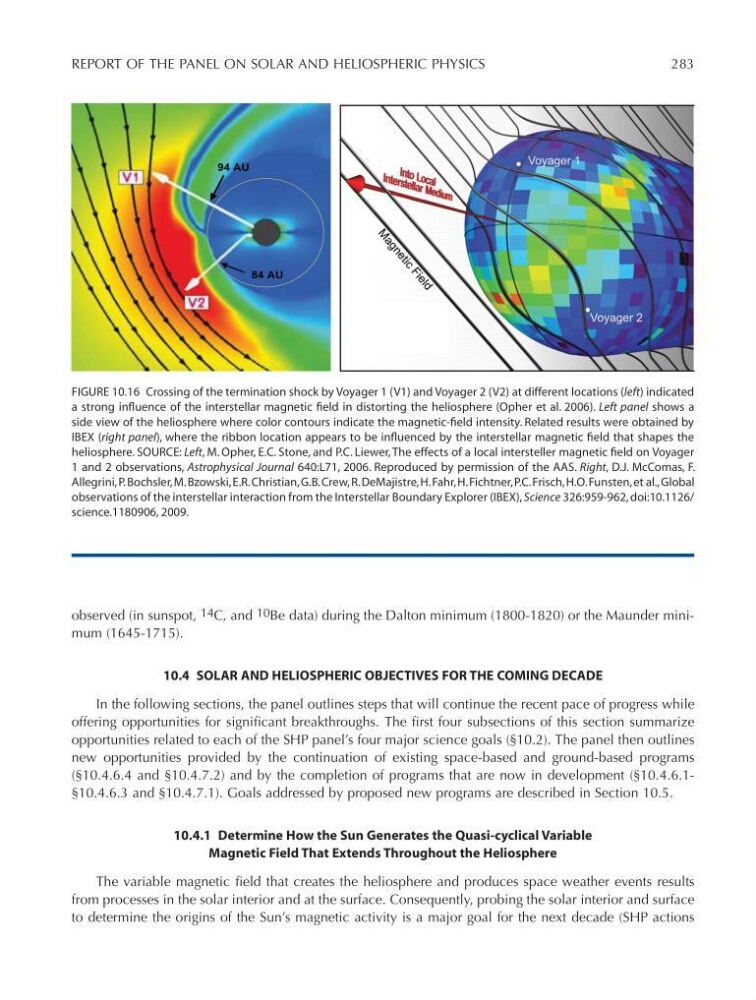
FIGURE 10.16 Crossing of the termination shock by Voyager 1 (V1) and Voyager 2 (V2) at different locations (left) indicated
a strong influence of the interstellar magnetic field in distorting the heliosphere (Opher et al. 2006). Left panel shows a
side view of the heliosphere where color contours indicate the magnetic-field intensity. Related results were obtained by
IBEX (right panel), where the ribbon location appears to be influenced by the interstellar magnetic field that shapes the
heliosphere. SOURCE: Left, M. Opher, E.C. Stone, and P.C. Liewer, The effects of a local intersteller magnetic field on Voyager
1 and 2 observations, Astrophysical Journal 640:L71, 2006. Reproduced by permission of the AAS. Right, D.J. McComas, F.
Allegrini, P. Bochsler, M. Bzowski, E.R. Christian, G.B. Crew, R. DeMajistre, H. Fahr, H. Fichtner, P.C. Frisch, H.O. Funsten, et al., Global
observations of the interstellar interaction from the Interstellar Boundary Explorer (IBEX), Science 326:959-962, doi:10.1126/
science.1180906, 2009.
Figure 10-16
Solar and Space Physics: A Science for a Technological Society
REPORT OF THE PANEL ON SOLAR AND HELIOSPHERIC PHYSICS
283
observed (in sunspot, 14 C, and 10 Be data) during the Dalton minimum (1800-1820) or the Maunder minimum (1645-1715).
10.4 SOLAR AND HELIOSPHERIC OBJECTIVES FOR THE COMING DECADE
In the following sections, the panel outlines steps that will continue the recent pace of progress while
offering opportunities for significant breakthroughs. The first four subsections of this section summarize
opportunities related to each of the SHP panel’s four major science goals (§10.2). The panel then outlines
new opportunities provided by the continuation of existing space-based and ground-based programs
(§10.4.6.4 and §10.4.7.2) and by the completion of programs that are now in development (§10.4.6.1§10.4.6.3 and §10.4.7.1). Goals addressed by proposed new programs are described in Section 10.5.
10.4.1 Determine How the Sun Generates the Quasi-cyclical Variable
Magnetic Field That Extends Throughout the Heliosphere
The variable magnetic field that creates the heliosphere and produces space weather events results
from processes in the solar interior and at the surface. Consequently, probing the solar interior and surface
to determine the origins of the Sun’s magnetic activity is a major goal for the next decade (SHP actions
FIGURE 10.16 Crossing of the termination shock by Voyager 1 (V1) and Voyager 2 (V2) at different locations (left) indicated
a strong influence of the interstellar magnetic field in distorting the heliosphere (Opher et al. 2006). Left panel shows a
side view of the heliosphere where color contours indicate the magnetic-field intensity. Related results were obtained by
IBEX (right panel), where the ribbon location appears to be influenced by the interstellar magnetic field that shapes the
heliosphere. SOURCE: Left, M. Opher, E.C. Stone, and P.C. Liewer, The effects of a local intersteller magnetic field on Voyager
1 and 2 observations, Astrophysical Journal 640:L71, 2006. Reproduced by permission of the AAS. Right, D.J. McComas, F.
Allegrini, P. Bochsler, M. Bzowski, E.R. Christian, G.B. Crew, R. DeMajistre, H. Fahr, H. Fichtner, P.C. Frisch, H.O. Funsten, et al., Global
observations of the interstellar interaction from the Interstellar Boundary Explorer (IBEX), Science 326:959-962, doi:10.1126/
science.1180906, 2009.
Figure 10-16