

Copyright © National Academy of Sciences. All rights reserved.
Solar and Space Physics: A Science for a Technological Society
276
SOLAR AND SPACE PHYSICS: A SCIENCE FOR A TECHNOLOGICAL SOCIETY
probably due to perturbations of the magnetic-field topology, indicating that ion acceleration is also related
to the magnetic reconnection responsible for the flare.
The acceleration profiles of CMEs below about 4 solar radii (R S ) are closely synchronized with flareHXR energy releases, implying that the fast CME expansion creates a flare current sheet below the CME,
where reconnection results in the particle acceleration responsible for the hard X rays (Figure 10.12). Theory
and remote-sensing observations agree that many ejected CMEs contain a magnetic flux-rope structure.
The shocks produced by fast CMEs (presumably the main solar energetic-particle [SEP] accelerators) can
now often be identified in SOHO/STEREO coronagraph images. Indeed, STEREO/HI images CMEs from
the deep corona to 1 AU, revealing their solar origins, propagation to Earth, and space weather impacts.
In a surprising discovery, STEREO A&B detected a burst of 1.6- to 15-MeV energetic neutral hydrogen
atoms (ENAs) arriving from the Sun hours before SEPs arrived from the E79 December 5, 2006, solar event.
The ENAs were produced by either flare or CME-shock-accelerated protons charge-exchanging with coronal
ions. Thus, ENAs provide a new probe of ion acceleration near the Sun.
The largest SEP events are generally thought to be due to CME-driven shock acceleration that can
quickly reach energies of 0.1-1 GeV near the Sun. In the past decade, accelerated ions and enhanced resonant waves predicted by diffusive shock-acceleration theory were detected in a few events. Although large
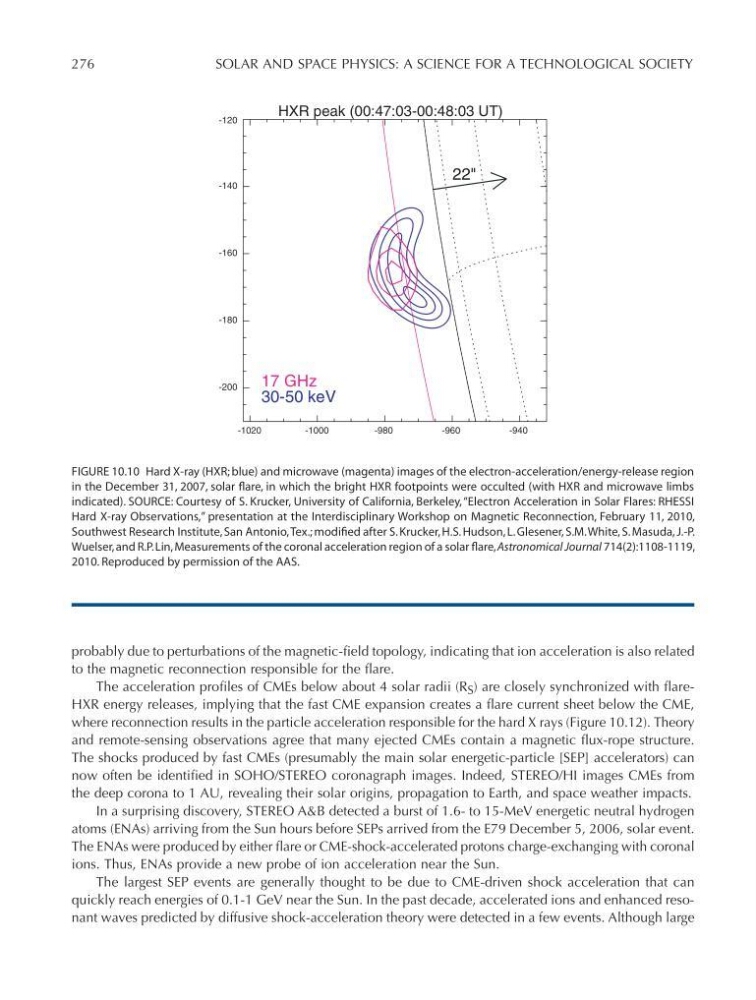
FIGURE 10.10 Hard X-ray (HXR; blue) and microwave (magenta) images of the electron-acceleration/energy-release region
in the December 31, 2007, solar flare, in which the bright HXR footpoints were occulted (with HXR and microwave limbs
indicated). SOURCE: Courtesy of S. Krucker, University of California, Berkeley, “Electron Acceleration in Solar Flares: RHESSI
Hard X-ray Observations,” presentation at the Interdisciplinary Workshop on Magnetic Reconnection, February 11, 2010,
Southwest Research Institute, San Antonio, Tex.; modified after S. Krucker, H.S. Hudson, L. Glesener, S.M. White, S. Masuda, J.-P.
Wuelser, and R.P. Lin, Measurements of the coronal acceleration region of a solar flare, Astronomical Journal 714(2):1108-1119,
2010. Reproduced by permission of the AAS.
HXR peak (00:47:03-00:48:03 UT)
-1020
-1000
-980
-960
-940
-200
-180
-160
-140
-120
22"
17 GHz
30-50 keV
Figure 10-10
Solar and Space Physics: A Science for a Technological Society
276
SOLAR AND SPACE PHYSICS: A SCIENCE FOR A TECHNOLOGICAL SOCIETY
probably due to perturbations of the magnetic-field topology, indicating that ion acceleration is also related
to the magnetic reconnection responsible for the flare.
The acceleration profiles of CMEs below about 4 solar radii (R S ) are closely synchronized with flareHXR energy releases, implying that the fast CME expansion creates a flare current sheet below the CME,
where reconnection results in the particle acceleration responsible for the hard X rays (Figure 10.12). Theory
and remote-sensing observations agree that many ejected CMEs contain a magnetic flux-rope structure.
The shocks produced by fast CMEs (presumably the main solar energetic-particle [SEP] accelerators) can
now often be identified in SOHO/STEREO coronagraph images. Indeed, STEREO/HI images CMEs from
the deep corona to 1 AU, revealing their solar origins, propagation to Earth, and space weather impacts.
In a surprising discovery, STEREO A&B detected a burst of 1.6- to 15-MeV energetic neutral hydrogen
atoms (ENAs) arriving from the Sun hours before SEPs arrived from the E79 December 5, 2006, solar event.
The ENAs were produced by either flare or CME-shock-accelerated protons charge-exchanging with coronal
ions. Thus, ENAs provide a new probe of ion acceleration near the Sun.
The largest SEP events are generally thought to be due to CME-driven shock acceleration that can
quickly reach energies of 0.1-1 GeV near the Sun. In the past decade, accelerated ions and enhanced resonant waves predicted by diffusive shock-acceleration theory were detected in a few events. Although large
FIGURE 10.10 Hard X-ray (HXR; blue) and microwave (magenta) images of the electron-acceleration/energy-release region
in the December 31, 2007, solar flare, in which the bright HXR footpoints were occulted (with HXR and microwave limbs
indicated). SOURCE: Courtesy of S. Krucker, University of California, Berkeley, “Electron Acceleration in Solar Flares: RHESSI
Hard X-ray Observations,” presentation at the Interdisciplinary Workshop on Magnetic Reconnection, February 11, 2010,
Southwest Research Institute, San Antonio, Tex.; modified after S. Krucker, H.S. Hudson, L. Glesener, S.M. White, S. Masuda, J.-P.
Wuelser, and R.P. Lin, Measurements of the coronal acceleration region of a solar flare, Astronomical Journal 714(2):1108-1119,
2010. Reproduced by permission of the AAS.
HXR peak (00:47:03-00:48:03 UT)
-1020
-1000
-980
-960
-940
-200
-180
-160
-140
-120
22"
17 GHz
30-50 keV
Figure 10-10