

Copyright © National Academy of Sciences. All rights reserved.
Solar and Space Physics: A Science for a Technological Society
272
SOLAR AND SPACE PHYSICS: A SCIENCE FOR A TECHNOLOGICAL SOCIETY
An unexpected discovery has been the observation of ubiquitous reconnection events in the solar
wind, often on a very large scale of about 1 million kilometers. The reconnection events constitute a major
puzzle in that they do not appear to accelerate particles to speeds greater than the local Alfvén speed.
Again, observations nearer to the Sun will be critical for understanding the physical properties of this type
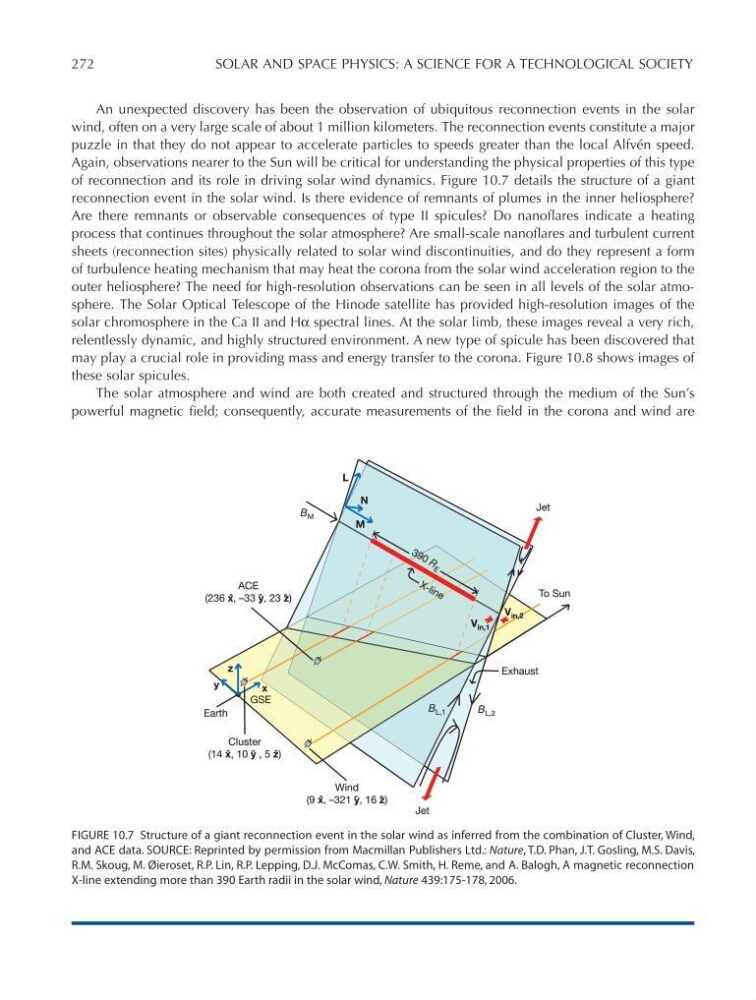
of reconnection and its role in driving solar wind dynamics. Figure 10.7 details the structure of a giant
reconnection event in the solar wind. Is there evidence of remnants of plumes in the inner heliosphere?
Are there remnants or observable consequences of type II spicules? Do nanoflares indicate a heating
process that continues throughout the solar atmosphere? Are small-scale nanoflares and turbulent current
sheets (reconnection sites) physically related to solar wind discontinuities, and do they represent a form
of turbulence heating mechanism that may heat the corona from the solar wind acceleration region to the
outer heliosphere? The need for high-resolution observations can be seen in all levels of the solar atmosphere. The Solar Optical Telescope of the Hinode satellite has provided high-resolution images of the
solar chromosphere in the Ca II and Hα spectral lines. At the solar limb, these images reveal a very rich,
relentlessly dynamic, and highly structured environment. A new type of spicule has been discovered that
may play a crucial role in providing mass and energy transfer to the corona. Figure 10.8 shows images of
these solar spicules.
The solar atmosphere and wind are both created and structured through the medium of the Sun’s
powerful magnetic field; consequently, accurate measurements of the field in the corona and wind are
FIGURE 10.7 Structure of a giant reconnection event in the solar wind as inferred from the combination of Cluster, Wind,
and ACE data. SOURCE: Reprinted by permission from Macmillan Publishers Ltd.: Nature, T.D. Phan, J.T. Gosling, M.S. Davis,
R.M. Skoug, M. Øieroset, R.P. Lin, R.P. Lepping, D.J. McComas, C.W. Smith, H. Reme, and A. Balogh, A magnetic reconnection
X-line extending more than 390 Earth radii in the solar wind, Nature 439:175-178, 2006.
Figure 10-7
Solar and Space Physics: A Science for a Technological Society
272
SOLAR AND SPACE PHYSICS: A SCIENCE FOR A TECHNOLOGICAL SOCIETY
An unexpected discovery has been the observation of ubiquitous reconnection events in the solar
wind, often on a very large scale of about 1 million kilometers. The reconnection events constitute a major
puzzle in that they do not appear to accelerate particles to speeds greater than the local Alfvén speed.
Again, observations nearer to the Sun will be critical for understanding the physical properties of this type
of reconnection and its role in driving solar wind dynamics. Figure 10.7 details the structure of a giant
reconnection event in the solar wind. Is there evidence of remnants of plumes in the inner heliosphere?
Are there remnants or observable consequences of type II spicules? Do nanoflares indicate a heating
process that continues throughout the solar atmosphere? Are small-scale nanoflares and turbulent current
sheets (reconnection sites) physically related to solar wind discontinuities, and do they represent a form
of turbulence heating mechanism that may heat the corona from the solar wind acceleration region to the
outer heliosphere? The need for high-resolution observations can be seen in all levels of the solar atmosphere. The Solar Optical Telescope of the Hinode satellite has provided high-resolution images of the
solar chromosphere in the Ca II and Hα spectral lines. At the solar limb, these images reveal a very rich,
relentlessly dynamic, and highly structured environment. A new type of spicule has been discovered that
may play a crucial role in providing mass and energy transfer to the corona. Figure 10.8 shows images of
these solar spicules.
The solar atmosphere and wind are both created and structured through the medium of the Sun’s
powerful magnetic field; consequently, accurate measurements of the field in the corona and wind are
FIGURE 10.7 Structure of a giant reconnection event in the solar wind as inferred from the combination of Cluster, Wind,
and ACE data. SOURCE: Reprinted by permission from Macmillan Publishers Ltd.: Nature, T.D. Phan, J.T. Gosling, M.S. Davis,
R.M. Skoug, M. Øieroset, R.P. Lin, R.P. Lepping, D.J. McComas, C.W. Smith, H. Reme, and A. Balogh, A magnetic reconnection
X-line extending more than 390 Earth radii in the solar wind, Nature 439:175-178, 2006.
Figure 10-7