

Copyright © National Academy of Sciences. All rights reserved.
Solar and Space Physics: A Science for a Technological Society
REPORT OF THE PANEL ON SOLAR AND HELIOSPHERIC PHYSICS
271
In the past decade, substantial progress has also been made in understanding the development of kinetic
instabilities in the solar wind due to nonthermal ion and electron distribution functions; in particular, how
temperature anisotropies are limited by the mirror, firehose, and cyclotron instabilities (motivations M1
and M3). A surprising result is that the mirror instability appears to play a stronger role than the cyclotron
instability in limiting temperature anisotropy. Instabilities have also been proposed to explain the observed
restriction of differential ion flow to the local Alfvén speed, but observational confirmation of these theories
has remained elusive.
In situ measurements of the solar wind are also a powerful diagnostic of the evolving connection
between the corona and interplanetary space, and measurements in the past decade have revealed new
features in the solar wind and related them to the structure and dynamics of the inner heliosphere and
evolving Sun. The anomalously low levels of solar activity in the recent solar minimum were associated
with substantial decreases in the density and pressure of the solar wind. Charge state and composition
allow changes in the coronal sources of the solar wind to be tracked independently of changes in the
solar wind speed due to the evolution of the plasma as it expands into interplanetary space. It is now
understood that the three distinct forms of wind—fast, slow, and transient (associated with ICMEs)—can
be identified clearly by their ionic charge-state signatures (using O 7+ /O 6+ ) without assumptions about the
dynamic evolution of the wind.
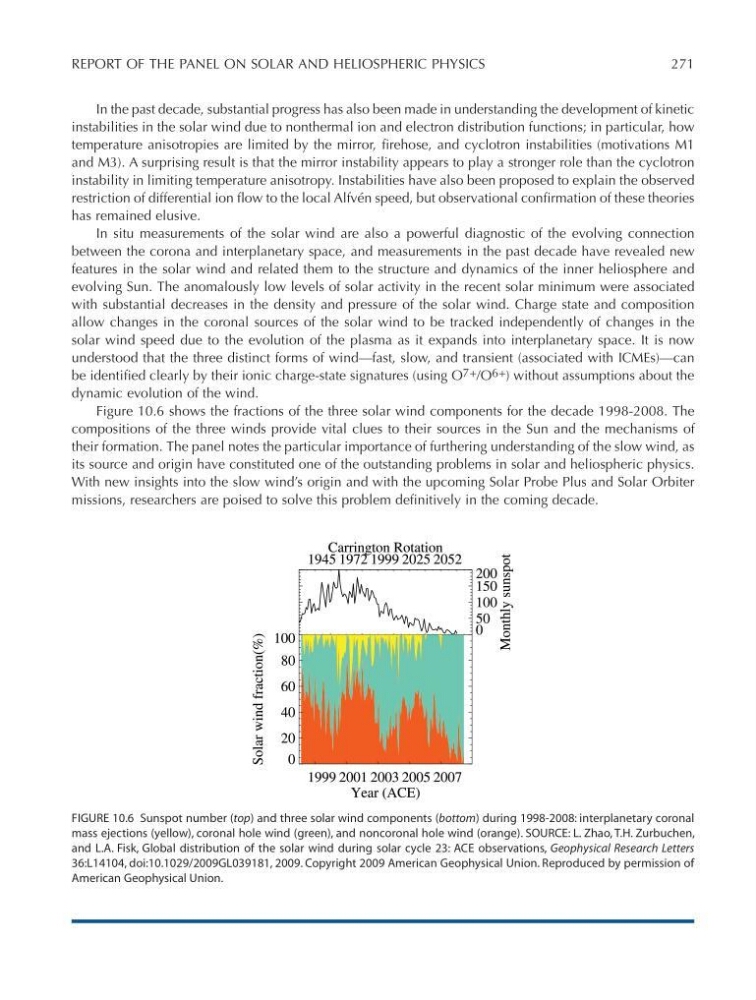
Figure 10.6 shows the fractions of the three solar wind components for the decade 1998-2008. The
compositions of the three winds provide vital clues to their sources in the Sun and the mechanisms of
their formation. The panel notes the particular importance of furthering understanding of the slow wind, as
its source and origin have constituted one of the outstanding problems in solar and heliospheric physics.
With new insights into the slow wind’s origin and with the upcoming Solar Probe Plus and Solar Orbiter
missions, researchers are poised to solve this problem definitively in the coming decade.
FIGURE 10.6 Sunspot number (top) and three solar wind components (bottom) during 1998-2008: interplanetary coronal
mass ejections (yellow), coronal hole wind (green), and noncoronal hole wind (orange). SOURCE: L. Zhao, T.H. Zurbuchen,
and L.A. Fisk, Global distribution of the solar wind during solar cycle 23: ACE observations, Geophysical Research Letters
36:L14104, doi:10.1029/2009GL039181, 2009. Copyright 2009 American Geophysical Union. Reproduced by permission of
American Geophysical Union.
Figure 10-6
Solar and Space Physics: A Science for a Technological Society
REPORT OF THE PANEL ON SOLAR AND HELIOSPHERIC PHYSICS
271
In the past decade, substantial progress has also been made in understanding the development of kinetic
instabilities in the solar wind due to nonthermal ion and electron distribution functions; in particular, how
temperature anisotropies are limited by the mirror, firehose, and cyclotron instabilities (motivations M1
and M3). A surprising result is that the mirror instability appears to play a stronger role than the cyclotron
instability in limiting temperature anisotropy. Instabilities have also been proposed to explain the observed
restriction of differential ion flow to the local Alfvén speed, but observational confirmation of these theories
has remained elusive.
In situ measurements of the solar wind are also a powerful diagnostic of the evolving connection
between the corona and interplanetary space, and measurements in the past decade have revealed new
features in the solar wind and related them to the structure and dynamics of the inner heliosphere and
evolving Sun. The anomalously low levels of solar activity in the recent solar minimum were associated
with substantial decreases in the density and pressure of the solar wind. Charge state and composition
allow changes in the coronal sources of the solar wind to be tracked independently of changes in the
solar wind speed due to the evolution of the plasma as it expands into interplanetary space. It is now
understood that the three distinct forms of wind—fast, slow, and transient (associated with ICMEs)—can
be identified clearly by their ionic charge-state signatures (using O 7+ /O 6+ ) without assumptions about the
dynamic evolution of the wind.
Figure 10.6 shows the fractions of the three solar wind components for the decade 1998-2008. The
compositions of the three winds provide vital clues to their sources in the Sun and the mechanisms of
their formation. The panel notes the particular importance of furthering understanding of the slow wind, as
its source and origin have constituted one of the outstanding problems in solar and heliospheric physics.
With new insights into the slow wind’s origin and with the upcoming Solar Probe Plus and Solar Orbiter
missions, researchers are poised to solve this problem definitively in the coming decade.
FIGURE 10.6 Sunspot number (top) and three solar wind components (bottom) during 1998-2008: interplanetary coronal
mass ejections (yellow), coronal hole wind (green), and noncoronal hole wind (orange). SOURCE: L. Zhao, T.H. Zurbuchen,
and L.A. Fisk, Global distribution of the solar wind during solar cycle 23: ACE observations, Geophysical Research Letters
36:L14104, doi:10.1029/2009GL039181, 2009. Copyright 2009 American Geophysical Union. Reproduced by permission of
American Geophysical Union.
Figure 10-6