

Copyright © National Academy of Sciences. All rights reserved.
Solar and Space Physics: A Science for a Technological Society
268
SOLAR AND SPACE PHYSICS: A SCIENCE FOR A TECHNOLOGICAL SOCIETY
The Sun sustains life on Earth by its nearly steady output of light. Measurements of total solar irradiance (TSI) with different space-based instruments have consistently shown a cycle variation on the order
of 0.1 percent but give conflicting results about the absolute value of the TSI. The conflicts have recently
been resolved in favor of a lower value that improves agreement with climate research results. The original
conflicting results and new results are shown in the two panels of Figure 10.5. The new results indicate
that the TSI at the recent cycle minimum was less than at previous minima. It has also been suggested that
this level is about as low as can be expected even if a long cessation of solar activity occurs (as during
the Maunder minimum).
10.3.2 Determining How the Sun’s Magnetism Creates Its Dynamic Atmosphere
Major advances have been made during the past decade in understanding the dynamic and coupled
nature of the Sun’s extended atmosphere, which reaches from the chromosphere and corona to the end
of the heliosphere (motivations M1-M3). The advances highlight the need for direct sampling of the solar
wind in the deep inner heliosphere as close to the Sun as possible, with high-resolution measurements
of plasma and electromagnetic fluctuations; high-spatial- and high-temporal-resolution observations of
the solar atmosphere from the photosphere into the corona; accurate magnetic field measurements in
the low-beta chromosphere and corona; and advanced theoretical models that can couple closely to the
upcoming observations.
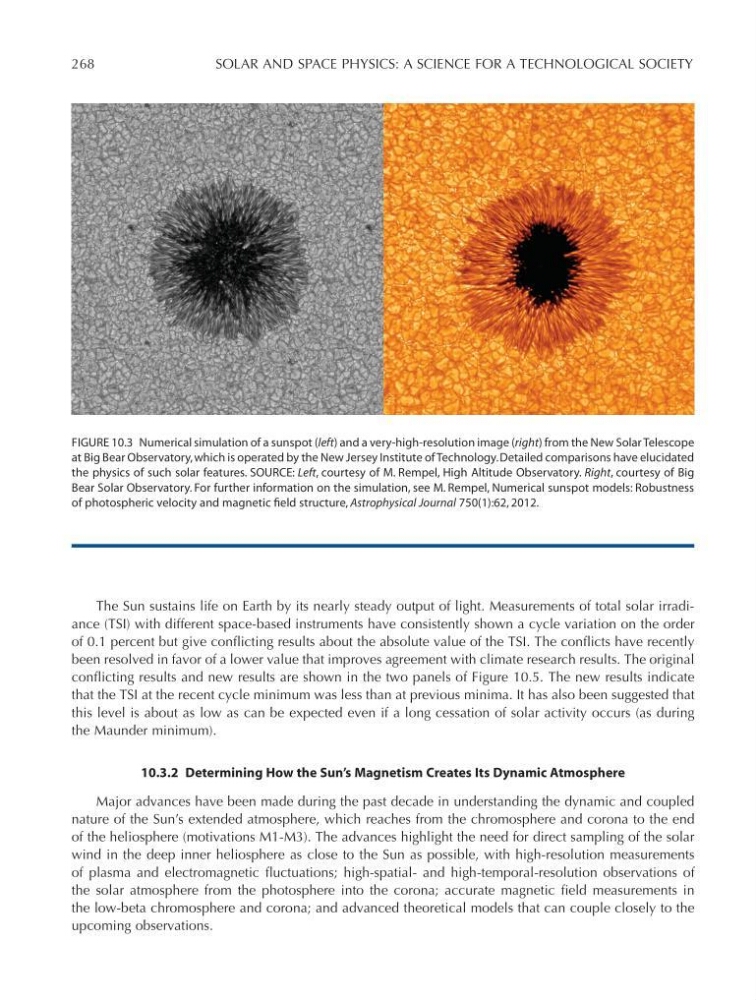
FIGURE 10.3 Numerical simulation of a sunspot (left) and a very-high-resolution image (right) from the New Solar Telescope
at Big Bear Observatory, which is operated by the New Jersey Institute of Technology. Detailed comparisons have elucidated
the physics of such solar features. SOURCE: Left, courtesy of M. Rempel, High Altitude Observatory. Right, courtesy of Big
Bear Solar Observatory. For further information on the simulation, see M. Rempel, Numerical sunspot models: Robustness
of photospheric velocity and magnetic field structure, Astrophysical Journal 750(1):62, 2012.
Solar and Space Physics: A Science for a Technological Society
268
SOLAR AND SPACE PHYSICS: A SCIENCE FOR A TECHNOLOGICAL SOCIETY
The Sun sustains life on Earth by its nearly steady output of light. Measurements of total solar irradiance (TSI) with different space-based instruments have consistently shown a cycle variation on the order
of 0.1 percent but give conflicting results about the absolute value of the TSI. The conflicts have recently
been resolved in favor of a lower value that improves agreement with climate research results. The original
conflicting results and new results are shown in the two panels of Figure 10.5. The new results indicate
that the TSI at the recent cycle minimum was less than at previous minima. It has also been suggested that
this level is about as low as can be expected even if a long cessation of solar activity occurs (as during
the Maunder minimum).
10.3.2 Determining How the Sun’s Magnetism Creates Its Dynamic Atmosphere
Major advances have been made during the past decade in understanding the dynamic and coupled
nature of the Sun’s extended atmosphere, which reaches from the chromosphere and corona to the end
of the heliosphere (motivations M1-M3). The advances highlight the need for direct sampling of the solar
wind in the deep inner heliosphere as close to the Sun as possible, with high-resolution measurements
of plasma and electromagnetic fluctuations; high-spatial- and high-temporal-resolution observations of
the solar atmosphere from the photosphere into the corona; accurate magnetic field measurements in
the low-beta chromosphere and corona; and advanced theoretical models that can couple closely to the
upcoming observations.
FIGURE 10.3 Numerical simulation of a sunspot (left) and a very-high-resolution image (right) from the New Solar Telescope
at Big Bear Observatory, which is operated by the New Jersey Institute of Technology. Detailed comparisons have elucidated
the physics of such solar features. SOURCE: Left, courtesy of M. Rempel, High Altitude Observatory. Right, courtesy of Big
Bear Solar Observatory. For further information on the simulation, see M. Rempel, Numerical sunspot models: Robustness
of photospheric velocity and magnetic field structure, Astrophysical Journal 750(1):62, 2012.