

Copyright © National Academy of Sciences. All rights reserved.
Solar and Space Physics: A Science for a Technological Society
REPORT OF THE PANEL ON SOLAR AND HELIOSPHERIC PHYSICS
267
Those surprising events and the rapid development of flux-transport dynamo models have led to
intense recent work in solar dynamo modeling. Two key issues that involve the transport of magnetic flux
have emerged: the speed with which meridional flows move poloidal magnetic flux to the solar poles and
the extent to which this moving flux stays near the surface or diffuses inward on its journey to the poles.
Because of the importance of those issues, there is a critical need for measurements of meridional flow and
its variability. The measurements are difficult, and a consensus view on how to proceed has yet to emerge.
Observational spatial resolution has greatly improved through image-processing techniques applied to
ground-based observations made with the 1.6-m New Solar Telescope (NST) at the Big Bear Solar Observatory and other 1-m-class apertures and direct observations made with the 0.5-m Hinode satellite. But it
is the combination of these state-of-the-art observations with advanced numerical modeling that has, after
400 years of speculation, revealed the main physical processes at work in sunspot penumbral filaments,
bright umbral dots, bright faculae, and small-scale magnetic elements. Figure 10.3 shows a numerical
simulation of a sunspot and an actual photograph. Good observational and modeling progress has also
been made with respect to the more complicated upper layers of the solar atmosphere.
Continuing and improved helioseismic measurements of the solar interior from instruments including
those on the SOHO and SDO spacecraft, launched in 1995 and 2010, respectively, and from the GONG
ground-based network, have shown cycle-related changes in large-scale internal zonal and meridional
flows. The varying flows may play a driving role rather than just being consequences of the solar activity
cycle, and they narrow the wide range of realistic solar dynamo models. Helioseismic observations of
active regions have shown subsurface helical flows whose strength is closely related to flare activity. In
addition, a new analytic method shows surprisingly deep-seated effects of large active regions well before
they emerge at the surface (Figure 10.4). Either or both of those findings may develop into useful forecasts
of strong solar activity with societal significance.
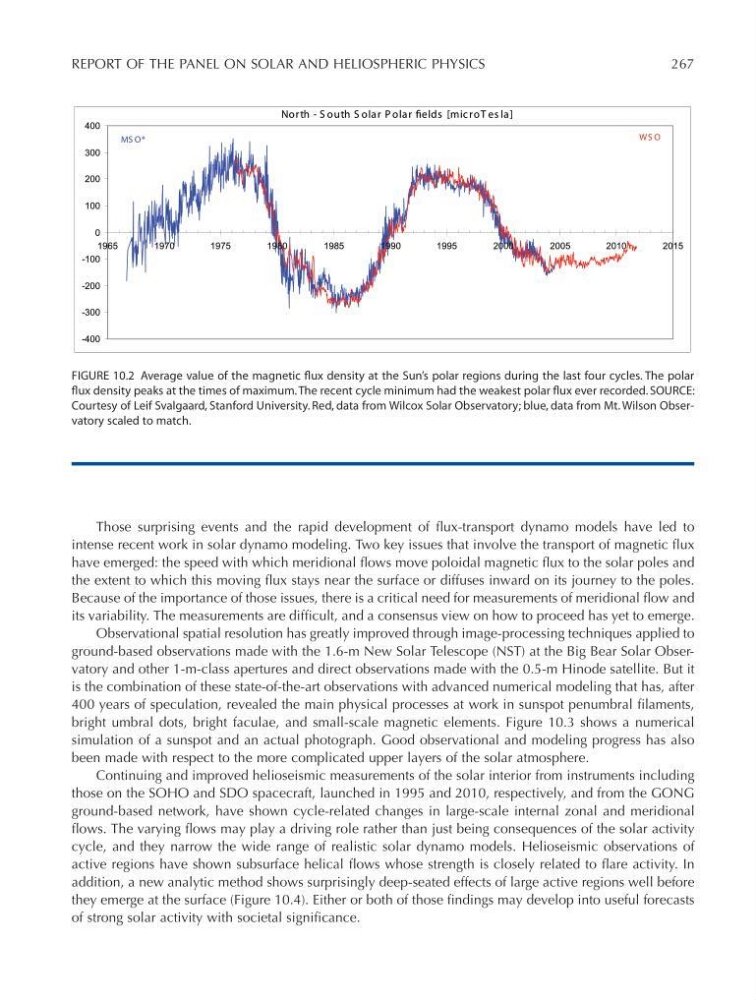
FIGURE 10.2 Average value of the magnetic flux density at the Sun’s polar regions during the last four cycles. The polar
flux density peaks at the times of maximum. The recent cycle minimum had the weakest polar flux ever recorded. SOURCE:
Courtesy of Leif Svalgaard, Stanford University. Red, data from Wilcox Solar Observatory; blue, data from Mt. Wilson Observatory scaled to match.
-400
-300
-200
-100
0
100
200
300
400
1965
1970
1975
1 980
1985
1990
1995
2000
2005
2010
2015
MS O*
WS O
North - S outh S olar P olar elds [mic roT es la]
Figure 10-2 replaced
Solar and Space Physics: A Science for a Technological Society
REPORT OF THE PANEL ON SOLAR AND HELIOSPHERIC PHYSICS
267
Those surprising events and the rapid development of flux-transport dynamo models have led to
intense recent work in solar dynamo modeling. Two key issues that involve the transport of magnetic flux
have emerged: the speed with which meridional flows move poloidal magnetic flux to the solar poles and
the extent to which this moving flux stays near the surface or diffuses inward on its journey to the poles.
Because of the importance of those issues, there is a critical need for measurements of meridional flow and
its variability. The measurements are difficult, and a consensus view on how to proceed has yet to emerge.
Observational spatial resolution has greatly improved through image-processing techniques applied to
ground-based observations made with the 1.6-m New Solar Telescope (NST) at the Big Bear Solar Observatory and other 1-m-class apertures and direct observations made with the 0.5-m Hinode satellite. But it
is the combination of these state-of-the-art observations with advanced numerical modeling that has, after
400 years of speculation, revealed the main physical processes at work in sunspot penumbral filaments,
bright umbral dots, bright faculae, and small-scale magnetic elements. Figure 10.3 shows a numerical
simulation of a sunspot and an actual photograph. Good observational and modeling progress has also
been made with respect to the more complicated upper layers of the solar atmosphere.
Continuing and improved helioseismic measurements of the solar interior from instruments including
those on the SOHO and SDO spacecraft, launched in 1995 and 2010, respectively, and from the GONG
ground-based network, have shown cycle-related changes in large-scale internal zonal and meridional
flows. The varying flows may play a driving role rather than just being consequences of the solar activity
cycle, and they narrow the wide range of realistic solar dynamo models. Helioseismic observations of
active regions have shown subsurface helical flows whose strength is closely related to flare activity. In
addition, a new analytic method shows surprisingly deep-seated effects of large active regions well before
they emerge at the surface (Figure 10.4). Either or both of those findings may develop into useful forecasts
of strong solar activity with societal significance.
FIGURE 10.2 Average value of the magnetic flux density at the Sun’s polar regions during the last four cycles. The polar
flux density peaks at the times of maximum. The recent cycle minimum had the weakest polar flux ever recorded. SOURCE:
Courtesy of Leif Svalgaard, Stanford University. Red, data from Wilcox Solar Observatory; blue, data from Mt. Wilson Observatory scaled to match.
-400
-300
-200
-100
0
100
200
300
400
1965
1970
1975
1 980
1985
1990
1995
2000
2005
2010
2015
MS O*
WS O
North - S outh S olar P olar elds [mic roT es la]
Figure 10-2 replaced