

Copyright © National Academy of Sciences. All rights reserved.
Solar and Space Physics: A Science for a Technological Society
REPORT OF THE PANEL ON SOLAR WIND-MAGNETOSPHERE INTERACTIONS
219
of the fluctuations have been determined. Global simulations of the solar-wind-driven magnetosphere are
reaching high-enough spatial resolutions in the magnetotail to enable them to predict irregular vortical
flows at these scales and to statistically match the properties of the vortical flows to observed fluctuations.
However, the dynamical nature of these fluctuations, what causes them, and their influence on the behavior
of the magnetosphere have not been determined. Fluid turbulence provides one pathway by which energy
moves across scale sizes from large to small where energy can be dissipated in the form of heating. When
and where turbulent processes play a significant role in magnetospheric dynamics remain unclear.
9.3.4 Linkages
9.3.4.1 Coupling with the Solar Wind
The variable solar wind drives a wide range of variations in magnetospheric behavior. Over the past
decade, continuous measurements of the solar wind combined with observations throughout geospace
have enabled significant advances in identifying which specific large- and mesoscale solar-wind properties produce different modes of magnetospheric response (e.g., storms, steady magnetospheric convection
events, sawtooth events). For example, studies have linked variations in the solar wind dynamic pressure
to radiation-belt loss and energization processes. Other studies quantified that the strength of geomagnetic
storms depends on both the electrodynamic coupling between the solar wind and the magnetosphere
and plasma loading of the magnetosphere, including both ionospheric and solar wind sources. Spacecraft
observations and numerical simulations reveal that solar-wind plasma entry into the magnetosphere is
surprisingly efficient under “quiescent” conditions of northward interplanetary magnetic field. This plasma
in turn participates as a substantial element of the storm-time ring-current development when southward
interplanetary magnetic fields couple with and energize the magnetosphere. Additional progress has also
been made in delineating the effects of smaller-scale solar wind variations on magnetospheric behavior.
While some of the specific processes that mediate this coupling with the solar wind were clarified in the
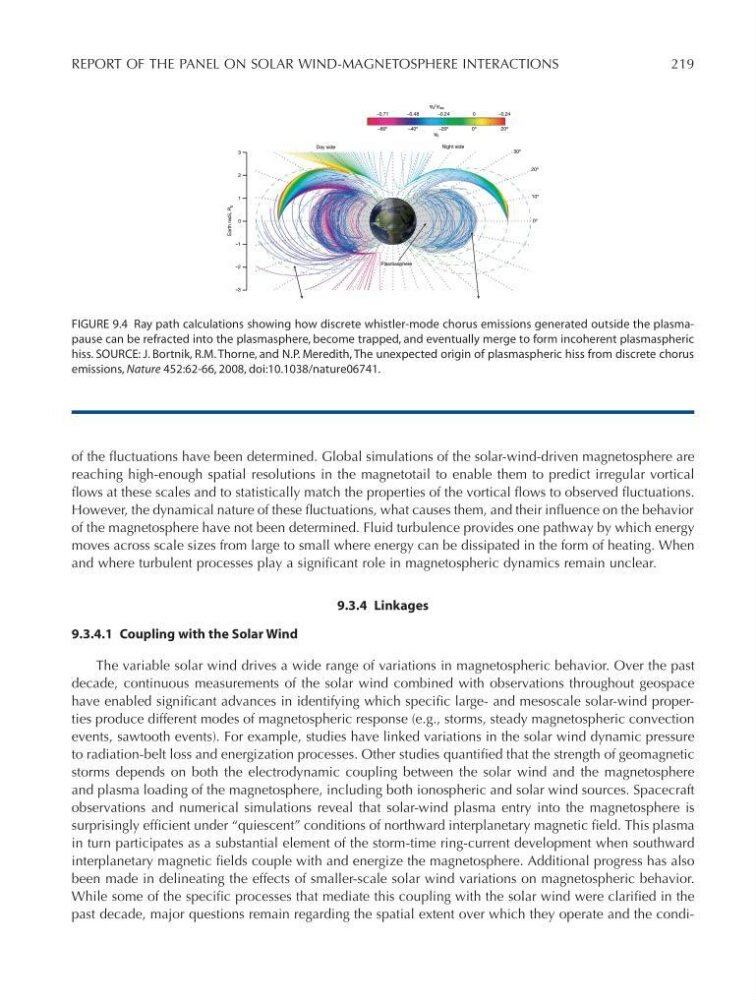
past decade, major questions remain regarding the spatial extent over which they operate and the condiFIGURE 9.4 Ray path calculations showing how discrete whistler-mode chorus emissions generated outside the plasmapause can be refracted into the plasmasphere, become trapped, and eventually merge to form incoherent plasmaspheric
hiss. SOURCE: J. Bortnik, R.M. Thorne, and N.P. Meredith, The unexpected origin of plasmaspheric hiss from discrete chorus
emissions, Nature 452:62-66, 2008, doi:10.1038/nature06741.
–3
–2
–1
0
1
2
3
Earth radii, R
E
ψ 0 /ψ res
Day side
Night side
–0.71
– 0.48
–0.24
0
–0.24
–60º
–40º
–20º
0º
20º
Plasmasphere
0º
10º
20º
30º
ψ 0
Solar and Space Physics: A Science for a Technological Society
REPORT OF THE PANEL ON SOLAR WIND-MAGNETOSPHERE INTERACTIONS
219
of the fluctuations have been determined. Global simulations of the solar-wind-driven magnetosphere are
reaching high-enough spatial resolutions in the magnetotail to enable them to predict irregular vortical
flows at these scales and to statistically match the properties of the vortical flows to observed fluctuations.
However, the dynamical nature of these fluctuations, what causes them, and their influence on the behavior
of the magnetosphere have not been determined. Fluid turbulence provides one pathway by which energy
moves across scale sizes from large to small where energy can be dissipated in the form of heating. When
and where turbulent processes play a significant role in magnetospheric dynamics remain unclear.
9.3.4 Linkages
9.3.4.1 Coupling with the Solar Wind
The variable solar wind drives a wide range of variations in magnetospheric behavior. Over the past
decade, continuous measurements of the solar wind combined with observations throughout geospace
have enabled significant advances in identifying which specific large- and mesoscale solar-wind properties produce different modes of magnetospheric response (e.g., storms, steady magnetospheric convection
events, sawtooth events). For example, studies have linked variations in the solar wind dynamic pressure
to radiation-belt loss and energization processes. Other studies quantified that the strength of geomagnetic
storms depends on both the electrodynamic coupling between the solar wind and the magnetosphere
and plasma loading of the magnetosphere, including both ionospheric and solar wind sources. Spacecraft
observations and numerical simulations reveal that solar-wind plasma entry into the magnetosphere is
surprisingly efficient under “quiescent” conditions of northward interplanetary magnetic field. This plasma
in turn participates as a substantial element of the storm-time ring-current development when southward
interplanetary magnetic fields couple with and energize the magnetosphere. Additional progress has also
been made in delineating the effects of smaller-scale solar wind variations on magnetospheric behavior.
While some of the specific processes that mediate this coupling with the solar wind were clarified in the
past decade, major questions remain regarding the spatial extent over which they operate and the condiFIGURE 9.4 Ray path calculations showing how discrete whistler-mode chorus emissions generated outside the plasmapause can be refracted into the plasmasphere, become trapped, and eventually merge to form incoherent plasmaspheric
hiss. SOURCE: J. Bortnik, R.M. Thorne, and N.P. Meredith, The unexpected origin of plasmaspheric hiss from discrete chorus
emissions, Nature 452:62-66, 2008, doi:10.1038/nature06741.
–3
–2
–1
0
1
2
3
Earth radii, R
E
ψ 0 /ψ res
Day side
Night side
–0.71
– 0.48
–0.24
0
–0.24
–60º
–40º
–20º
0º
20º
Plasmasphere
0º
10º
20º
30º
ψ 0