

Copyright © National Academy of Sciences. All rights reserved.
Solar and Space Physics: A Science for a Technological Society
218
SOLAR AND SPACE PHYSICS: A SCIENCE FOR A TECHNOLOGICAL SOCIETY
rent, which incorporate the effects of wave-particle scattering, have been developed and are beginning to
provide a more realistic picture of storm-time particle dynamics.
Satellite observations of peaks in the radial profiles of radiation-belt electrons have demonstrated that
local acceleration due to WPI may at times dominate over traditionally accepted acceleration associated
with diffusive radial transport. Diffusive radial transport may actually lead to enhanced losses at the magnetopause, causing a decrease in trapped flux rather than an increase. Particle interactions with “chorus”
waves in particular have been shown to provide a major probable source of local acceleration. The source
of plasmaspheric hiss, another wave mode known to be responsible for strong losses of radiation belt electrons near the edge of the plasmasphere, has been shown to be discrete chorus emissions generated in the
low-density region outside the plasmapause (Figure 9.4). Chorus emissions have also been shown to be the
dominant cause of scattering of plasma sheet electrons, leading to their precipitation into the atmosphere,
where they produce the diffuse aurora. Intriguingly, recent observations of extremely large-amplitude
waves suggest that nonlinear wave-particle physics may play an important role in radiation belt dynamics.
9.3.3.3 Turbulence
In the past decade the presence of large-amplitude MHD fluctuations in the magnetotail plasma sheet
has been established by spacecraft measurements, and the spatial scales (~1 R E ) and timescales (~1 minute)
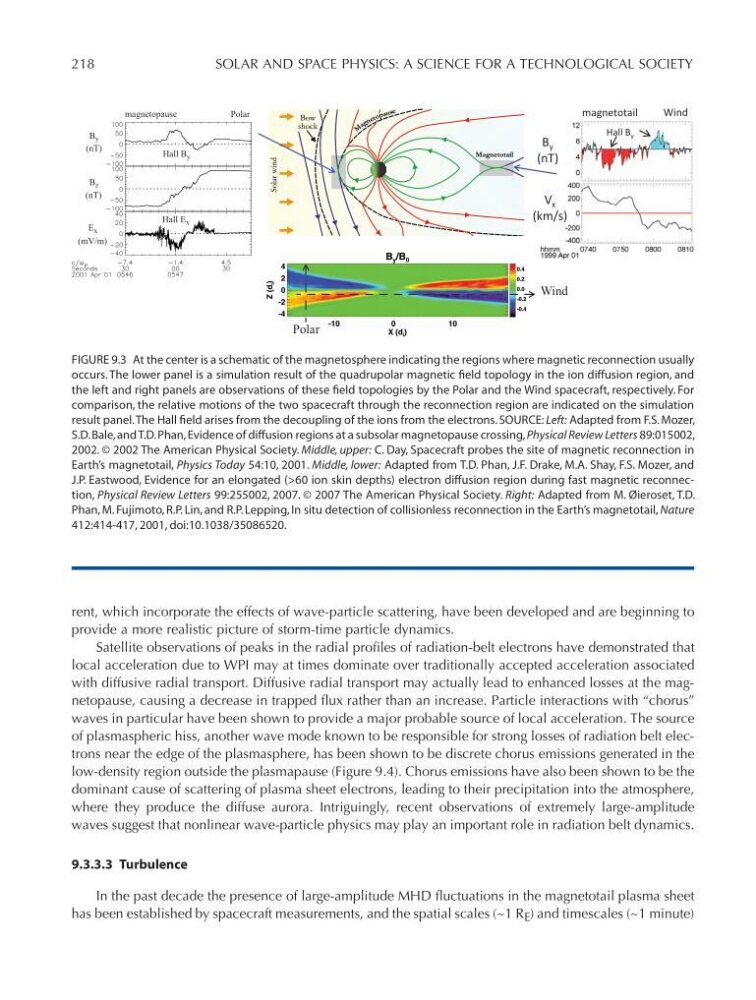
FIGURE 9.3 At the center is a schematic of the magnetosphere indicating the regions where magnetic reconnection usually
occurs. The lower panel is a simulation result of the quadrupolar magnetic field topology in the ion diffusion region, and
the left and right panels are observations of these field topologies by the Polar and the Wind spacecraft, respectively. For
comparison, the relative motions of the two spacecraft through the reconnection region are indicated on the simulation
result panel. The Hall field arises from the decoupling of the ions from the electrons. SOURCE: Left: Adapted from F.S. Mozer,
S.D. Bale, and T.D. Phan, Evidence of diffusion regions at a subsolar magnetopause crossing, Physical Review Letters 89:015002,
2002. © 2002 The American Physical Society. Middle, upper: C. Day, Spacecraft probes the site of magnetic reconnection in
Earth’s magnetotail, Physics Today 54:10, 2001. Middle, lower: Adapted from T.D. Phan, J.F. Drake, M.A. Shay, F.S. Mozer, and
J.P. Eastwood, Evidence for an elongated (>60 ion skin depths) electron diffusion region during fast magnetic reconnection, Physical Review Letters 99:255002, 2007. © 2007 The American Physical Society. Right: Adapted from M. Øieroset, T.D.
Phan, M. Fujimoto, R.P. Lin, and R.P. Lepping, In situ detection of collisionless reconnection in the Earth’s magnetotail, Nature
412:414-417, 2001, doi:10.1038/35086520.
Wind
B y
(nT)
V x
(km/s)
Hall B y
magnetotail
Bow
shock
Solar wind
Magnetotail
M
a g n et o pa us e
magnetopause
Polar
B y
(nT)
E x
(mV/m)
B z
(nT)
Hall B y
Hall E x
B y /B 0
-10
0
10
X (d i )
-4
-2
0
2
4
Z (d
i )
-0.4
-0.2
0.0
0.2
0.4
Polar
Wind
Figure 9-3 replaced
Solar and Space Physics: A Science for a Technological Society
218
SOLAR AND SPACE PHYSICS: A SCIENCE FOR A TECHNOLOGICAL SOCIETY
rent, which incorporate the effects of wave-particle scattering, have been developed and are beginning to
provide a more realistic picture of storm-time particle dynamics.
Satellite observations of peaks in the radial profiles of radiation-belt electrons have demonstrated that
local acceleration due to WPI may at times dominate over traditionally accepted acceleration associated
with diffusive radial transport. Diffusive radial transport may actually lead to enhanced losses at the magnetopause, causing a decrease in trapped flux rather than an increase. Particle interactions with “chorus”
waves in particular have been shown to provide a major probable source of local acceleration. The source
of plasmaspheric hiss, another wave mode known to be responsible for strong losses of radiation belt electrons near the edge of the plasmasphere, has been shown to be discrete chorus emissions generated in the
low-density region outside the plasmapause (Figure 9.4). Chorus emissions have also been shown to be the
dominant cause of scattering of plasma sheet electrons, leading to their precipitation into the atmosphere,
where they produce the diffuse aurora. Intriguingly, recent observations of extremely large-amplitude
waves suggest that nonlinear wave-particle physics may play an important role in radiation belt dynamics.
9.3.3.3 Turbulence
In the past decade the presence of large-amplitude MHD fluctuations in the magnetotail plasma sheet
has been established by spacecraft measurements, and the spatial scales (~1 R E ) and timescales (~1 minute)
FIGURE 9.3 At the center is a schematic of the magnetosphere indicating the regions where magnetic reconnection usually
occurs. The lower panel is a simulation result of the quadrupolar magnetic field topology in the ion diffusion region, and
the left and right panels are observations of these field topologies by the Polar and the Wind spacecraft, respectively. For
comparison, the relative motions of the two spacecraft through the reconnection region are indicated on the simulation
result panel. The Hall field arises from the decoupling of the ions from the electrons. SOURCE: Left: Adapted from F.S. Mozer,
S.D. Bale, and T.D. Phan, Evidence of diffusion regions at a subsolar magnetopause crossing, Physical Review Letters 89:015002,
2002. © 2002 The American Physical Society. Middle, upper: C. Day, Spacecraft probes the site of magnetic reconnection in
Earth’s magnetotail, Physics Today 54:10, 2001. Middle, lower: Adapted from T.D. Phan, J.F. Drake, M.A. Shay, F.S. Mozer, and
J.P. Eastwood, Evidence for an elongated (>60 ion skin depths) electron diffusion region during fast magnetic reconnection, Physical Review Letters 99:255002, 2007. © 2007 The American Physical Society. Right: Adapted from M. Øieroset, T.D.
Phan, M. Fujimoto, R.P. Lin, and R.P. Lepping, In situ detection of collisionless reconnection in the Earth’s magnetotail, Nature
412:414-417, 2001, doi:10.1038/35086520.
Wind
B y
(nT)
V x
(km/s)
Hall B y
magnetotail
Bow
shock
Solar wind
Magnetotail
M
a g n et o pa us e
magnetopause
Polar
B y
(nT)
E x
(mV/m)
B z
(nT)
Hall B y
Hall E x
B y /B 0
-10
0
10
X (d i )
-4
-2
0
2
4
Z (d
i )
-0.4
-0.2
0.0
0.2
0.4
Polar
Wind
Figure 9-3 replaced