

Copyright © National Academy of Sciences. All rights reserved.
Solar and Space Physics: A Science for a Technological Society
REPORT OF THE PANEL ON ATMOSPHERE-IONOSPHERE-MAGNETOSPHERE INTERACTIONS
201
8.5.3.4 Ionospheric Modification Facilities
Ionospheric modification using high-frequency (HF) radio transmitters, or “heaters,” provides a powerful tool for exploring the physics of the upper atmosphere from the ground. Heating facilities treat the
ionosphere as a “laboratory without walls,” providing insight into complicated plasma physics processes
that occur elsewhere in the cosmos but that are difficult or impossible to explore in the laboratory. Ionospheric heaters affect the propagation of radio signals; they generate airglow and radio emissions that can
be observed from the ground; they create plasma density irregularities that can be studied using small
coherent scatter radars; they provide access to chemical rate constants that are otherwise hard to quantify;
they accelerate electrons, mimicking auroral processes; and finally, they modify plasma density and electron
and ion temperatures and enhance the plasma and ion lines observed by incoherent scatter.
The DOD operates and maintains the world’s largest ionospheric modification facility, HAARP, near
Gakona, Alaska. HAARP is not collocated with an incoherent scatter radar, and so its full potential has
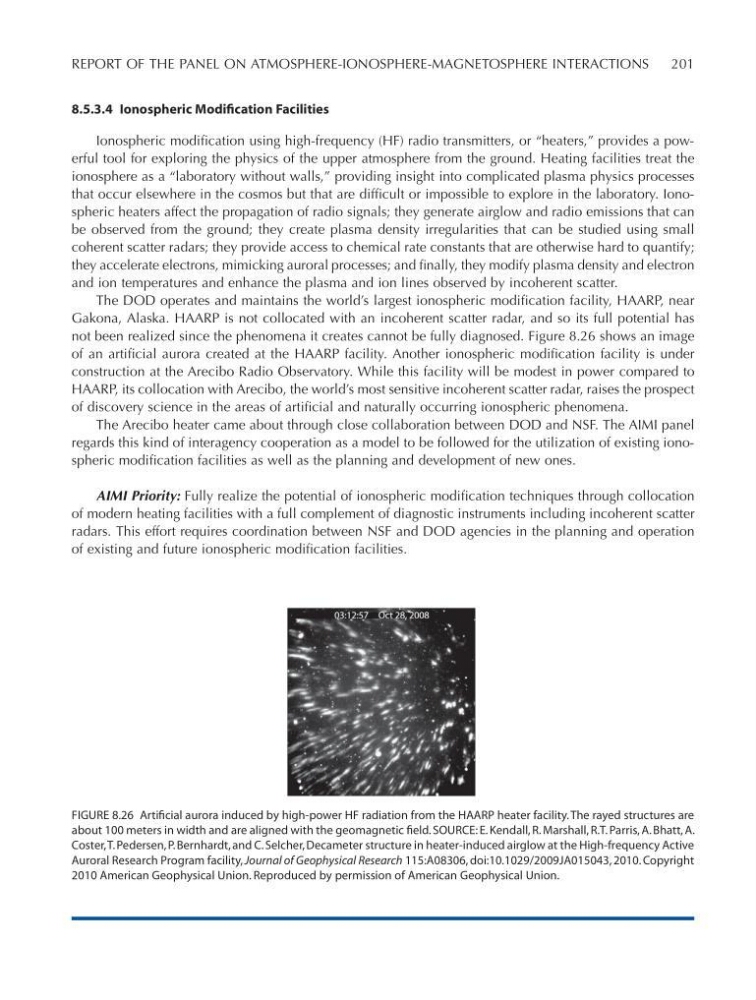
not been realized since the phenomena it creates cannot be fully diagnosed. Figure 8.26 shows an image
of an artificial aurora created at the HAARP facility. Another ionospheric modification facility is under
construction at the Arecibo Radio Observatory. While this facility will be modest in power compared to
HAARP, its collocation with Arecibo, the world’s most sensitive incoherent scatter radar, raises the prospect
of discovery science in the areas of artificial and naturally occurring ionospheric phenomena.
The Arecibo heater came about through close collaboration between DOD and NSF. The AIMI panel
regards this kind of interagency cooperation as a model to be followed for the utilization of existing ionospheric modification facilities as well as the planning and development of new ones.
AIMI Priority: Fully realize the potential of ionospheric modification techniques through collocation
of modern heating facilities with a full complement of diagnostic instruments including incoherent scatter
radars. This effort requires coordination between NSF and DOD agencies in the planning and operation
of existing and future ionospheric modification facilities.
FIGURE 8.26 Artificial aurora induced by high-power HF radiation from the HAARP heater facility. The rayed structures are
about 100 meters in width and are aligned with the geomagnetic field. SOURCE: E. Kendall, R. Marshall, R.T. Parris, A. Bhatt, A.
Coster, T. Pedersen, P. Bernhardt, and C. Selcher, Decameter structure in heater-induced airglow at the High-frequency Active
Auroral Research Program facility, Journal of Geophysical Research 115:A08306, doi:10.1029/2009JA015043, 2010. Copyright
2010 American Geophysical Union. Reproduced by permission of American Geophysical Union.
Figure 8-26
Solar and Space Physics: A Science for a Technological Society
REPORT OF THE PANEL ON ATMOSPHERE-IONOSPHERE-MAGNETOSPHERE INTERACTIONS
201
8.5.3.4 Ionospheric Modification Facilities
Ionospheric modification using high-frequency (HF) radio transmitters, or “heaters,” provides a powerful tool for exploring the physics of the upper atmosphere from the ground. Heating facilities treat the
ionosphere as a “laboratory without walls,” providing insight into complicated plasma physics processes
that occur elsewhere in the cosmos but that are difficult or impossible to explore in the laboratory. Ionospheric heaters affect the propagation of radio signals; they generate airglow and radio emissions that can
be observed from the ground; they create plasma density irregularities that can be studied using small
coherent scatter radars; they provide access to chemical rate constants that are otherwise hard to quantify;
they accelerate electrons, mimicking auroral processes; and finally, they modify plasma density and electron
and ion temperatures and enhance the plasma and ion lines observed by incoherent scatter.
The DOD operates and maintains the world’s largest ionospheric modification facility, HAARP, near
Gakona, Alaska. HAARP is not collocated with an incoherent scatter radar, and so its full potential has
not been realized since the phenomena it creates cannot be fully diagnosed. Figure 8.26 shows an image
of an artificial aurora created at the HAARP facility. Another ionospheric modification facility is under
construction at the Arecibo Radio Observatory. While this facility will be modest in power compared to
HAARP, its collocation with Arecibo, the world’s most sensitive incoherent scatter radar, raises the prospect
of discovery science in the areas of artificial and naturally occurring ionospheric phenomena.
The Arecibo heater came about through close collaboration between DOD and NSF. The AIMI panel
regards this kind of interagency cooperation as a model to be followed for the utilization of existing ionospheric modification facilities as well as the planning and development of new ones.
AIMI Priority: Fully realize the potential of ionospheric modification techniques through collocation
of modern heating facilities with a full complement of diagnostic instruments including incoherent scatter
radars. This effort requires coordination between NSF and DOD agencies in the planning and operation
of existing and future ionospheric modification facilities.
FIGURE 8.26 Artificial aurora induced by high-power HF radiation from the HAARP heater facility. The rayed structures are
about 100 meters in width and are aligned with the geomagnetic field. SOURCE: E. Kendall, R. Marshall, R.T. Parris, A. Bhatt, A.
Coster, T. Pedersen, P. Bernhardt, and C. Selcher, Decameter structure in heater-induced airglow at the High-frequency Active
Auroral Research Program facility, Journal of Geophysical Research 115:A08306, doi:10.1029/2009JA015043, 2010. Copyright
2010 American Geophysical Union. Reproduced by permission of American Geophysical Union.
Figure 8-26