

Copyright © National Academy of Sciences. All rights reserved.
Solar and Space Physics: A Science for a Technological Society
186
SOLAR AND SPACE PHYSICS: A SCIENCE FOR A TECHNOLOGICAL SOCIETY
highly elliptical orbits that will gather data that will address important science questions under AIMI science goals 2, 3, and 4, in addition to science goal 1, thus cutting across all three AIMI science priorities
for the 2013-2022 decade.
Baseline Mission and Possible Descope
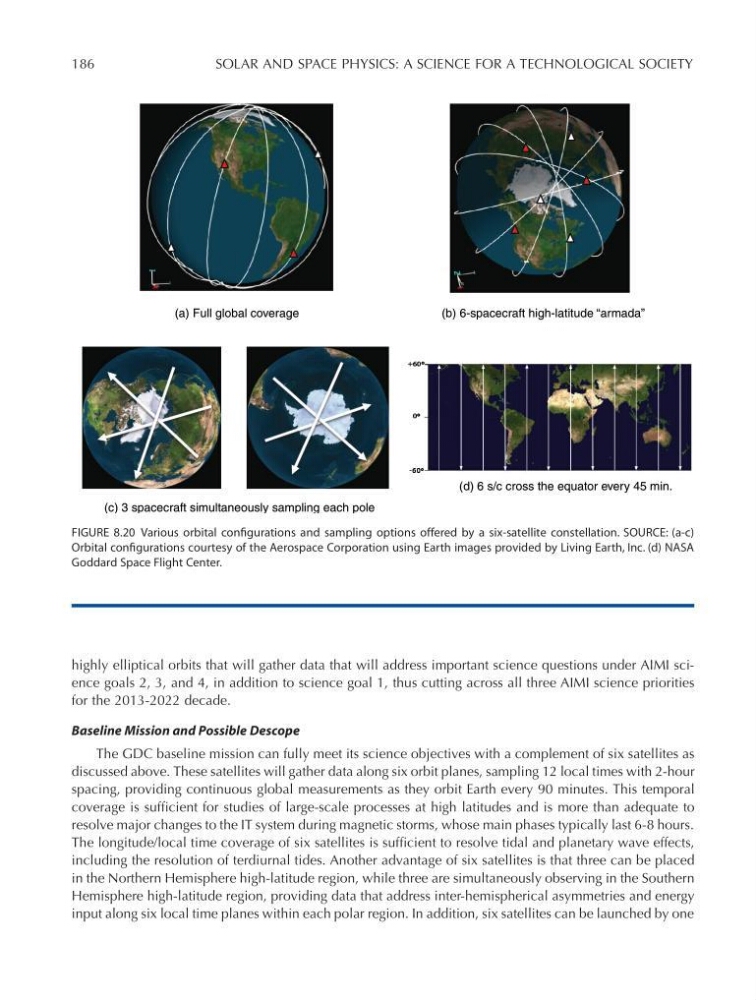
The GDC baseline mission can fully meet its science objectives with a complement of six satellites as
discussed above. These satellites will gather data along six orbit planes, sampling 12 local times with 2-hour
spacing, providing continuous global measurements as they orbit Earth every 90 minutes. This temporal
coverage is sufficient for studies of large-scale processes at high latitudes and is more than adequate to
resolve major changes to the IT system during magnetic storms, whose main phases typically last 6-8 hours.
The longitude/local time coverage of six satellites is sufficient to resolve tidal and planetary wave effects,
including the resolution of terdiurnal tides. Another advantage of six satellites is that three can be placed
in the Northern Hemisphere high-latitude region, while three are simultaneously observing in the Southern
Hemisphere high-latitude region, providing data that address inter-hemispherical asymmetries and energy
input along six local time planes within each polar region. In addition, six satellites can be launched by one
FIGURE 8.20 Various orbital configurations and sampling options offered by a six-satellite constellation. SOURCE: (a-c)
Orbital configurations courtesy of the Aerospace Corporation using Earth images provided by Living Earth, Inc. (d) NASA
Goddard Space Flight Center.
Figure 4-10 and 8-20
(a) Full global coverage
(b) 6-spacecraft high-latitude “armada”
(c) 3 spacecraft simultaneously sampling each pole
(d) 6 s/c cross the equator every 45 min.
Solar and Space Physics: A Science for a Technological Society
186
SOLAR AND SPACE PHYSICS: A SCIENCE FOR A TECHNOLOGICAL SOCIETY
highly elliptical orbits that will gather data that will address important science questions under AIMI science goals 2, 3, and 4, in addition to science goal 1, thus cutting across all three AIMI science priorities
for the 2013-2022 decade.
Baseline Mission and Possible Descope
The GDC baseline mission can fully meet its science objectives with a complement of six satellites as
discussed above. These satellites will gather data along six orbit planes, sampling 12 local times with 2-hour
spacing, providing continuous global measurements as they orbit Earth every 90 minutes. This temporal
coverage is sufficient for studies of large-scale processes at high latitudes and is more than adequate to
resolve major changes to the IT system during magnetic storms, whose main phases typically last 6-8 hours.
The longitude/local time coverage of six satellites is sufficient to resolve tidal and planetary wave effects,
including the resolution of terdiurnal tides. Another advantage of six satellites is that three can be placed
in the Northern Hemisphere high-latitude region, while three are simultaneously observing in the Southern
Hemisphere high-latitude region, providing data that address inter-hemispherical asymmetries and energy
input along six local time planes within each polar region. In addition, six satellites can be launched by one
FIGURE 8.20 Various orbital configurations and sampling options offered by a six-satellite constellation. SOURCE: (a-c)
Orbital configurations courtesy of the Aerospace Corporation using Earth images provided by Living Earth, Inc. (d) NASA
Goddard Space Flight Center.
Figure 4-10 and 8-20
(a) Full global coverage
(b) 6-spacecraft high-latitude “armada”
(c) 3 spacecraft simultaneously sampling each pole
(d) 6 s/c cross the equator every 45 min.