

Copyright © National Academy of Sciences. All rights reserved.
Solar and Space Physics: A Science for a Technological Society
184
SOLAR AND SPACE PHYSICS: A SCIENCE FOR A TECHNOLOGICAL SOCIETY
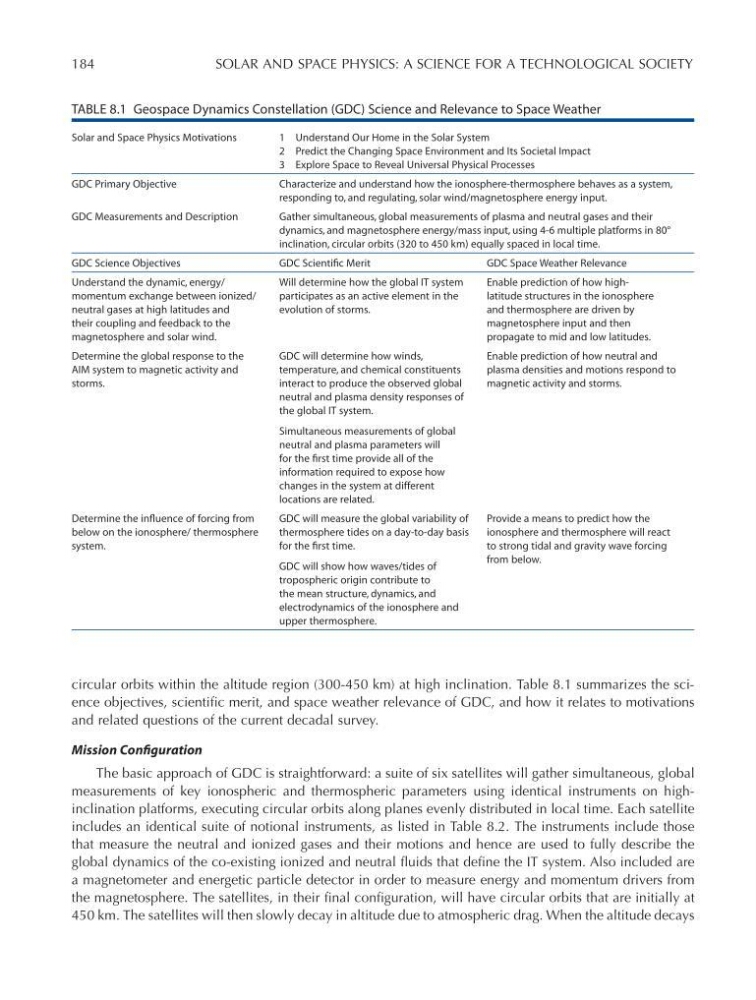
circular orbits within the altitude region (300-450 km) at high inclination. Table 8.1 summarizes the science objectives, scientific merit, and space weather relevance of GDC, and how it relates to motivations
and related questions of the current decadal survey.
Mission Configuration
The basic approach of GDC is straightforward: a suite of six satellites will gather simultaneous, global
measurements of key ionospheric and thermospheric parameters using identical instruments on highinclination platforms, executing circular orbits along planes evenly distributed in local time. Each satellite
includes an identical suite of notional instruments, as listed in Table 8.2. The instruments include those
that measure the neutral and ionized gases and their motions and hence are used to fully describe the
global dynamics of the co-existing ionized and neutral fluids that define the IT system. Also included are
a magnetometer and energetic particle detector in order to measure energy and momentum drivers from
the magnetosphere. The satellites, in their final configuration, will have circular orbits that are initially at
450 km. The satellites will then slowly decay in altitude due to atmospheric drag. When the altitude decays
TABLE 8.1 Geospace Dynamics Constellation (GDC) Science and Relevance to Space Weather
Solar and Space Physics Motivations
1 Understand Our Home in the Solar System
2 Predict the Changing Space Environment and Its Societal Impact
3 Explore Space to Reveal Universal Physical Processes
GDC Primary Objective
Characterize and understand how the ionosphere-thermosphere behaves as a system,
responding to, and regulating, solar wind/magnetosphere energy input.
GDC Measurements and Description
Gather simultaneous, global measurements of plasma and neutral gases and their
dynamics, and magnetosphere energy/mass input, using 4-6 multiple platforms in 80°
inclination, circular orbits (320 to 450 km) equally spaced in local time.
GDC Science Objectives
GDC Scientific Merit
GDC Space Weather Relevance
Understand the dynamic, energy/
momentum exchange between ionized/
neutral gases at high latitudes and
their coupling and feedback to the
magnetosphere and solar wind.
Will determine how the global IT system
participates as an active element in the
evolution of storms.
Enable prediction of how highlatitude structures in the ionosphere
and thermosphere are driven by
magnetosphere input and then
propagate to mid and low latitudes.
Determine the global response to the
AIM system to magnetic activity and
storms.
GDC will determine how winds,
temperature, and chemical constituents
interact to produce the observed global
neutral and plasma density responses of
the global IT system.
Simultaneous measurements of global
neutral and plasma parameters will
for the first time provide all of the
information required to expose how
changes in the system at different
locations are related.
Enable prediction of how neutral and
plasma densities and motions respond to
magnetic activity and storms.
Determine the influence of forcing from
below on the ionosphere/ thermosphere
system.
GDC will measure the global variability of
thermosphere tides on a day-to-day basis
for the first time.
GDC will show how waves/tides of
tropospheric origin contribute to
the mean structure, dynamics, and
electrodynamics of the ionosphere and
upper thermosphere.
Provide a means to predict how the
ionosphere and thermosphere will react
to strong tidal and gravity wave forcing
from below.
Solar and Space Physics: A Science for a Technological Society
184
SOLAR AND SPACE PHYSICS: A SCIENCE FOR A TECHNOLOGICAL SOCIETY
circular orbits within the altitude region (300-450 km) at high inclination. Table 8.1 summarizes the science objectives, scientific merit, and space weather relevance of GDC, and how it relates to motivations
and related questions of the current decadal survey.
Mission Configuration
The basic approach of GDC is straightforward: a suite of six satellites will gather simultaneous, global
measurements of key ionospheric and thermospheric parameters using identical instruments on highinclination platforms, executing circular orbits along planes evenly distributed in local time. Each satellite
includes an identical suite of notional instruments, as listed in Table 8.2. The instruments include those
that measure the neutral and ionized gases and their motions and hence are used to fully describe the
global dynamics of the co-existing ionized and neutral fluids that define the IT system. Also included are
a magnetometer and energetic particle detector in order to measure energy and momentum drivers from
the magnetosphere. The satellites, in their final configuration, will have circular orbits that are initially at
450 km. The satellites will then slowly decay in altitude due to atmospheric drag. When the altitude decays
TABLE 8.1 Geospace Dynamics Constellation (GDC) Science and Relevance to Space Weather
Solar and Space Physics Motivations
1 Understand Our Home in the Solar System
2 Predict the Changing Space Environment and Its Societal Impact
3 Explore Space to Reveal Universal Physical Processes
GDC Primary Objective
Characterize and understand how the ionosphere-thermosphere behaves as a system,
responding to, and regulating, solar wind/magnetosphere energy input.
GDC Measurements and Description
Gather simultaneous, global measurements of plasma and neutral gases and their
dynamics, and magnetosphere energy/mass input, using 4-6 multiple platforms in 80°
inclination, circular orbits (320 to 450 km) equally spaced in local time.
GDC Science Objectives
GDC Scientific Merit
GDC Space Weather Relevance
Understand the dynamic, energy/
momentum exchange between ionized/
neutral gases at high latitudes and
their coupling and feedback to the
magnetosphere and solar wind.
Will determine how the global IT system
participates as an active element in the
evolution of storms.
Enable prediction of how highlatitude structures in the ionosphere
and thermosphere are driven by
magnetosphere input and then
propagate to mid and low latitudes.
Determine the global response to the
AIM system to magnetic activity and
storms.
GDC will determine how winds,
temperature, and chemical constituents
interact to produce the observed global
neutral and plasma density responses of
the global IT system.
Simultaneous measurements of global
neutral and plasma parameters will
for the first time provide all of the
information required to expose how
changes in the system at different
locations are related.
Enable prediction of how neutral and
plasma densities and motions respond to
magnetic activity and storms.
Determine the influence of forcing from
below on the ionosphere/ thermosphere
system.
GDC will measure the global variability of
thermosphere tides on a day-to-day basis
for the first time.
GDC will show how waves/tides of
tropospheric origin contribute to
the mean structure, dynamics, and
electrodynamics of the ionosphere and
upper thermosphere.
Provide a means to predict how the
ionosphere and thermosphere will react
to strong tidal and gravity wave forcing
from below.