

Copyright © National Academy of Sciences. All rights reserved.
Solar and Space Physics: A Science for a Technological Society
180
SOLAR AND SPACE PHYSICS: A SCIENCE FOR A TECHNOLOGICAL SOCIETY
Model simulations and decades of observations indicate that changes in ozone and greenhouse gases
have produced long-term changes in the wind fields of the stratosphere and mesosphere that serve as the
environment through which tropospherically excited waves propagate. Waves propagating through the
middle atmosphere and into the base of the thermosphere (ca. 100 km) must therefore also undergo change,
and this is confirmed by trends seen in long-term wind and magnetic perturbations between 80 and 120
km observed from the ground. Since dissipation of waves in this region helps drive the mean circulation
of the mesosphere and lower thermosphere, these effects must feed back to modify the circulation system
that resulted in the changed wave spectrum in the first place. In addition, there is the question of downward control and whether the adiabatic heating and cooling effects of the wave-driven vertical motion
field extend far enough down in altitude to have practical consequences.
One of the most spectacular signatures of the coupling of the lower and upper atmosphere is the
existence of polar mesospheric clouds (PMCs). These water ice clouds at the edge of space (~84 km) are
seen in the summer hemisphere. Stratospheric and mesospheric water vapor is created largely through the
oxidation of methane (CH 4 ). Water vapor is trapped at the tropopause while methane is mixed into the
upper atmosphere, thus changing the hydrogen chemistry of the upper atmosphere. Local temperature is
also key to the existence of PMCs, and at these altitudes is determined largely by the adiabatic heating
and cooling accompanying the wave-driven circulation discussed above. In the coming decade, the AIM
community will build on the work of previous missions like the NASA Aeronomy of Ice Mission and the
Thermosphere Ionosphere Mesosphere Energetics and Dynamics (TIMED) mission to understand how
geospace is influenced by the lower atmosphere.
One of the urgent, unresolved heliophysics questions is how feedback processes in the Earth system
amplify the effects of small changes in solar energy output, leading to disproportionately large changes
in atmospheric parameters. The atmospheric response to energetic particle precipitation (EPP) is a key
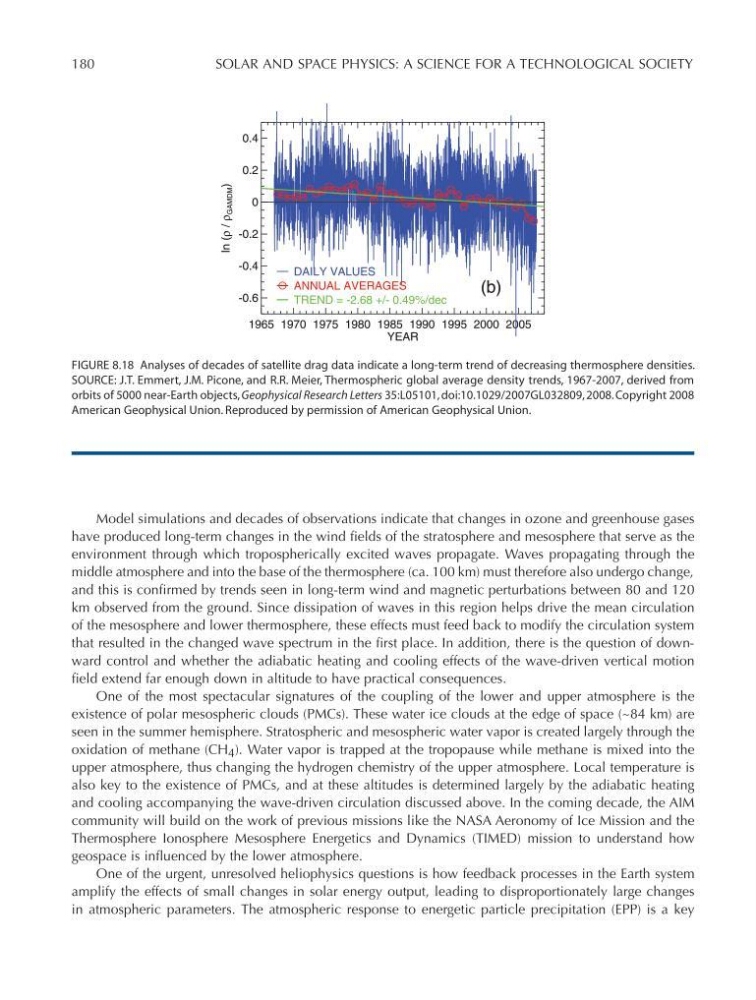
FIGURE 8.18 Analyses of decades of satellite drag data indicate a long-term trend of decreasing thermosphere densities.
SOURCE: J.T. Emmert, J.M. Picone, and R.R. Meier, Thermospheric global average density trends, 1967-2007, derived from
orbits of 5000 near-Earth objects, Geophysical Research Letters 35:L05101, doi:10.1029/2007GL032809, 2008. Copyright 2008
American Geophysical Union. Reproduced by permission of American Geophysical Union.
Figure 2-13 and 8-18
vector editable, may be enlarged
Solar and Space Physics: A Science for a Technological Society
180
SOLAR AND SPACE PHYSICS: A SCIENCE FOR A TECHNOLOGICAL SOCIETY
Model simulations and decades of observations indicate that changes in ozone and greenhouse gases
have produced long-term changes in the wind fields of the stratosphere and mesosphere that serve as the
environment through which tropospherically excited waves propagate. Waves propagating through the
middle atmosphere and into the base of the thermosphere (ca. 100 km) must therefore also undergo change,
and this is confirmed by trends seen in long-term wind and magnetic perturbations between 80 and 120
km observed from the ground. Since dissipation of waves in this region helps drive the mean circulation
of the mesosphere and lower thermosphere, these effects must feed back to modify the circulation system
that resulted in the changed wave spectrum in the first place. In addition, there is the question of downward control and whether the adiabatic heating and cooling effects of the wave-driven vertical motion
field extend far enough down in altitude to have practical consequences.
One of the most spectacular signatures of the coupling of the lower and upper atmosphere is the
existence of polar mesospheric clouds (PMCs). These water ice clouds at the edge of space (~84 km) are
seen in the summer hemisphere. Stratospheric and mesospheric water vapor is created largely through the
oxidation of methane (CH 4 ). Water vapor is trapped at the tropopause while methane is mixed into the
upper atmosphere, thus changing the hydrogen chemistry of the upper atmosphere. Local temperature is
also key to the existence of PMCs, and at these altitudes is determined largely by the adiabatic heating
and cooling accompanying the wave-driven circulation discussed above. In the coming decade, the AIM
community will build on the work of previous missions like the NASA Aeronomy of Ice Mission and the
Thermosphere Ionosphere Mesosphere Energetics and Dynamics (TIMED) mission to understand how
geospace is influenced by the lower atmosphere.
One of the urgent, unresolved heliophysics questions is how feedback processes in the Earth system
amplify the effects of small changes in solar energy output, leading to disproportionately large changes
in atmospheric parameters. The atmospheric response to energetic particle precipitation (EPP) is a key
FIGURE 8.18 Analyses of decades of satellite drag data indicate a long-term trend of decreasing thermosphere densities.
SOURCE: J.T. Emmert, J.M. Picone, and R.R. Meier, Thermospheric global average density trends, 1967-2007, derived from
orbits of 5000 near-Earth objects, Geophysical Research Letters 35:L05101, doi:10.1029/2007GL032809, 2008. Copyright 2008
American Geophysical Union. Reproduced by permission of American Geophysical Union.
Figure 2-13 and 8-18
vector editable, may be enlarged