

Copyright © National Academy of Sciences. All rights reserved.
Solar and Space Physics: A Science for a Technological Society
REPORT OF THE PANEL ON ATMOSPHERE-IONOSPHERE-MAGNETOSPHERE INTERACTIONS
179
this challenge will provide vital information not only on the variability of Earth’s near-space environment,
but also on terrestrial climate variability and change.
Human activities, particularly the introduction of greenhouse gases (e.g., CO 2 and CH 4 ) into the
atmosphere, are changing the global climate. One of the many manifold demonstrations that the change
in Earth’s climate is due to the rise in CO 2 concentrations is that the lower atmosphere is warming while
the upper atmosphere is cooling. This demonstrable fact is fully consonant with the well-understood role of
CO 2 as an effective radiator of energy in the upper atmosphere. A systematic decrease by several percent
per decade near 400-km altitude in thermosphere mass density has recently been identified, evident in the
record of satellite orbit decay measured since the beginning of the space age (Figure 8.18).
One result of an increase in the average temperature in the lower atmosphere is that the amount of
water vapor, and consequently the available latent heat, may increase. Possible consequences include
changes in the strength of the lower-atmosphere tides that, as noted above, modify the longitudinal structure
of the ionosphere. Gravity wave, Kelvin wave, and planetary wave fluxes are also likely to be affected.
Given recent findings of an El Niño-Southern Oscillation-related signature in low-latitude ionospheric
structure, scientists should expect its structure to change in response to other climate changes in the lower
atmosphere. Another aspect of lower-atmosphere changes is an expected increase in the number of severe
storms. If ionospheric instabilities are seeded by tropospheric gravity waves propagating into the upper
atmosphere, this may have an impact on the frequency of these events. Another source of gravity waves
is the flow of tropospheric winds over topographic features. If lower atmospheric circulation patterns are
altered, this too may change the spectrum and frequency of occurrence of gravity waves, and ionospheric
instabilities.
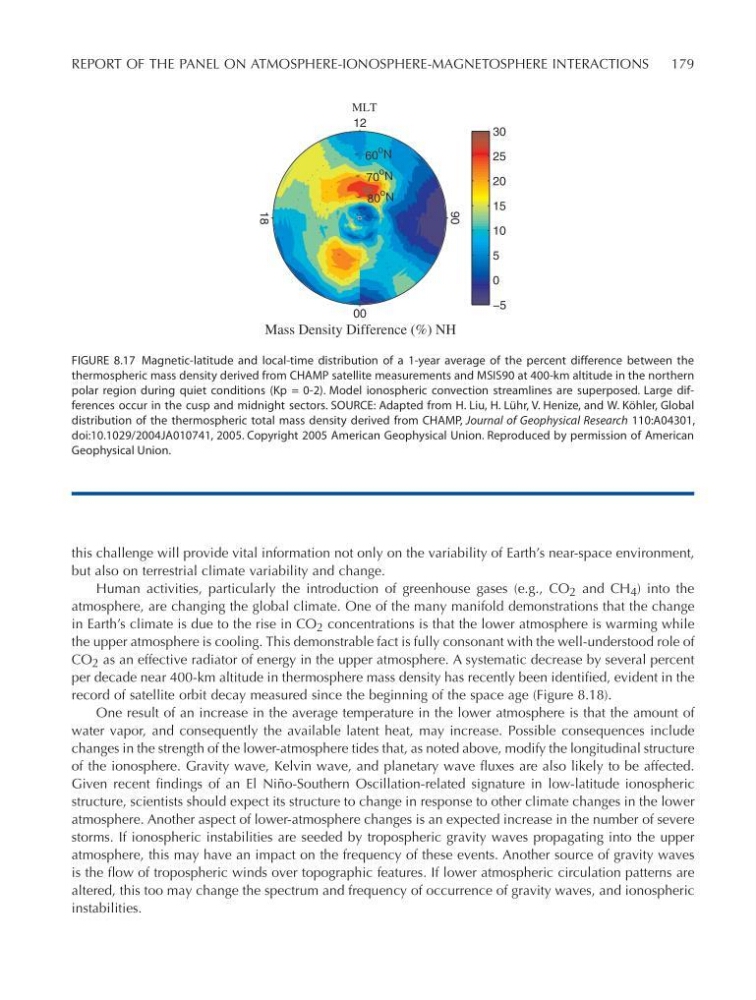
FIGURE 8.17 Magnetic-latitude and local-time distribution of a 1-year average of the percent difference between the
thermospheric mass density derived from CHAMP satellite measurements and MSIS90 at 400-km altitude in the northern
polar region during quiet conditions (Kp = 0-2). Model ionospheric convection streamlines are superposed. Large differences occur in the cusp and midnight sectors. SOURCE: Adapted from H. Liu, H. Lühr, V. Henize, and W. Köhler, Global
distribution of the thermospheric total mass density derived from CHAMP, Journal of Geophysical Research 110:A04301,
doi:10.1029/2004JA010741, 2005. Copyright 2005 American Geophysical Union. Reproduced by permission of American
Geophysical Union.
Figure 8-17
Solar and Space Physics: A Science for a Technological Society
REPORT OF THE PANEL ON ATMOSPHERE-IONOSPHERE-MAGNETOSPHERE INTERACTIONS
179
this challenge will provide vital information not only on the variability of Earth’s near-space environment,
but also on terrestrial climate variability and change.
Human activities, particularly the introduction of greenhouse gases (e.g., CO 2 and CH 4 ) into the
atmosphere, are changing the global climate. One of the many manifold demonstrations that the change
in Earth’s climate is due to the rise in CO 2 concentrations is that the lower atmosphere is warming while
the upper atmosphere is cooling. This demonstrable fact is fully consonant with the well-understood role of
CO 2 as an effective radiator of energy in the upper atmosphere. A systematic decrease by several percent
per decade near 400-km altitude in thermosphere mass density has recently been identified, evident in the
record of satellite orbit decay measured since the beginning of the space age (Figure 8.18).
One result of an increase in the average temperature in the lower atmosphere is that the amount of
water vapor, and consequently the available latent heat, may increase. Possible consequences include
changes in the strength of the lower-atmosphere tides that, as noted above, modify the longitudinal structure
of the ionosphere. Gravity wave, Kelvin wave, and planetary wave fluxes are also likely to be affected.
Given recent findings of an El Niño-Southern Oscillation-related signature in low-latitude ionospheric
structure, scientists should expect its structure to change in response to other climate changes in the lower
atmosphere. Another aspect of lower-atmosphere changes is an expected increase in the number of severe
storms. If ionospheric instabilities are seeded by tropospheric gravity waves propagating into the upper
atmosphere, this may have an impact on the frequency of these events. Another source of gravity waves
is the flow of tropospheric winds over topographic features. If lower atmospheric circulation patterns are
altered, this too may change the spectrum and frequency of occurrence of gravity waves, and ionospheric
instabilities.
FIGURE 8.17 Magnetic-latitude and local-time distribution of a 1-year average of the percent difference between the
thermospheric mass density derived from CHAMP satellite measurements and MSIS90 at 400-km altitude in the northern
polar region during quiet conditions (Kp = 0-2). Model ionospheric convection streamlines are superposed. Large differences occur in the cusp and midnight sectors. SOURCE: Adapted from H. Liu, H. Lühr, V. Henize, and W. Köhler, Global
distribution of the thermospheric total mass density derived from CHAMP, Journal of Geophysical Research 110:A04301,
doi:10.1029/2004JA010741, 2005. Copyright 2005 American Geophysical Union. Reproduced by permission of American
Geophysical Union.
Figure 8-17