

Copyright © National Academy of Sciences. All rights reserved.
Solar and Space Physics: A Science for a Technological Society
REPORT OF THE PANEL ON ATMOSPHERE-IONOSPHERE-MAGNETOSPHERE INTERACTIONS
177
terminator waves, and atmospheric superrotation. In summary, the overarching question that captures most
low-latitude IT phenomena is thus, How are gas temperatures and densities at low latitudes modified by
momentum transfer between neutrals and ions in the presence of a magnetic field?
Middle latitudes serve as a laboratory for different kinds of plasma-neutral interactions that also exhibit
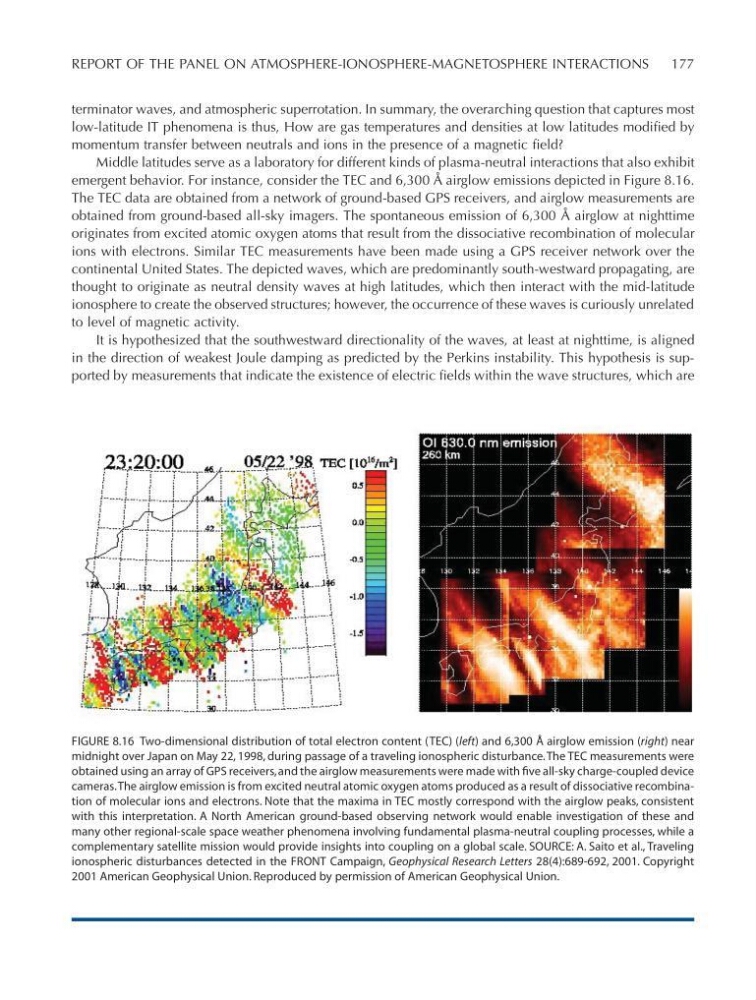
emergent behavior. For instance, consider the TEC and 6,300 Å airglow emissions depicted in Figure 8.16.
The TEC data are obtained from a network of ground-based GPS receivers, and airglow measurements are
obtained from ground-based all-sky imagers. The spontaneous emission of 6,300 Å airglow at nighttime
originates from excited atomic oxygen atoms that result from the dissociative recombination of molecular
ions with electrons. Similar TEC measurements have been made using a GPS receiver network over the
continental United States. The depicted waves, which are predominantly south-westward propagating, are
thought to originate as neutral density waves at high latitudes, which then interact with the mid-latitude
ionosphere to create the observed structures; however, the occurrence of these waves is curiously unrelated
to level of magnetic activity.
It is hypothesized that the southwestward directionality of the waves, at least at nighttime, is aligned
in the direction of weakest Joule damping as predicted by the Perkins instability. This hypothesis is supported by measurements that indicate the existence of electric fields within the wave structures, which are
FIGURE 8.16 Two-dimensional distribution of total electron content (TEC) (left) and 6,300 Å airglow emission (right) near
midnight over Japan on May 22, 1998, during passage of a traveling ionospheric disturbance. The TEC measurements were
obtained using an array of GPS receivers, and the airglow measurements were made with five all-sky charge-coupled device
cameras. The airglow emission is from excited neutral atomic oxygen atoms produced as a result of dissociative recombination of molecular ions and electrons. Note that the maxima in TEC mostly correspond with the airglow peaks, consistent
with this interpretation. A North American ground-based observing network would enable investigation of these and
many other regional-scale space weather phenomena involving fundamental plasma-neutral coupling processes, while a
complementary satellite mission would provide insights into coupling on a global scale. SOURCE: A. Saito et al., Traveling
ionospheric disturbances detected in the FRONT Campaign, Geophysical Research Letters 28(4):689-692, 2001. Copyright
2001 American Geophysical Union. Reproduced by permission of American Geophysical Union.
Figure 8-16
Solar and Space Physics: A Science for a Technological Society
REPORT OF THE PANEL ON ATMOSPHERE-IONOSPHERE-MAGNETOSPHERE INTERACTIONS
177
terminator waves, and atmospheric superrotation. In summary, the overarching question that captures most
low-latitude IT phenomena is thus, How are gas temperatures and densities at low latitudes modified by
momentum transfer between neutrals and ions in the presence of a magnetic field?
Middle latitudes serve as a laboratory for different kinds of plasma-neutral interactions that also exhibit
emergent behavior. For instance, consider the TEC and 6,300 Å airglow emissions depicted in Figure 8.16.
The TEC data are obtained from a network of ground-based GPS receivers, and airglow measurements are
obtained from ground-based all-sky imagers. The spontaneous emission of 6,300 Å airglow at nighttime
originates from excited atomic oxygen atoms that result from the dissociative recombination of molecular
ions with electrons. Similar TEC measurements have been made using a GPS receiver network over the
continental United States. The depicted waves, which are predominantly south-westward propagating, are
thought to originate as neutral density waves at high latitudes, which then interact with the mid-latitude
ionosphere to create the observed structures; however, the occurrence of these waves is curiously unrelated
to level of magnetic activity.
It is hypothesized that the southwestward directionality of the waves, at least at nighttime, is aligned
in the direction of weakest Joule damping as predicted by the Perkins instability. This hypothesis is supported by measurements that indicate the existence of electric fields within the wave structures, which are
FIGURE 8.16 Two-dimensional distribution of total electron content (TEC) (left) and 6,300 Å airglow emission (right) near
midnight over Japan on May 22, 1998, during passage of a traveling ionospheric disturbance. The TEC measurements were
obtained using an array of GPS receivers, and the airglow measurements were made with five all-sky charge-coupled device
cameras. The airglow emission is from excited neutral atomic oxygen atoms produced as a result of dissociative recombination of molecular ions and electrons. Note that the maxima in TEC mostly correspond with the airglow peaks, consistent
with this interpretation. A North American ground-based observing network would enable investigation of these and
many other regional-scale space weather phenomena involving fundamental plasma-neutral coupling processes, while a
complementary satellite mission would provide insights into coupling on a global scale. SOURCE: A. Saito et al., Traveling
ionospheric disturbances detected in the FRONT Campaign, Geophysical Research Letters 28(4):689-692, 2001. Copyright
2001 American Geophysical Union. Reproduced by permission of American Geophysical Union.
Figure 8-16