

Copyright © National Academy of Sciences. All rights reserved.
Solar and Space Physics: A Science for a Technological Society
176
SOLAR AND SPACE PHYSICS: A SCIENCE FOR A TECHNOLOGICAL SOCIETY
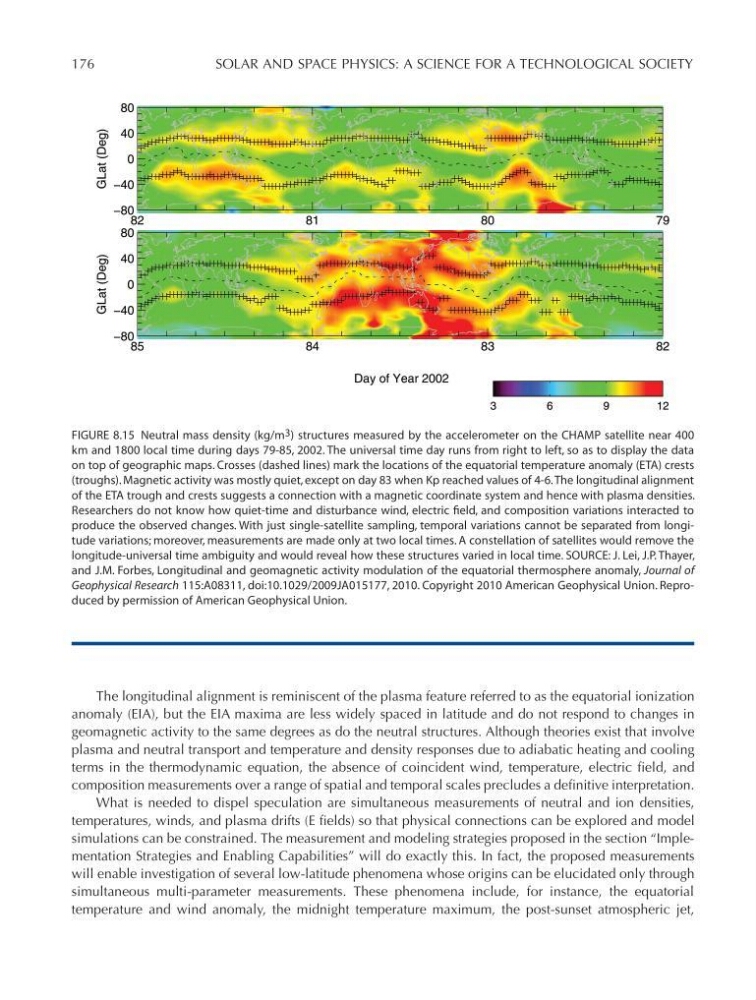
The longitudinal alignment is reminiscent of the plasma feature referred to as the equatorial ionization
anomaly (EIA), but the EIA maxima are less widely spaced in latitude and do not respond to changes in
geomagnetic activity to the same degrees as do the neutral structures. Although theories exist that involve
plasma and neutral transport and temperature and density responses due to adiabatic heating and cooling
terms in the thermodynamic equation, the absence of coincident wind, temperature, electric field, and
composition measurements over a range of spatial and temporal scales precludes a definitive interpretation.
What is needed to dispel speculation are simultaneous measurements of neutral and ion densities,
temperatures, winds, and plasma drifts (E fields) so that physical connections can be explored and model
simulations can be constrained. The measurement and modeling strategies proposed in the section “Implementation Strategies and Enabling Capabilities” will do exactly this. In fact, the proposed measurements
will enable investigation of several low-latitude phenomena whose origins can be elucidated only through
simultaneous multi-parameter measurements. These phenomena include, for instance, the equatorial
temperature and wind anomaly, the midnight temperature maximum, the post-sunset atmospheric jet,
FIGURE 8.15 Neutral mass density (kg/m 3 ) structures measured by the accelerometer on the CHAMP satellite near 400
km and 1800 local time during days 79-85, 2002. The universal time day runs from right to left, so as to display the data
on top of geographic maps. Crosses (dashed lines) mark the locations of the equatorial temperature anomaly (ETA) crests
(troughs). Magnetic activity was mostly quiet, except on day 83 when Kp reached values of 4-6. The longitudinal alignment
of the ETA trough and crests suggests a connection with a magnetic coordinate system and hence with plasma densities.
Researchers do not know how quiet-time and disturbance wind, electric field, and composition variations interacted to
produce the observed changes. With just single-satellite sampling, temporal variations cannot be separated from longitude variations; moreover, measurements are made only at two local times. A constellation of satellites would remove the
longitude-universal time ambiguity and would reveal how these structures varied in local time. SOURCE: J. Lei, J.P. Thayer,
and J.M. Forbes, Longitudinal and geomagnetic activity modulation of the equatorial thermosphere anomaly, Journal of
Geophysical Research 115:A08311, doi:10.1029/2009JA015177, 2010. Copyright 2010 American Geophysical Union. Reproduced by permission of American Geophysical Union.
Figure 8-15
Solar and Space Physics: A Science for a Technological Society
176
SOLAR AND SPACE PHYSICS: A SCIENCE FOR A TECHNOLOGICAL SOCIETY
The longitudinal alignment is reminiscent of the plasma feature referred to as the equatorial ionization
anomaly (EIA), but the EIA maxima are less widely spaced in latitude and do not respond to changes in
geomagnetic activity to the same degrees as do the neutral structures. Although theories exist that involve
plasma and neutral transport and temperature and density responses due to adiabatic heating and cooling
terms in the thermodynamic equation, the absence of coincident wind, temperature, electric field, and
composition measurements over a range of spatial and temporal scales precludes a definitive interpretation.
What is needed to dispel speculation are simultaneous measurements of neutral and ion densities,
temperatures, winds, and plasma drifts (E fields) so that physical connections can be explored and model
simulations can be constrained. The measurement and modeling strategies proposed in the section “Implementation Strategies and Enabling Capabilities” will do exactly this. In fact, the proposed measurements
will enable investigation of several low-latitude phenomena whose origins can be elucidated only through
simultaneous multi-parameter measurements. These phenomena include, for instance, the equatorial
temperature and wind anomaly, the midnight temperature maximum, the post-sunset atmospheric jet,
FIGURE 8.15 Neutral mass density (kg/m 3 ) structures measured by the accelerometer on the CHAMP satellite near 400
km and 1800 local time during days 79-85, 2002. The universal time day runs from right to left, so as to display the data
on top of geographic maps. Crosses (dashed lines) mark the locations of the equatorial temperature anomaly (ETA) crests
(troughs). Magnetic activity was mostly quiet, except on day 83 when Kp reached values of 4-6. The longitudinal alignment
of the ETA trough and crests suggests a connection with a magnetic coordinate system and hence with plasma densities.
Researchers do not know how quiet-time and disturbance wind, electric field, and composition variations interacted to
produce the observed changes. With just single-satellite sampling, temporal variations cannot be separated from longitude variations; moreover, measurements are made only at two local times. A constellation of satellites would remove the
longitude-universal time ambiguity and would reveal how these structures varied in local time. SOURCE: J. Lei, J.P. Thayer,
and J.M. Forbes, Longitudinal and geomagnetic activity modulation of the equatorial thermosphere anomaly, Journal of
Geophysical Research 115:A08311, doi:10.1029/2009JA015177, 2010. Copyright 2010 American Geophysical Union. Reproduced by permission of American Geophysical Union.
Figure 8-15