

Copyright © National Academy of Sciences. All rights reserved.
Solar and Space Physics: A Science for a Technological Society
SPACE WEATHER AND SPACE CLIMATOLOGY: A VISION FOR FUTURE CAPABILITIES
145
—Continue the grants program to transition to operations the environment specification and forecasting models for use by NASA and NOAA and DOD operations.
• Year 5
—Operate the operational L1 mission, and initiate a concept study of a follow-on mission.
—Continue development of a solar monitoring mission for L5.
—Initiate a geospace monitoring mission concept study.
—At a NASA center, plan for integration of operational L5 and geospace monitoring measurements
into space environment specification and forecasting models.
—Continue the grants program to facilitate a transition to operational readiness of space environment specification and forecasting models that will include new data sets as they become available.
A new plan is also needed that synthesizes and capitalizes on the strengths of the participating agencies
listed above as well as opportunities in the commercial sector, such as Iridium/AMPERE. The committee
sees NASA as assuming a leading role in creating a clearinghouse for coordinating the acquisition, processing, and archiving of underutilized real-time and near-real-time ground- and space-based data needed for
space weather applications. For example, highly valued energetic particle measurements made by GPS
and Los Alamos National Laboratory GEO satellites for specification of the radiation belts are not now
routinely provided. Likewise, model development has been supported by individual agencies rather than
being coordinated across relevant stakeholders.
The survey committee also foresees NASA assuming a leading role in coordinating model development
through a center such as the Community Coordinated Modeling Center, which both serves as a repository
for models and coordinates model development and transition to operations at NOAA, NASA, and DOD.
Additional funding will be required by NOAA and DOD to support the integration of data acquired and
models developed by the envisioned new NASA program in order to address the specific needs of the user
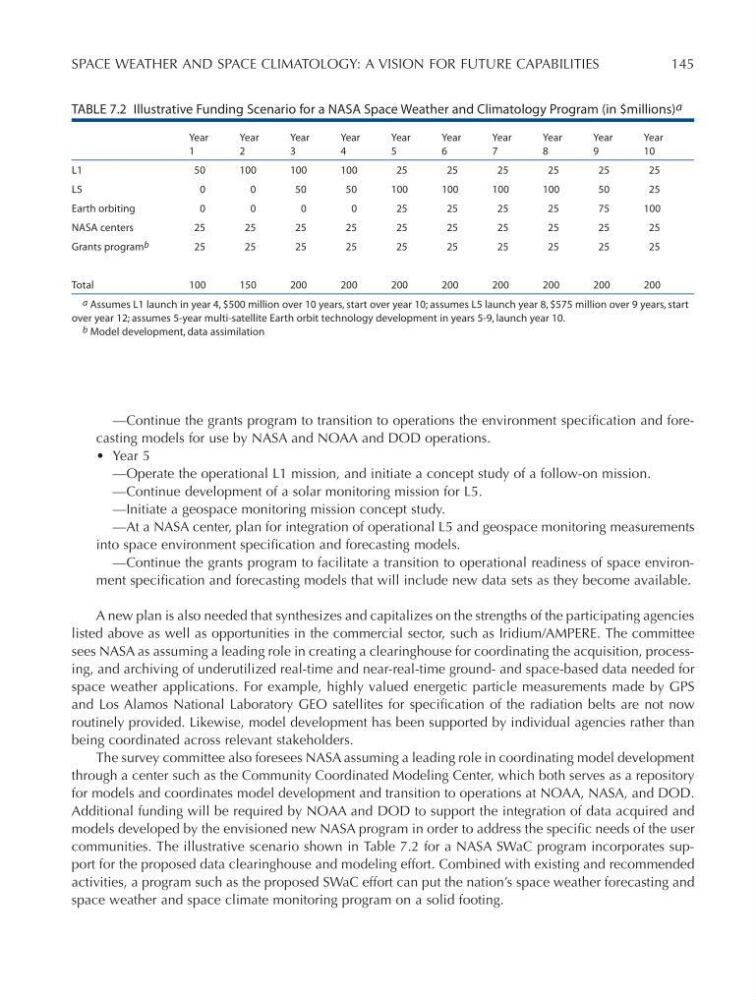
communities. The illustrative scenario shown in Table 7.2 for a NASA SWaC program incorporates support for the proposed data clearinghouse and modeling effort. Combined with existing and recommended
activities, a program such as the proposed SWaC effort can put the nation’s space weather forecasting and
space weather and space climate monitoring program on a solid footing.
TABLE 7.2 Illustrative Funding Scenario for a NASA Space Weather and Climatology Program (in $millions) a
Year
1
Year
2
Year
3
Year
4
Year
5
Year
6
Year
7
Year
8
Year
9
Year
10
L1
50
100
100
100
25
25
25
25
25
25
L5
0
0
50
50
100
100
100
100
50
25
Earth orbiting
0
0
0
0
25
25
25
25
75
100
NASA centers
25
25
25
25
25
25
25
25
25
25
Grants program b
25
25
25
25
25
25
25
25
25
25
Total
100
150
200
200
200
200
200
200
200
200
a Assumes L1 launch in year 4, $500 million over 10 years, start over year 10; assumes L5 launch year 8, $575 million over 9 years, start
over year 12; assumes 5-year multi-satellite Earth orbit technology development in years 5-9, launch year 10.
b Model development, data assimilation
Solar and Space Physics: A Science for a Technological Society
SPACE WEATHER AND SPACE CLIMATOLOGY: A VISION FOR FUTURE CAPABILITIES
145
—Continue the grants program to transition to operations the environment specification and forecasting models for use by NASA and NOAA and DOD operations.
• Year 5
—Operate the operational L1 mission, and initiate a concept study of a follow-on mission.
—Continue development of a solar monitoring mission for L5.
—Initiate a geospace monitoring mission concept study.
—At a NASA center, plan for integration of operational L5 and geospace monitoring measurements
into space environment specification and forecasting models.
—Continue the grants program to facilitate a transition to operational readiness of space environment specification and forecasting models that will include new data sets as they become available.
A new plan is also needed that synthesizes and capitalizes on the strengths of the participating agencies
listed above as well as opportunities in the commercial sector, such as Iridium/AMPERE. The committee
sees NASA as assuming a leading role in creating a clearinghouse for coordinating the acquisition, processing, and archiving of underutilized real-time and near-real-time ground- and space-based data needed for
space weather applications. For example, highly valued energetic particle measurements made by GPS
and Los Alamos National Laboratory GEO satellites for specification of the radiation belts are not now
routinely provided. Likewise, model development has been supported by individual agencies rather than
being coordinated across relevant stakeholders.
The survey committee also foresees NASA assuming a leading role in coordinating model development
through a center such as the Community Coordinated Modeling Center, which both serves as a repository
for models and coordinates model development and transition to operations at NOAA, NASA, and DOD.
Additional funding will be required by NOAA and DOD to support the integration of data acquired and
models developed by the envisioned new NASA program in order to address the specific needs of the user
communities. The illustrative scenario shown in Table 7.2 for a NASA SWaC program incorporates support for the proposed data clearinghouse and modeling effort. Combined with existing and recommended
activities, a program such as the proposed SWaC effort can put the nation’s space weather forecasting and
space weather and space climate monitoring program on a solid footing.
TABLE 7.2 Illustrative Funding Scenario for a NASA Space Weather and Climatology Program (in $millions) a
Year
1
Year
2
Year
3
Year
4
Year
5
Year
6
Year
7
Year
8
Year
9
Year
10
L1
50
100
100
100
25
25
25
25
25
25
L5
0
0
50
50
100
100
100
100
50
25
Earth orbiting
0
0
0
0
25
25
25
25
75
100
NASA centers
25
25
25
25
25
25
25
25
25
25
Grants program b
25
25
25
25
25
25
25
25
25
25
Total
100
150
200
200
200
200
200
200
200
200
a Assumes L1 launch in year 4, $500 million over 10 years, start over year 10; assumes L5 launch year 8, $575 million over 9 years, start
over year 12; assumes 5-year multi-satellite Earth orbit technology development in years 5-9, launch year 10.
b Model development, data assimilation