

Copyright © National Academy of Sciences. All rights reserved.
Solar and Space Physics: A Science for a Technological Society
144
SOLAR AND SPACE PHYSICS: A SCIENCE FOR A TECHNOLOGICAL SOCIETY
—Evaluate the effectiveness of the proposed new space weather clearinghouse in meeting multiagency operational forecast needs.
—Continue the grants program to test the operational readiness of space environment specification
and forecasting models and coordinate with DOD and NOAA partners.
• Year 4
—Build, integrate, and launch an operational L1 mission.
—Continue development of a solar monitoring mission for L5.
—At a NASA center, begin to integrate and distribute operational L1 measurements.
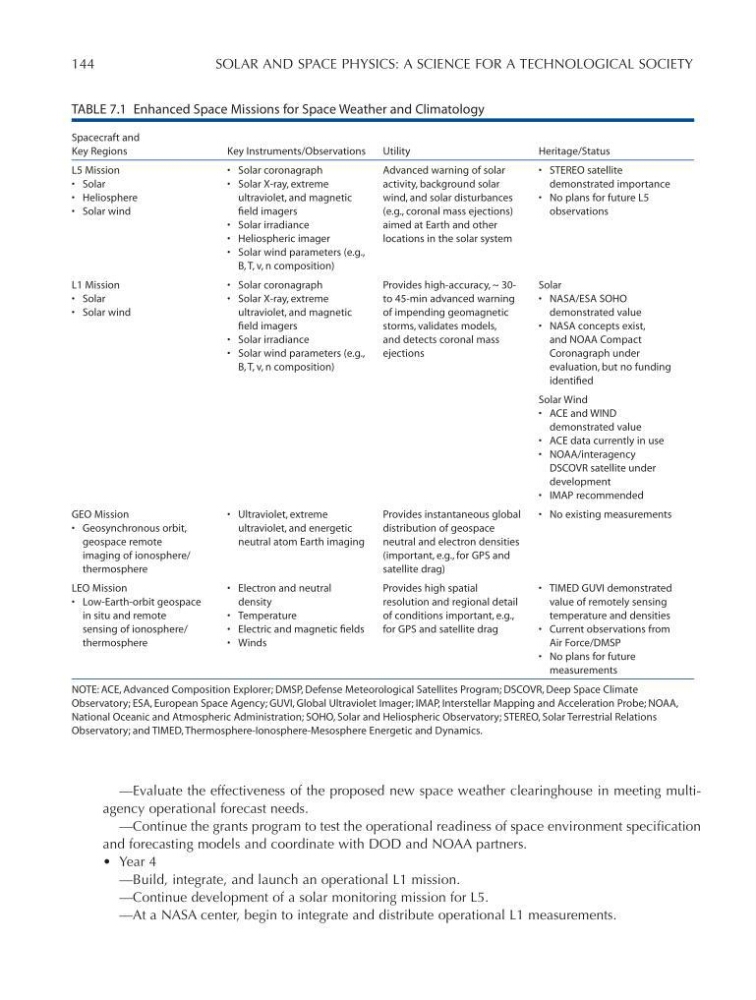
TABLE 7.1 Enhanced Space Missions for Space Weather and Climatology
Spacecraft and
Key Regions
Key Instruments/Observations
Utility
Heritage/Status
L5 Mission
• Solar
• Heliosphere
• Solar wind
• Solar coronagraph
• Solar X-ray, extreme
ultraviolet, and magnetic
field imagers
• Solar irradiance
• Heliospheric imager
• Solar wind parameters (e.g.,
B, T, v, n composition)
Advanced warning of solar
activity, background solar
wind, and solar disturbances
(e.g., coronal mass ejections)
aimed at Earth and other
locations in the solar system
• STEREO satellite
demonstrated importance
• No plans for future L5
observations
L1 Mission
• Solar
• Solar wind
• Solar coronagraph
• Solar X-ray, extreme
ultraviolet, and magnetic
field imagers
• Solar irradiance
• Solar wind parameters (e.g.,
B, T, v, n composition)
Provides high-accuracy, ~ 30to 45-min advanced warning
of impending geomagnetic
storms, validates models,
and detects coronal mass
ejections
Solar
• NASA/ESA SOHO
demonstrated value
• NASA concepts exist,
and NOAA Compact
Coronagraph under
evaluation, but no funding
identified
Solar Wind
• ACE and WIND
demonstrated value
• ACE data currently in use
• NOAA/interagency
DSCOVR satellite under
development
• IMAP recommended
GEO Mission
• Geosynchronous orbit,
geospace remote
imaging of ionosphere/
thermosphere
• Ultraviolet, extreme
ultraviolet, and energetic
neutral atom Earth imaging
Provides instantaneous global
distribution of geospace
neutral and electron densities
(important, e.g., for GPS and
satellite drag)
• No existing measurements
LEO Mission
• Low-Earth-orbit geospace
in situ and remote
sensing of ionosphere/
thermosphere
• Electron and neutral
density
• Temperature
• Electric and magnetic fields
• Winds
Provides high spatial
resolution and regional detail
of conditions important, e.g.,
for GPS and satellite drag
• TIMED GUVI demonstrated
value of remotely sensing
temperature and densities
• Current observations from
Air Force/DMSP
• No plans for future
measurements
NOTE: ACE, Advanced Composition Explorer; DMSP, Defense Meteorological Satellites Program; DSCOVR, Deep Space Climate
Observatory; ESA, European Space Agency; GUVI, Global Ultraviolet Imager; IMAP, Interstellar Mapping and Acceleration Probe; NOAA,
National Oceanic and Atmospheric Administration; SOHO, Solar and Heliospheric Observatory; STEREO, Solar Terrestrial Relations
Observatory; and TIMED, Thermosphere-Ionosphere-Mesosphere Energetic and Dynamics.
Solar and Space Physics: A Science for a Technological Society
144
SOLAR AND SPACE PHYSICS: A SCIENCE FOR A TECHNOLOGICAL SOCIETY
—Evaluate the effectiveness of the proposed new space weather clearinghouse in meeting multiagency operational forecast needs.
—Continue the grants program to test the operational readiness of space environment specification
and forecasting models and coordinate with DOD and NOAA partners.
• Year 4
—Build, integrate, and launch an operational L1 mission.
—Continue development of a solar monitoring mission for L5.
—At a NASA center, begin to integrate and distribute operational L1 measurements.
TABLE 7.1 Enhanced Space Missions for Space Weather and Climatology
Spacecraft and
Key Regions
Key Instruments/Observations
Utility
Heritage/Status
L5 Mission
• Solar
• Heliosphere
• Solar wind
• Solar coronagraph
• Solar X-ray, extreme
ultraviolet, and magnetic
field imagers
• Solar irradiance
• Heliospheric imager
• Solar wind parameters (e.g.,
B, T, v, n composition)
Advanced warning of solar
activity, background solar
wind, and solar disturbances
(e.g., coronal mass ejections)
aimed at Earth and other
locations in the solar system
• STEREO satellite
demonstrated importance
• No plans for future L5
observations
L1 Mission
• Solar
• Solar wind
• Solar coronagraph
• Solar X-ray, extreme
ultraviolet, and magnetic
field imagers
• Solar irradiance
• Solar wind parameters (e.g.,
B, T, v, n composition)
Provides high-accuracy, ~ 30to 45-min advanced warning
of impending geomagnetic
storms, validates models,
and detects coronal mass
ejections
Solar
• NASA/ESA SOHO
demonstrated value
• NASA concepts exist,
and NOAA Compact
Coronagraph under
evaluation, but no funding
identified
Solar Wind
• ACE and WIND
demonstrated value
• ACE data currently in use
• NOAA/interagency
DSCOVR satellite under
development
• IMAP recommended
GEO Mission
• Geosynchronous orbit,
geospace remote
imaging of ionosphere/
thermosphere
• Ultraviolet, extreme
ultraviolet, and energetic
neutral atom Earth imaging
Provides instantaneous global
distribution of geospace
neutral and electron densities
(important, e.g., for GPS and
satellite drag)
• No existing measurements
LEO Mission
• Low-Earth-orbit geospace
in situ and remote
sensing of ionosphere/
thermosphere
• Electron and neutral
density
• Temperature
• Electric and magnetic fields
• Winds
Provides high spatial
resolution and regional detail
of conditions important, e.g.,
for GPS and satellite drag
• TIMED GUVI demonstrated
value of remotely sensing
temperature and densities
• Current observations from
Air Force/DMSP
• No plans for future
measurements
NOTE: ACE, Advanced Composition Explorer; DMSP, Defense Meteorological Satellites Program; DSCOVR, Deep Space Climate
Observatory; ESA, European Space Agency; GUVI, Global Ultraviolet Imager; IMAP, Interstellar Mapping and Acceleration Probe; NOAA,
National Oceanic and Atmospheric Administration; SOHO, Solar and Heliospheric Observatory; STEREO, Solar Terrestrial Relations
Observatory; and TIMED, Thermosphere-Ionosphere-Mesosphere Energetic and Dynamics.