

Copyright © National Academy of Sciences. All rights reserved.
Solar and Space Physics: A Science for a Technological Society
138
SOLAR AND SPACE PHYSICS: A SCIENCE FOR A TECHNOLOGICAL SOCIETY
STRENGTHENING THE NATIONAL CAPABILITY FOR OBTAINING
SPACE WEATHER AND CLIMATE INFORMATION
Current National Space Weather Program
U.S. space-based operational environment monitoring, currently based on data collected by NOAA
Geostationary Operational Environmental Satellite, NOAA Polar Operational Environmental Satellite
(POES), and Department of Defense (DOD) Defense Meteorological Satellites Program (DMSP) satellites,
is of recognized fundamental importance to both the space weather operational and the space weather
research communities. However, despite the well-documented vulnerability of essential societal, economic,
and security services, space environment monitoring remains resource challenged. 4 For example, key
energetic particle measurements now made by the POES and DMSP spacecraft are not currently slated
to continue with the next generation of low-Earth-orbiting weather satellites. To address this and related
problems will require, in the survey committee’s view, a National Space Weather Program (NSWP) that is
4 See, for example, National Space Weather Program Strategic Plan, 2010, available at http://www.ofcm.gov/nswp-sp/fcm-p30.htm.
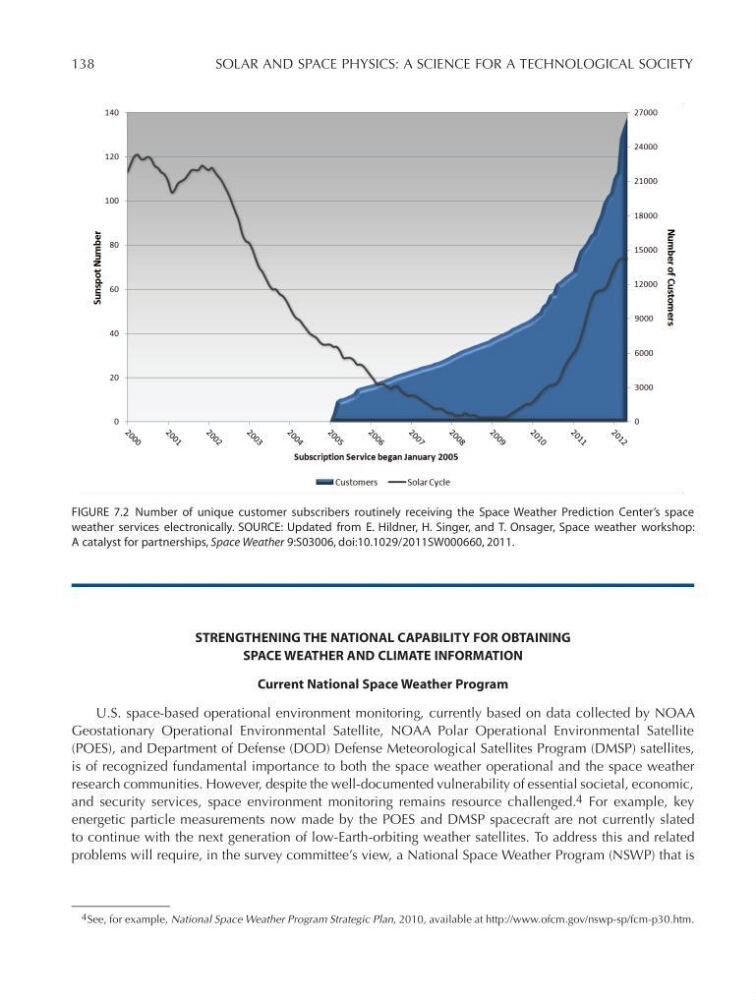
FIGURE 7.2 Number of unique customer subscribers routinely receiving the Space Weather Prediction Center’s space
weather services electronically. SOURCE: Updated from E. Hildner, H. Singer, and T. Onsager, Space weather workshop:
A catalyst for partnerships, Space Weather 9:S03006, doi:10.1029/2011SW000660, 2011.
Figure 7-2
Solar and Space Physics: A Science for a Technological Society
138
SOLAR AND SPACE PHYSICS: A SCIENCE FOR A TECHNOLOGICAL SOCIETY
STRENGTHENING THE NATIONAL CAPABILITY FOR OBTAINING
SPACE WEATHER AND CLIMATE INFORMATION
Current National Space Weather Program
U.S. space-based operational environment monitoring, currently based on data collected by NOAA
Geostationary Operational Environmental Satellite, NOAA Polar Operational Environmental Satellite
(POES), and Department of Defense (DOD) Defense Meteorological Satellites Program (DMSP) satellites,
is of recognized fundamental importance to both the space weather operational and the space weather
research communities. However, despite the well-documented vulnerability of essential societal, economic,
and security services, space environment monitoring remains resource challenged. 4 For example, key
energetic particle measurements now made by the POES and DMSP spacecraft are not currently slated
to continue with the next generation of low-Earth-orbiting weather satellites. To address this and related
problems will require, in the survey committee’s view, a National Space Weather Program (NSWP) that is
4 See, for example, National Space Weather Program Strategic Plan, 2010, available at http://www.ofcm.gov/nswp-sp/fcm-p30.htm.
FIGURE 7.2 Number of unique customer subscribers routinely receiving the Space Weather Prediction Center’s space
weather services electronically. SOURCE: Updated from E. Hildner, H. Singer, and T. Onsager, Space weather workshop:
A catalyst for partnerships, Space Weather 9:S03006, doi:10.1029/2011SW000660, 2011.
Figure 7-2