

Copyright © National Academy of Sciences. All rights reserved.
Solar and Space Physics: A Science for a Technological Society
SPACE WEATHER AND SPACE CLIMATOLOGY: A VISION FOR FUTURE CAPABILITIES
137
climate of the space environment. Growth in the number of space weather customers since the National
Oceanic and Atmospheric Administration (NOAA) initiated a customer subscription service in 2004 (Figure 7.2) is another important indicator of the increasing U.S. need for monitoring and characterization of
space weather. Moreover, the number of customers has been growing rapidly despite the deep and longlasting solar minimum for much of the time period shown.
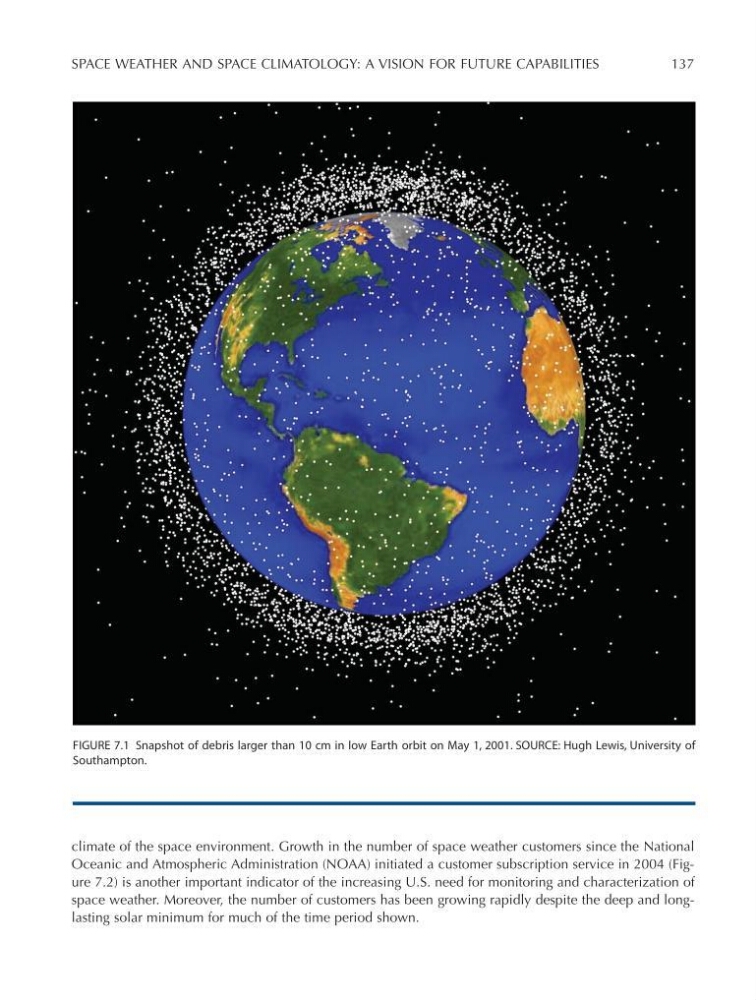
FIGURE 7.1 Snapshot of debris larger than 10 cm in low Earth orbit on May 1, 2001. SOURCE: Hugh Lewis, University of
Southampton.
Figure 7-1
Solar and Space Physics: A Science for a Technological Society
SPACE WEATHER AND SPACE CLIMATOLOGY: A VISION FOR FUTURE CAPABILITIES
137
climate of the space environment. Growth in the number of space weather customers since the National
Oceanic and Atmospheric Administration (NOAA) initiated a customer subscription service in 2004 (Figure 7.2) is another important indicator of the increasing U.S. need for monitoring and characterization of
space weather. Moreover, the number of customers has been growing rapidly despite the deep and longlasting solar minimum for much of the time period shown.
FIGURE 7.1 Snapshot of debris larger than 10 cm in low Earth orbit on May 1, 2001. SOURCE: Hugh Lewis, University of
Southampton.
Figure 7-1