

Copyright © National Academy of Sciences. All rights reserved.
Solar and Space Physics: A Science for a Technological Society
128
SOLAR AND SPACE PHYSICS: A SCIENCE FOR A TECHNOLOGICAL SOCIETY
flexibility in the NASA heliophysics program, the focus is on completing the implementation of existing
missions, as well as on maintaining the baseline level of enabling research programs and Explorers. The first
new recommendations of this survey to be acted on pertain to the DRIVE initiative. Early implementation
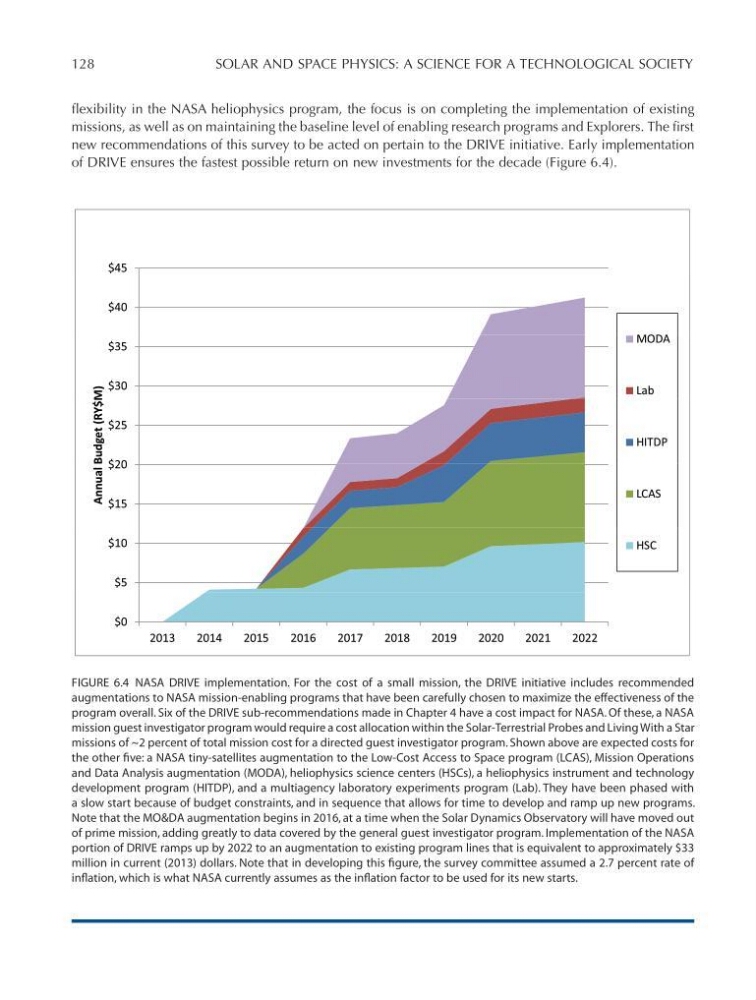
of DRIVE ensures the fastest possible return on new investments for the decade (Figure 6.4).
FIGURE 6.4 NASA DRIVE implementation. For the cost of a small mission, the DRIVE initiative includes recommended
augmentations to NASA mission-enabling programs that have been carefully chosen to maximize the effectiveness of the
program overall. Six of the DRIVE sub-recommendations made in Chapter 4 have a cost impact for NASA. Of these, a NASA
mission guest investigator program would require a cost allocation within the Solar-Terrestrial Probes and Living With a Star
missions of ~2 percent of total mission cost for a directed guest investigator program. Shown above are expected costs for
the other five: a NASA tiny-satellites augmentation to the Low-Cost Access to Space program (LCAS), Mission Operations
and Data Analysis augmentation (MODA), heliophysics science centers (HSCs), a heliophysics instrument and technology
development program (HITDP), and a multiagency laboratory experiments program (Lab). They have been phased with
a slow start because of budget constraints, and in sequence that allows for time to develop and ramp up new programs.
Note that the MO&DA augmentation begins in 2016, at a time when the Solar Dynamics Observatory will have moved out
of prime mission, adding greatly to data covered by the general guest investigator program. Implementation of the NASA
portion of DRIVE ramps up by 2022 to an augmentation to existing program lines that is equivalent to approximately $33
million in current (2013) dollars. Note that in developing this figure, the survey committee assumed a 2.7 percent rate of
inflation, which is what NASA currently assumes as the inflation factor to be used for its new starts.
$45
$40
$45
$30
$35
M)
MODA
Lab
$20
$25
Budget (RY$M
HITDP
$15
$20
Annual B
LCAS
$5
$10
HSC
$0
2013
2014
2015
2016
2017
2018
2019
2020
2021
2022
Figure 6-4
Solar and Space Physics: A Science for a Technological Society
128
SOLAR AND SPACE PHYSICS: A SCIENCE FOR A TECHNOLOGICAL SOCIETY
flexibility in the NASA heliophysics program, the focus is on completing the implementation of existing
missions, as well as on maintaining the baseline level of enabling research programs and Explorers. The first
new recommendations of this survey to be acted on pertain to the DRIVE initiative. Early implementation
of DRIVE ensures the fastest possible return on new investments for the decade (Figure 6.4).
FIGURE 6.4 NASA DRIVE implementation. For the cost of a small mission, the DRIVE initiative includes recommended
augmentations to NASA mission-enabling programs that have been carefully chosen to maximize the effectiveness of the
program overall. Six of the DRIVE sub-recommendations made in Chapter 4 have a cost impact for NASA. Of these, a NASA
mission guest investigator program would require a cost allocation within the Solar-Terrestrial Probes and Living With a Star
missions of ~2 percent of total mission cost for a directed guest investigator program. Shown above are expected costs for
the other five: a NASA tiny-satellites augmentation to the Low-Cost Access to Space program (LCAS), Mission Operations
and Data Analysis augmentation (MODA), heliophysics science centers (HSCs), a heliophysics instrument and technology
development program (HITDP), and a multiagency laboratory experiments program (Lab). They have been phased with
a slow start because of budget constraints, and in sequence that allows for time to develop and ramp up new programs.
Note that the MO&DA augmentation begins in 2016, at a time when the Solar Dynamics Observatory will have moved out
of prime mission, adding greatly to data covered by the general guest investigator program. Implementation of the NASA
portion of DRIVE ramps up by 2022 to an augmentation to existing program lines that is equivalent to approximately $33
million in current (2013) dollars. Note that in developing this figure, the survey committee assumed a 2.7 percent rate of
inflation, which is what NASA currently assumes as the inflation factor to be used for its new starts.
$45
$40
$45
$30
$35
M)
MODA
Lab
$20
$25
Budget (RY$M
HITDP
$15
$20
Annual B
LCAS
$5
$10
HSC
$0
2013
2014
2015
2016
2017
2018
2019
2020
2021
2022
Figure 6-4