

Copyright © National Academy of Sciences. All rights reserved.
Solar and Space Physics: A Science for a Technological Society
RECOMMENDATIONS
109
APPLICATIONS RECOMMENDATIONS: SPACE WEATHER AND SPACE CLIMATOLOGY
Space weather is receiving increased attention as the importance of its effects on society is more
broadly recognized. Previous NRC reports 13 and the National Space Weather Program (NSWP) Strategic
Plan 2010 14 document the nation’s need for increased capability to specify and predict the weather and
climate of the space environment. The past decade has seen the growth of new services and technologies,
including GPS location and timing services, aircraft flights over polar regions, electric power transmission
systems, and a growing space tourism industry, all of which increase the need to consider vulnerabilities
that can result from space weather conditions. Space weather affects our lives directly and indirectly. In
the extreme case of an event of historic proportion, space weather may even lead to catastrophic disruptions of society.
From economic and societal perspectives, reliable knowledge about and forecasting of conditions in
the space environment are important on a range of timescales for multiple applications. Prominent among
them are radio signal utilization (which enables increasingly precise navigation and communication)
and mitigation of the drag on Earth-orbiting objects that alters the location of spacecraft, threatens their
functionality as a result of collisions with debris, and impedes reliable determination of reentry. Energetic
particles can damage assets and humans in space. Currents induced in ground systems can disrupt and
damage power grids and pipelines.
All national space weather forecasting entities (Box 4.8) currently rely on potentially threatened
operational space assets and critical data from limited-term research missions, and they require a bettersupported and cost-effective research-to-operations pathway for models. As such, the future of even the
status quo is threatened—at a time when national space weather requirements are continuously growing.
The U.S. and international space physics communities are poised to make significant advances in space
weather and space climate science. There is already a vibrant, cooperative enterprise of study along with
a strong culture of student development across the three major skill areas: instrument development, data
analysis, and theory and modeling. The future is therefore highly promising. However, the key is long-term
13 See National Research Council, Severe Space Weather: Understanding Societal and Economic Impacts (2009), and National
Research Council, Limiting Future Collision Risk to Spacecraft: NASA’s Meteoroid and Orbital Debris Programs (2011), both published
by the National Academies Press, Washington, D.C.
14 Committee for Space Weather, Office of the Federal Coordinator for Meteorological Services and Supporting Research, “National
Space Weather Program Strategic Plan,” FCM-P30-2010, August 17, 2010, available at http://www.ofcm.gov/nswp-sp/fcm-p30.htm.
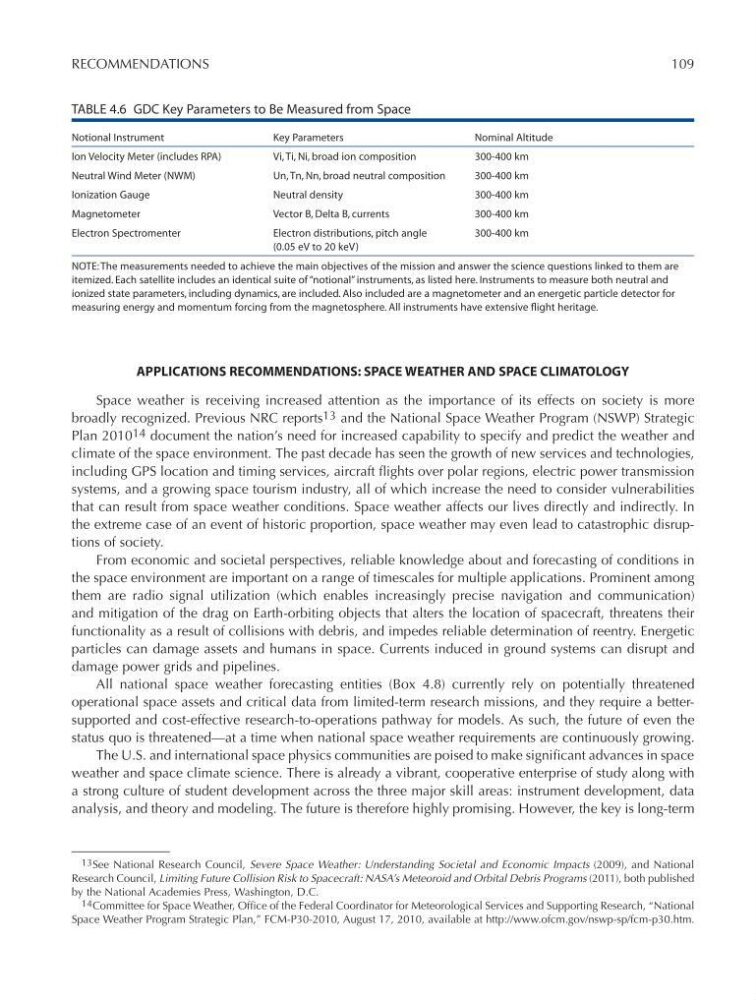
TABLE 4.6 GDC Key Parameters to Be Measured from Space
Notional Instrument
Key Parameters
Nominal Altitude
Ion Velocity Meter (includes RPA)
Vi, Ti, Ni, broad ion composition
300-400 km
Neutral Wind Meter (NWM)
Un, Tn, Nn, broad neutral composition
300-400 km
Ionization Gauge
Neutral density
300-400 km
Magnetometer
Vector B, Delta B, currents
300-400 km
Electron Spectromenter
Electron distributions, pitch angle
(0.05 eV to 20 keV)
300-400 km
NOTE: The measurements needed to achieve the main objectives of the mission and answer the science questions linked to them are
itemized. Each satellite includes an identical suite of “notional” instruments, as listed here. Instruments to measure both neutral and
ionized state parameters, including dynamics, are included. Also included are a magnetometer and an energetic particle detector for
measuring energy and momentum forcing from the magnetosphere. All instruments have extensive flight heritage.
Solar and Space Physics: A Science for a Technological Society
RECOMMENDATIONS
109
APPLICATIONS RECOMMENDATIONS: SPACE WEATHER AND SPACE CLIMATOLOGY
Space weather is receiving increased attention as the importance of its effects on society is more
broadly recognized. Previous NRC reports 13 and the National Space Weather Program (NSWP) Strategic
Plan 2010 14 document the nation’s need for increased capability to specify and predict the weather and
climate of the space environment. The past decade has seen the growth of new services and technologies,
including GPS location and timing services, aircraft flights over polar regions, electric power transmission
systems, and a growing space tourism industry, all of which increase the need to consider vulnerabilities
that can result from space weather conditions. Space weather affects our lives directly and indirectly. In
the extreme case of an event of historic proportion, space weather may even lead to catastrophic disruptions of society.
From economic and societal perspectives, reliable knowledge about and forecasting of conditions in
the space environment are important on a range of timescales for multiple applications. Prominent among
them are radio signal utilization (which enables increasingly precise navigation and communication)
and mitigation of the drag on Earth-orbiting objects that alters the location of spacecraft, threatens their
functionality as a result of collisions with debris, and impedes reliable determination of reentry. Energetic
particles can damage assets and humans in space. Currents induced in ground systems can disrupt and
damage power grids and pipelines.
All national space weather forecasting entities (Box 4.8) currently rely on potentially threatened
operational space assets and critical data from limited-term research missions, and they require a bettersupported and cost-effective research-to-operations pathway for models. As such, the future of even the
status quo is threatened—at a time when national space weather requirements are continuously growing.
The U.S. and international space physics communities are poised to make significant advances in space
weather and space climate science. There is already a vibrant, cooperative enterprise of study along with
a strong culture of student development across the three major skill areas: instrument development, data
analysis, and theory and modeling. The future is therefore highly promising. However, the key is long-term
13 See National Research Council, Severe Space Weather: Understanding Societal and Economic Impacts (2009), and National
Research Council, Limiting Future Collision Risk to Spacecraft: NASA’s Meteoroid and Orbital Debris Programs (2011), both published
by the National Academies Press, Washington, D.C.
14 Committee for Space Weather, Office of the Federal Coordinator for Meteorological Services and Supporting Research, “National
Space Weather Program Strategic Plan,” FCM-P30-2010, August 17, 2010, available at http://www.ofcm.gov/nswp-sp/fcm-p30.htm.
TABLE 4.6 GDC Key Parameters to Be Measured from Space
Notional Instrument
Key Parameters
Nominal Altitude
Ion Velocity Meter (includes RPA)
Vi, Ti, Ni, broad ion composition
300-400 km
Neutral Wind Meter (NWM)
Un, Tn, Nn, broad neutral composition
300-400 km
Ionization Gauge
Neutral density
300-400 km
Magnetometer
Vector B, Delta B, currents
300-400 km
Electron Spectromenter
Electron distributions, pitch angle
(0.05 eV to 20 keV)
300-400 km
NOTE: The measurements needed to achieve the main objectives of the mission and answer the science questions linked to them are
itemized. Each satellite includes an identical suite of “notional” instruments, as listed here. Instruments to measure both neutral and
ionized state parameters, including dynamics, are included. Also included are a magnetometer and an energetic particle detector for
measuring energy and momentum forcing from the magnetosphere. All instruments have extensive flight heritage.