

Copyright © National Academy of Sciences. All rights reserved.
Solar and Space Physics: A Science for a Technological Society
108
SOLAR AND SPACE PHYSICS: A SCIENCE FOR A TECHNOLOGICAL SOCIETY
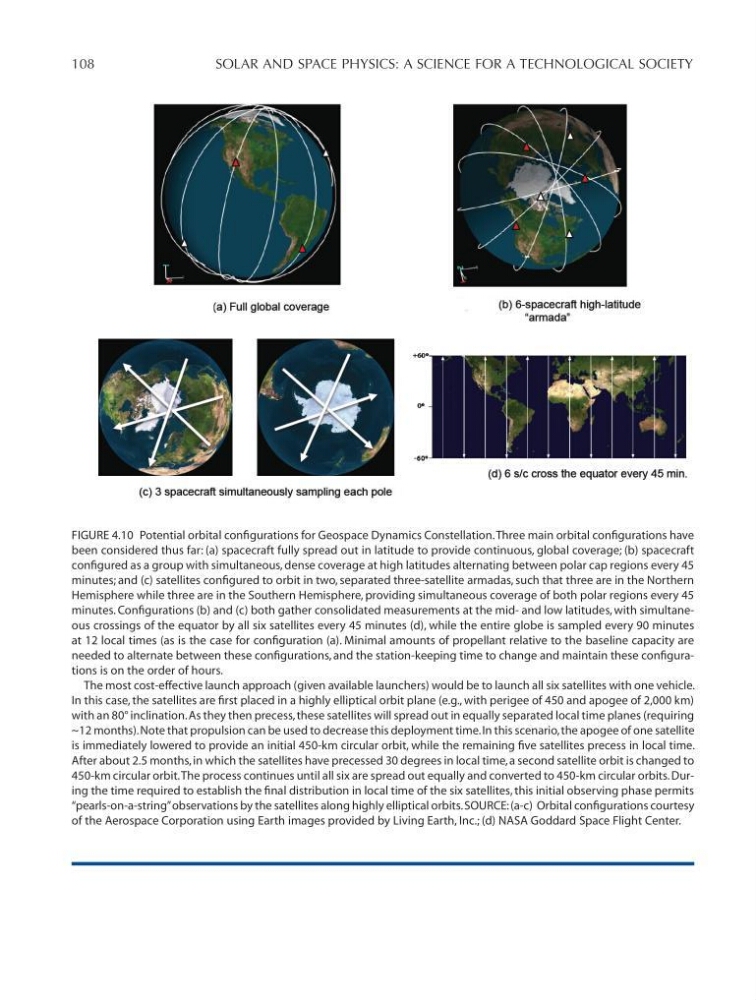
FIGURE 4.10 Potential orbital configurations for Geospace Dynamics Constellation. Three main orbital configurations have
been considered thus far: (a) spacecraft fully spread out in latitude to provide continuous, global coverage; (b) spacecraft
configured as a group with simultaneous, dense coverage at high latitudes alternating between polar cap regions every 45
minutes; and (c) satellites configured to orbit in two, separated three-satellite armadas, such that three are in the Northern
Hemisphere while three are in the Southern Hemisphere, providing simultaneous coverage of both polar regions every 45
minutes. Configurations (b) and (c) both gather consolidated measurements at the mid- and low latitudes, with simultaneous crossings of the equator by all six satellites every 45 minutes (d), while the entire globe is sampled every 90 minutes
at 12 local times (as is the case for configuration (a). Minimal amounts of propellant relative to the baseline capacity are
needed to alternate between these configurations, and the station-keeping time to change and maintain these configurations is on the order of hours.
The most cost-effective launch approach (given available launchers) would be to launch all six satellites with one vehicle.
In this case, the satellites are first placed in a highly elliptical orbit plane (e.g., with perigee of 450 and apogee of 2,000 km)
with an 80° inclination. As they then precess, these satellites will spread out in equally separated local time planes (requiring
~12 months). Note that propulsion can be used to decrease this deployment time. In this scenario, the apogee of one satellite
is immediately lowered to provide an initial 450-km circular orbit, while the remaining five satellites precess in local time.
After about 2.5 months, in which the satellites have precessed 30 degrees in local time, a second satellite orbit is changed to
450-km circular orbit. The process continues until all six are spread out equally and converted to 450-km circular orbits. During the time required to establish the final distribution in local time of the six satellites, this initial observing phase permits
“pearls-on-a-string” observations by the satellites along highly elliptical orbits. SOURCE: (a-c) Orbital configurations courtesy
of the Aerospace Corporation using Earth images provided by Living Earth, Inc.; (d) NASA Goddard Space Flight Center.
Figure 4-10 and 8-20
Solar and Space Physics: A Science for a Technological Society
108
SOLAR AND SPACE PHYSICS: A SCIENCE FOR A TECHNOLOGICAL SOCIETY
FIGURE 4.10 Potential orbital configurations for Geospace Dynamics Constellation. Three main orbital configurations have
been considered thus far: (a) spacecraft fully spread out in latitude to provide continuous, global coverage; (b) spacecraft
configured as a group with simultaneous, dense coverage at high latitudes alternating between polar cap regions every 45
minutes; and (c) satellites configured to orbit in two, separated three-satellite armadas, such that three are in the Northern
Hemisphere while three are in the Southern Hemisphere, providing simultaneous coverage of both polar regions every 45
minutes. Configurations (b) and (c) both gather consolidated measurements at the mid- and low latitudes, with simultaneous crossings of the equator by all six satellites every 45 minutes (d), while the entire globe is sampled every 90 minutes
at 12 local times (as is the case for configuration (a). Minimal amounts of propellant relative to the baseline capacity are
needed to alternate between these configurations, and the station-keeping time to change and maintain these configurations is on the order of hours.
The most cost-effective launch approach (given available launchers) would be to launch all six satellites with one vehicle.
In this case, the satellites are first placed in a highly elliptical orbit plane (e.g., with perigee of 450 and apogee of 2,000 km)
with an 80° inclination. As they then precess, these satellites will spread out in equally separated local time planes (requiring
~12 months). Note that propulsion can be used to decrease this deployment time. In this scenario, the apogee of one satellite
is immediately lowered to provide an initial 450-km circular orbit, while the remaining five satellites precess in local time.
After about 2.5 months, in which the satellites have precessed 30 degrees in local time, a second satellite orbit is changed to
450-km circular orbit. The process continues until all six are spread out equally and converted to 450-km circular orbits. During the time required to establish the final distribution in local time of the six satellites, this initial observing phase permits
“pearls-on-a-string” observations by the satellites along highly elliptical orbits. SOURCE: (a-c) Orbital configurations courtesy
of the Aerospace Corporation using Earth images provided by Living Earth, Inc.; (d) NASA Goddard Space Flight Center.
Figure 4-10 and 8-20