

Copyright © National Academy of Sciences. All rights reserved.
Solar and Space Physics: A Science for a Technological Society
RECOMMENDATIONS
103
DYNAMIC Contribution to the Heliophysics Systems Observatory
By resolving the fundamental question of meteorological influences from below, DYNAMIC will
firmly connect the ionosphere-thermosphere (IT) system to Earth’s lower atmosphere, capturing a critical,
missing component of scientific understanding of geospace and providing a critical new capability to the
HSO at an important boundary in near-Earth space. In establishing the relative importance of thermal
expansion, upwelling, and advection in defining total mass density changes, DYNAMIC will also provide
information fundamental to understanding the global IT response to forcing from above. This investigation
of the contribution of the lower atmosphere to the mean structure and dynamics of the IT system reflects
a scientific appreciation of the importance of these drivers gained since the 2003 solar and space physics
decadal survey.
MEDICI (Magnetosphere Energetics, Dynamics, and Ionospheric Coupling Investigation)
MEDICI Overview
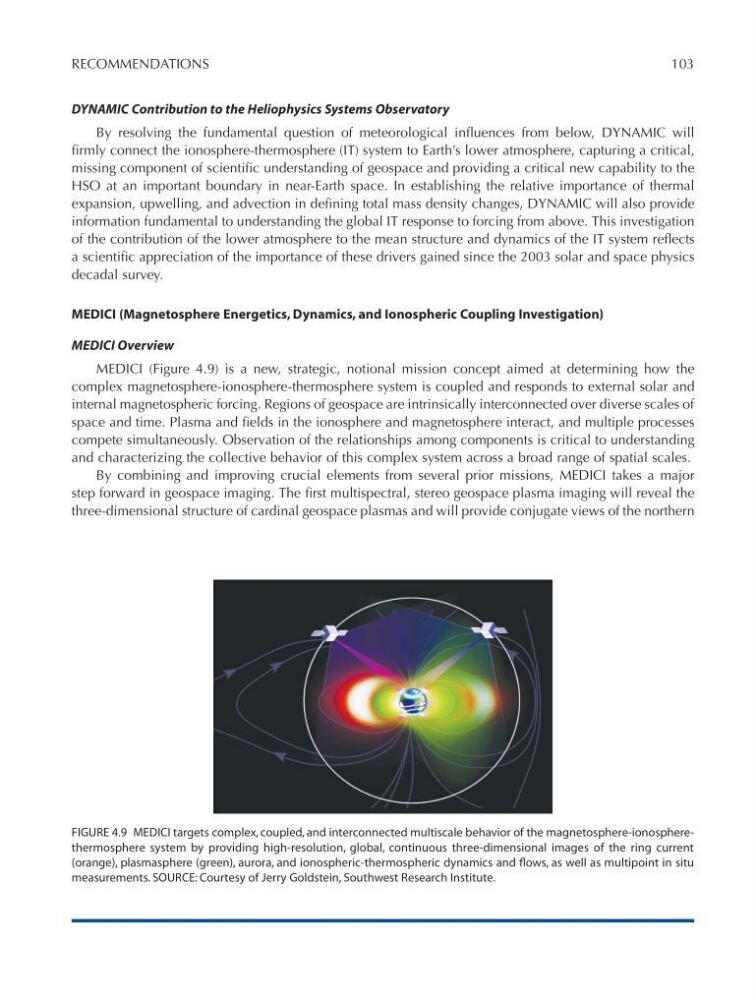
MEDICI (Figure 4.9) is a new, strategic, notional mission concept aimed at determining how the
complex magnetosphere-ionosphere-thermosphere system is coupled and responds to external solar and
internal magnetospheric forcing. Regions of geospace are intrinsically interconnected over diverse scales of
space and time. Plasma and fields in the ionosphere and magnetosphere interact, and multiple processes
compete simultaneously. Observation of the relationships among components is critical to understanding
and characterizing the collective behavior of this complex system across a broad range of spatial scales.
By combining and improving crucial elements from several prior missions, MEDICI takes a major
step forward in geospace imaging. The first multispectral, stereo geospace plasma imaging will reveal the
three-dimensional structure of cardinal geospace plasmas and will provide conjugate views of the northern
FIGURE 4.9 MEDICI targets complex, coupled, and interconnected multiscale behavior of the magnetosphere-ionospherethermosphere system by providing high-resolution, global, continuous three-dimensional images of the ring current
(orange), plasmasphere (green), aurora, and ionospheric-thermospheric dynamics and flows, as well as multipoint in situ
measurements. SOURCE: Courtesy of Jerry Goldstein, Southwest Research Institute.
Solar and Space Physics: A Science for a Technological Society
RECOMMENDATIONS
103
DYNAMIC Contribution to the Heliophysics Systems Observatory
By resolving the fundamental question of meteorological influences from below, DYNAMIC will
firmly connect the ionosphere-thermosphere (IT) system to Earth’s lower atmosphere, capturing a critical,
missing component of scientific understanding of geospace and providing a critical new capability to the
HSO at an important boundary in near-Earth space. In establishing the relative importance of thermal
expansion, upwelling, and advection in defining total mass density changes, DYNAMIC will also provide
information fundamental to understanding the global IT response to forcing from above. This investigation
of the contribution of the lower atmosphere to the mean structure and dynamics of the IT system reflects
a scientific appreciation of the importance of these drivers gained since the 2003 solar and space physics
decadal survey.
MEDICI (Magnetosphere Energetics, Dynamics, and Ionospheric Coupling Investigation)
MEDICI Overview
MEDICI (Figure 4.9) is a new, strategic, notional mission concept aimed at determining how the
complex magnetosphere-ionosphere-thermosphere system is coupled and responds to external solar and
internal magnetospheric forcing. Regions of geospace are intrinsically interconnected over diverse scales of
space and time. Plasma and fields in the ionosphere and magnetosphere interact, and multiple processes
compete simultaneously. Observation of the relationships among components is critical to understanding
and characterizing the collective behavior of this complex system across a broad range of spatial scales.
By combining and improving crucial elements from several prior missions, MEDICI takes a major
step forward in geospace imaging. The first multispectral, stereo geospace plasma imaging will reveal the
three-dimensional structure of cardinal geospace plasmas and will provide conjugate views of the northern
FIGURE 4.9 MEDICI targets complex, coupled, and interconnected multiscale behavior of the magnetosphere-ionospherethermosphere system by providing high-resolution, global, continuous three-dimensional images of the ring current
(orange), plasmasphere (green), aurora, and ionospheric-thermospheric dynamics and flows, as well as multipoint in situ
measurements. SOURCE: Courtesy of Jerry Goldstein, Southwest Research Institute.