

Copyright © National Academy of Sciences. All rights reserved.
Solar and Space Physics: A Science for a Technological Society
102
SOLAR AND SPACE PHYSICS: A SCIENCE FOR A TECHNOLOGICAL SOCIETY
latitudes will lead to estimates of Joule heating, as well as a number of other plasma-neutral interactions at
high and low latitudes. In addition, the simultaneous measurement of lower-altitude thermosphere winds
and plasma drifts at higher altitudes will enable delineation of the disturbance dynamo in addition to the
tidal-driven dynamo.
DYNAMIC Mission Concept
The above science focus translates to a mission involving instruments that remotely sense the lower
and middle thermosphere while also collecting in situ data at higher altitudes. A key mission driver is the
need to address atmospheric thermal tides, which demands measurements over all local times. Because
satellite orbits generally take weeks to months to precess through 24 hours of local time, one must trade
off latitude coverage against local time precession rate, or possibly consider multiple satellites. Since the
research seeks to include important wave sources at high latitudes (e.g., weather systems and stratospheric
warmings) and moreover to distinguish aurorally generated waves from those originating in the lower atmosphere, a high-inclination (75°-90°) orbit is required. However, for these orbital inclinations 24-hour local
time precession occurs over a time period that exceeds that of important variability that has to be captured.
Taking these factors into account, the recommended strategy is to employ two identical satellites in 80°
inclination orbits at 600-km altitude, with their orbital planes spaced about 6 hours apart in local time.
Assuming measurements are made at four local times over all longitudes in 1 day, all zonal (longitudinal)
components of the diurnal (24-hour) tide would be fully characterized once per day, and semidiurnal (12hour) tides as well as the diurnal mean would be acquired about once every 20 days. Gravity waves would
be measured throughout each orbit, and planetary waves would easily be extracted with 1-day resolution.
With the exception of semidiurnal tides, all wave-wave interactions could be explored, and on a 20-day
timescale the interactions between the wave field and the mean state could be explored. In situ plasma and
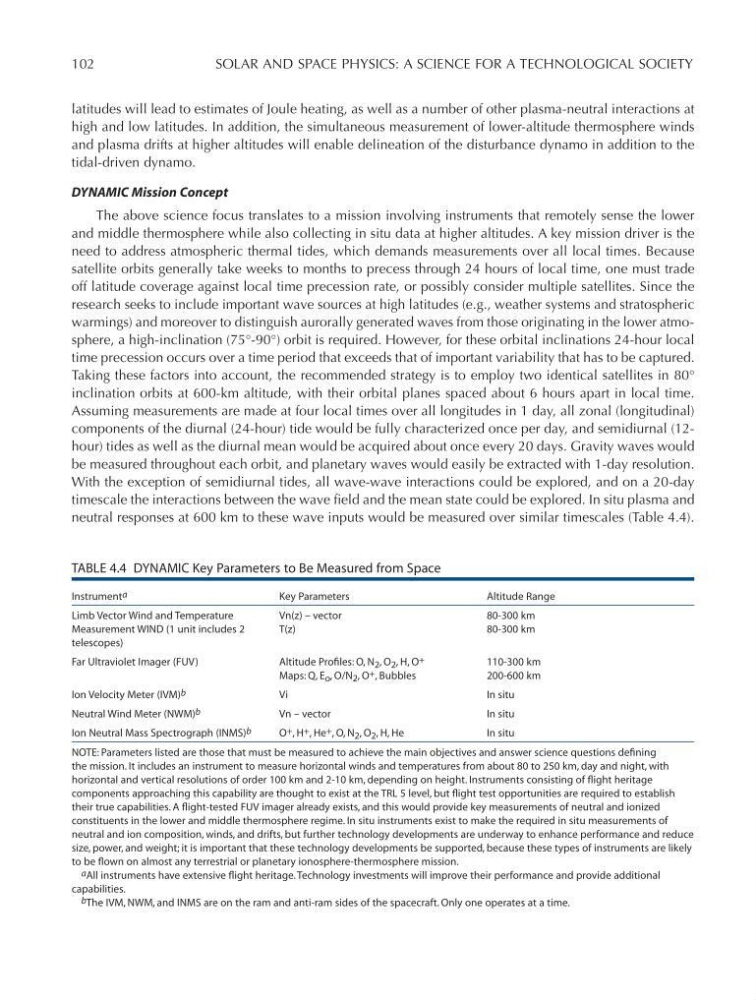
neutral responses at 600 km to these wave inputs would be measured over similar timescales (Table 4.4).
TABLE 4.4 DYNAMIC Key Parameters to Be Measured from Space
Instrument a
Key Parameters
Altitude Range
Limb Vector Wind and Temperature
Measurement WIND (1 unit includes 2
telescopes)
Vn(z) – vector
T(z)
80-300 km
80-300 km
Far Ultraviolet Imager (FUV)
Altitude Profiles: O, N 2 , O 2 , H, O +
Maps: Q, E o , O/N 2 , O + , Bubbles
110-300 km
200-600 km
Ion Velocity Meter (IVM) b
Vi
In situ
Neutral Wind Meter (NWM) b
Vn – vector
In situ
Ion Neutral Mass Spectrograph (INMS) b
O + , H + , He + , O, N 2 , O 2 , H, He
In situ
NOTE: Parameters listed are those that must be measured to achieve the main objectives and answer science questions defining
the mission. It includes an instrument to measure horizontal winds and temperatures from about 80 to 250 km, day and night, with
horizontal and vertical resolutions of order 100 km and 2-10 km, depending on height. Instruments consisting of flight heritage
components approaching this capability are thought to exist at the TRL 5 level, but flight test opportunities are required to establish
their true capabilities. A flight-tested FUV imager already exists, and this would provide key measurements of neutral and ionized
constituents in the lower and middle thermosphere regime. In situ instruments exist to make the required in situ measurements of
neutral and ion composition, winds, and drifts, but further technology developments are underway to enhance performance and reduce
size, power, and weight; it is important that these technology developments be supported, because these types of instruments are likely
to be flown on almost any terrestrial or planetary ionosphere-thermosphere mission.
a All instruments have extensive flight heritage. Technology investments will improve their performance and provide additional
capabilities.
b The IVM, NWM, and INMS are on the ram and anti-ram sides of the spacecraft. Only one operates at a time.
Solar and Space Physics: A Science for a Technological Society
102
SOLAR AND SPACE PHYSICS: A SCIENCE FOR A TECHNOLOGICAL SOCIETY
latitudes will lead to estimates of Joule heating, as well as a number of other plasma-neutral interactions at
high and low latitudes. In addition, the simultaneous measurement of lower-altitude thermosphere winds
and plasma drifts at higher altitudes will enable delineation of the disturbance dynamo in addition to the
tidal-driven dynamo.
DYNAMIC Mission Concept
The above science focus translates to a mission involving instruments that remotely sense the lower
and middle thermosphere while also collecting in situ data at higher altitudes. A key mission driver is the
need to address atmospheric thermal tides, which demands measurements over all local times. Because
satellite orbits generally take weeks to months to precess through 24 hours of local time, one must trade
off latitude coverage against local time precession rate, or possibly consider multiple satellites. Since the
research seeks to include important wave sources at high latitudes (e.g., weather systems and stratospheric
warmings) and moreover to distinguish aurorally generated waves from those originating in the lower atmosphere, a high-inclination (75°-90°) orbit is required. However, for these orbital inclinations 24-hour local
time precession occurs over a time period that exceeds that of important variability that has to be captured.
Taking these factors into account, the recommended strategy is to employ two identical satellites in 80°
inclination orbits at 600-km altitude, with their orbital planes spaced about 6 hours apart in local time.
Assuming measurements are made at four local times over all longitudes in 1 day, all zonal (longitudinal)
components of the diurnal (24-hour) tide would be fully characterized once per day, and semidiurnal (12hour) tides as well as the diurnal mean would be acquired about once every 20 days. Gravity waves would
be measured throughout each orbit, and planetary waves would easily be extracted with 1-day resolution.
With the exception of semidiurnal tides, all wave-wave interactions could be explored, and on a 20-day
timescale the interactions between the wave field and the mean state could be explored. In situ plasma and
neutral responses at 600 km to these wave inputs would be measured over similar timescales (Table 4.4).
TABLE 4.4 DYNAMIC Key Parameters to Be Measured from Space
Instrument a
Key Parameters
Altitude Range
Limb Vector Wind and Temperature
Measurement WIND (1 unit includes 2
telescopes)
Vn(z) – vector
T(z)
80-300 km
80-300 km
Far Ultraviolet Imager (FUV)
Altitude Profiles: O, N 2 , O 2 , H, O +
Maps: Q, E o , O/N 2 , O + , Bubbles
110-300 km
200-600 km
Ion Velocity Meter (IVM) b
Vi
In situ
Neutral Wind Meter (NWM) b
Vn – vector
In situ
Ion Neutral Mass Spectrograph (INMS) b
O + , H + , He + , O, N 2 , O 2 , H, He
In situ
NOTE: Parameters listed are those that must be measured to achieve the main objectives and answer science questions defining
the mission. It includes an instrument to measure horizontal winds and temperatures from about 80 to 250 km, day and night, with
horizontal and vertical resolutions of order 100 km and 2-10 km, depending on height. Instruments consisting of flight heritage
components approaching this capability are thought to exist at the TRL 5 level, but flight test opportunities are required to establish
their true capabilities. A flight-tested FUV imager already exists, and this would provide key measurements of neutral and ionized
constituents in the lower and middle thermosphere regime. In situ instruments exist to make the required in situ measurements of
neutral and ion composition, winds, and drifts, but further technology developments are underway to enhance performance and reduce
size, power, and weight; it is important that these technology developments be supported, because these types of instruments are likely
to be flown on almost any terrestrial or planetary ionosphere-thermosphere mission.
a All instruments have extensive flight heritage. Technology investments will improve their performance and provide additional
capabilities.
b The IVM, NWM, and INMS are on the ram and anti-ram sides of the spacecraft. Only one operates at a time.