

Copyright © National Academy of Sciences. All rights reserved.
Solar and Space Physics: A Science for a Technological Society
76
SOLAR AND SPACE PHYSICS: A SCIENCE FOR A TECHNOLOGICAL SOCIETY
RESEARCH RECOMMENDATIONS
Baseline Priority for NASA and NSF: Complete the Current Program
The survey committee’s recommended program for NSF and NASA assumes continued support in the
near term for the key existing program elements that constitute the Heliophysics Systems Observatory
(HSO) and successful implementation of programs in advanced stages of development.
NASA’s existing heliophysics flight missions and NSF’s ground-based facilities form a network of
observing platforms that operate simultaneously to investigate the solar system. This array can be thought
of as a single observatory—the Heliophysics Systems Observatory (HSO) (see Figure 1.2). The evolving
HSO lies at the heart of the field of solar and space physics and provides a rich source of observations
that can be used to address increasingly interdisciplinary and long-term scientific questions. Missions now
under development will expand the HSO and drive scientific discovery. For NASA, these missions include
the following:
• Radiation Belt Storm Probes (RBSP; Living With a Star (LWS); 2012 launch 1 ) and the related Balloon
Array for RBSP Relativistic Electron Losses (BARREL; first launch 2012). These missions will determine the
mechanisms that control the energy, intensity, spatial distribution, and time variability of the radiation
belts.
• The Interface Region Imaging Spectrograph (IRIS; Explorer program; 2013 launch). IRIS will deliver
pioneering observations of chromospheric dynamics to help reveal their role in the origin of the fluxes of
heat and mass into the corona and wind.
• The Magnetospheric Multiscale Mission (MMS; Solar-Terrestrial Probes (STP) program; 2014 launch).
MMS will address the physics of magnetic reconnection at the previously inaccessible tiny scale where
reconnection is triggered.
Missions that are less fully developed but that are part of the assumed baseline program 2 include:
1 Following its launch on August 30, 2012, RBSP was renamed the Van Allen Probes.
2 In accordance with its charge, the committee did not reprioritize any NASA mission that was in formulation or advanced development. In June 2010, the committee’s charge was modified by NASA to include a request for it to present decision rules to guide
the future development of the SPP mission.
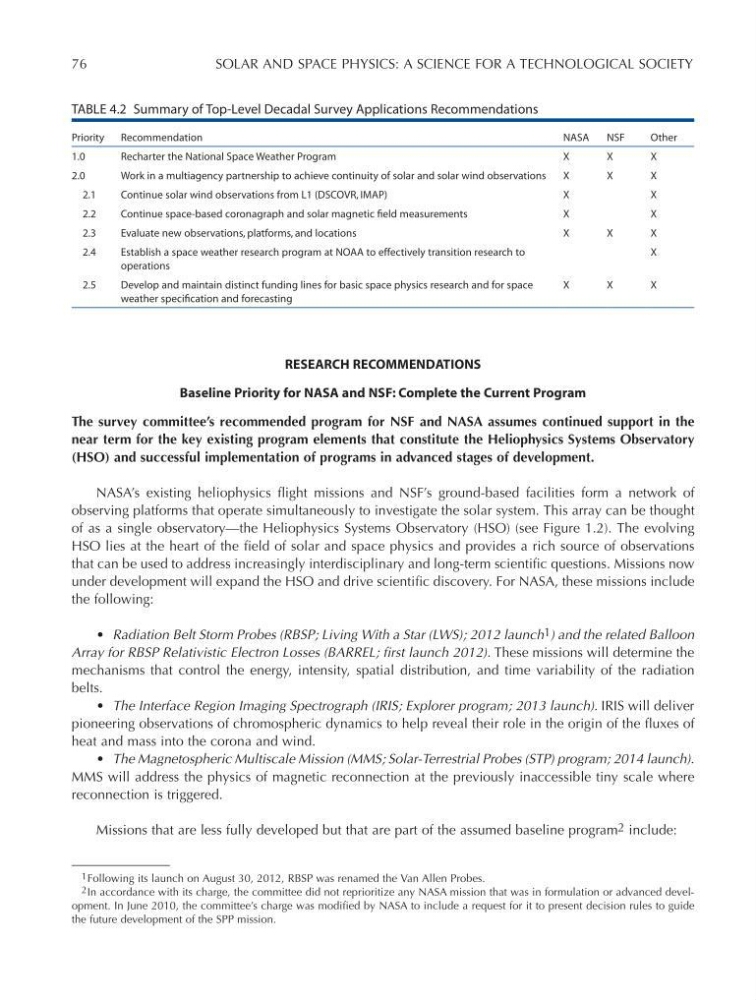
TABLE 4.2 Summary of Top-Level Decadal Survey Applications Recommendations
Priority
Recommendation
NASA
NSF
Other
1.0
Recharter the National Space Weather Program
X
X
X
2.0
Work in a multiagency partnership to achieve continuity of solar and solar wind observations
X
X
X
2.1
Continue solar wind observations from L1 (DSCOVR, IMAP)
X
X
2.2
Continue space-based coronagraph and solar magnetic field measurements
X
X
2.3
Evaluate new observations, platforms, and locations
X
X
X
2.4
Establish a space weather research program at NOAA to effectively transition research to
operations
X
2.5
Develop and maintain distinct funding lines for basic space physics research and for space
weather specification and forecasting
X
X
X
Solar and Space Physics: A Science for a Technological Society
76
SOLAR AND SPACE PHYSICS: A SCIENCE FOR A TECHNOLOGICAL SOCIETY
RESEARCH RECOMMENDATIONS
Baseline Priority for NASA and NSF: Complete the Current Program
The survey committee’s recommended program for NSF and NASA assumes continued support in the
near term for the key existing program elements that constitute the Heliophysics Systems Observatory
(HSO) and successful implementation of programs in advanced stages of development.
NASA’s existing heliophysics flight missions and NSF’s ground-based facilities form a network of
observing platforms that operate simultaneously to investigate the solar system. This array can be thought
of as a single observatory—the Heliophysics Systems Observatory (HSO) (see Figure 1.2). The evolving
HSO lies at the heart of the field of solar and space physics and provides a rich source of observations
that can be used to address increasingly interdisciplinary and long-term scientific questions. Missions now
under development will expand the HSO and drive scientific discovery. For NASA, these missions include
the following:
• Radiation Belt Storm Probes (RBSP; Living With a Star (LWS); 2012 launch 1 ) and the related Balloon
Array for RBSP Relativistic Electron Losses (BARREL; first launch 2012). These missions will determine the
mechanisms that control the energy, intensity, spatial distribution, and time variability of the radiation
belts.
• The Interface Region Imaging Spectrograph (IRIS; Explorer program; 2013 launch). IRIS will deliver
pioneering observations of chromospheric dynamics to help reveal their role in the origin of the fluxes of
heat and mass into the corona and wind.
• The Magnetospheric Multiscale Mission (MMS; Solar-Terrestrial Probes (STP) program; 2014 launch).
MMS will address the physics of magnetic reconnection at the previously inaccessible tiny scale where
reconnection is triggered.
Missions that are less fully developed but that are part of the assumed baseline program 2 include:
1 Following its launch on August 30, 2012, RBSP was renamed the Van Allen Probes.
2 In accordance with its charge, the committee did not reprioritize any NASA mission that was in formulation or advanced development. In June 2010, the committee’s charge was modified by NASA to include a request for it to present decision rules to guide
the future development of the SPP mission.
TABLE 4.2 Summary of Top-Level Decadal Survey Applications Recommendations
Priority
Recommendation
NASA
NSF
Other
1.0
Recharter the National Space Weather Program
X
X
X
2.0
Work in a multiagency partnership to achieve continuity of solar and solar wind observations
X
X
X
2.1
Continue solar wind observations from L1 (DSCOVR, IMAP)
X
X
2.2
Continue space-based coronagraph and solar magnetic field measurements
X
X
2.3
Evaluate new observations, platforms, and locations
X
X
X
2.4
Establish a space weather research program at NOAA to effectively transition research to
operations
X
2.5
Develop and maintain distinct funding lines for basic space physics research and for space
weather specification and forecasting
X
X
X